GT New Horizons · Zero Point Module (ZPM)
Zero Point Module (ZPM)
Zero Point Voltage (ZPM) is the seventh electric tier in GregTech: New Horizons. This tier is largely centered around building the infrastructure necessary to construct the next tier of Fusion Reactor, which is necessary for progression into UV. In addition, this tier introduces TecTech, the source of many late game multi-blocks. It also sees additional power generation with the availability of the Large Naquadah Reactor and MK2 Fusion Controller, and a new source of resources in the Void Miner. However, similar to LuV, material costs and processing requirements continue to rise and so infrastructure such as a Mega Electric Blast Furnace, Mega Vacuum Freezer, and Mega Chemical Reactor may be necessary. Circuits get a major improvement with the addition of Europium-doped wafers. The PCB Factory is also build-able at this stage, though its quest is UV. ZPM is generally considered to mark the transition from midgame to lategame.
Progression
Waterline
New water grades for the Waterline are now mandatory to cut and use Europium doped wafers. These wafers can be used to improve circuit production, but their main use is for ZPM Energy Hatches and Dynamo Hatches, which require NPIC wafers that can only be made from Europium or better wafers. Grade 3 water is the minimum needed, though grade 4 provides a speed boost, and will be required in UV as an ingredient in grade 5.
Naquadah Line
Although the Naquadah portion of the Naqline was already required in LuV, the portions for Enriched Naquadah and Naquadria become required in ZPM. Both are significantly shorter than the Naquadah portion; combined, they have roughly the same number of steps as Naquadah does. The full Naqline is required to progress further into ZPM, as both Enriched Naquadah and Naquadria are used to make the HIP Unit. These portions also have useful byproducts: Enriched Naquadah yields Trinium, and Naquadria produces Indium.
Hot Isostatic Pressurization Unit
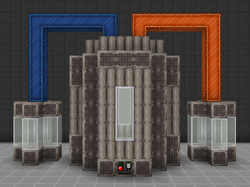
The Hot Isostatic Pressurization Unit (HIP Unit) is an upgraded version of the Large Electric Compressor that is both unlocked and required in ZPM. It can run regular Compressor recipes quicker and more efficiently, and it has the ability to make Superdense Plates from most materials, which are required in many recipes in ZPM and onwards, such as the Fusion Reactor Mk2. However, it is more challenging to automate, as it heats up while running, and if it overheats it becomes far slower and will void recipes that require the HIP Unit.
Fusion Reactor Mk2
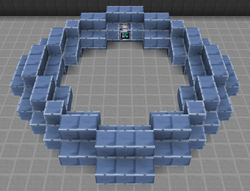
The Fusion Reactor Mk2 becomes available when the player is able to make Superdense Plates and ZPM Energy Hatches. It is also the final goal of ZPM, as it is required to make Americium, which is needed in large quantities for UV components. In addition to the new recipes they have available, Mk2 fusion reactors can also run Mk1 recipes, which will result in a "fusion overclock", which uses twice the EU/t and works twice as fast.
Americium
Americium is incredibly slow in the Mk2 Fusion Reactor, taking 43.2 seconds per ingot and 34 minutes for enough ingots for a single UV Electric Motor. It is much slower than Europium: it takes three times as long to produce, and twice as much is used in each motor. Methods for dealing with this include making it passively, either in multiple reactors or over many days on a server, or even making a Compact Fusion Reactor for players whose infrastructure, resources, and power can support it. In UV, many better methods of making Americium will become available, including the Americium Bee in a Mega Apiary, a Meteor containing thousands of Americium Dust worth of ore, and a much faster recipe in the Mk3 Fusion Reactor; however, all of them require large amounts of Americium to reach.
Lutetium
Americium also requires Lutetium, a metal which cannot be found as an ore naturally. Methods for obtaining Lutetium at this point include:
- Processing Monazite Ore through the Milling Line
- Cracking and distilling Heavy Naquadah Fuel, which is part of the Naquadah Fuel production line
- Processing Thorium in the High Temperature Gas-Cooled Reactor
- Using the meteor summoned by the ZPM Circuit Assembler
- Using the Lutetium Bee
- Processing Depleted Thorium Fuel Rods from a Nuclear Reactor
- Replicating it from UU-Matter
Other Fusion Recipes
Other notable recipes unlocked by the Mk2 Fusion Reactor are:
- Tritanium is produced from Duranium and Titanium. In ZPM its main use is as a gate for Void Miners and the Tier 6 Rocket, but in UV and UHV it begins to see many more uses for circuits, superconductors, Energy Hatches, and more.
- Naquadah Based Liquid Fuel MkI is the first step in the Naquadah Fuels, which can be burned for immense amounts of power in a Large Naquadah Reactor.
- Tin Plasma is a step up from Helium Plasma in conventional plasma power generation, and Zinc Plasma, Niobium Plasma, Krypton Plasma, Astral Titanium Plasma, and Runite Plasma are new steps in the "plasma chain" of advanced plasma fuels.
- Nitrogen Plasma is used in the Beam Line and the Plasma Arc Furnace.
- Zinc Plasma, Oxygen Plasma, and Titanium Plasma have some uses in UV or UHV, but none are relevant enough to make them worth producing in ZPM.
- Tungsten, Iridium, Naquadah, and Uranium 238 can all be produced via fusion, although none of these recipes are generally useful due to how slow they are in comparison to conventional methods.
- Excited Uranium and Plutonium liquid fuels can be made with fusion, but the Neutron Activator recipe is much faster and cheaper and should always be used instead.
Tier 6 Rocket
The Tier 6 Rocket can be crafted once a Mk2 Fusion Reactor has been used to produce Tritanium, which is needed for the Tier 6 Heavy Duty Plate. There are two planets available, Proteus and Triton, both moons of Neptune. They contain a few new ores, most notably Neutronium, Black Plutonium, Plutonium 241, Uranium 235, Niobium, and Yttrium, which can be harvested either with conventional Ore Drilling Plants or with Void Miners. Deuterium and Ethylene are available as underground fluids from a Fluid Drilling Rig. The Tier 6 Rocket also unlocks the ability to make Planetary Gas Siphons above Neptune for Tritium, Helium-3, Ammonia, and Xenon.
Infrastructure Improvements
Power Generation
In ZPM, most existing power generation methods from earlier tiers, such as Nitrobenzene, Rocket Fuel, and Nuclear Reactors, remain viable, but start to fall off due to increasing power demands and a lack of upgrades. One notable upgrade is Huge Turbines for all gas, steam, or plasma-based power, which are unlocked with Americium.
Plasma, on the other hand, is still viable and will continue to be viable for many more tiers. In addition to the aforementioned Huge Turbines, plasma benefits from better fuels in the form of Tin Plasma or Runite Plasma (although the latter requires a UV Alloy Blast Smelter), better production rates using the Mk2 Fusion Reactor, and the XL Plasma Turbine and XL Supercritical Steam Turbine to greatly improve power throughput.
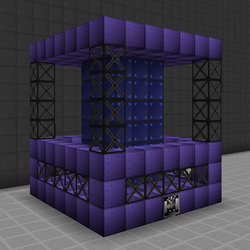
ZPM also unlocks one of the strongest power generation methods in the mid and late game: Naquadah Fuel, often abbreviated to Naqfuel. Power is produced by inputting Naqfuel into a Large Naquadah Reactor (LNR), alongside Liquid Air, a coolant (Gelid Cryotheum), and an excited liquid (Molten Atomic Separation Catalyst), all of which will need to be produced in large quantities by players seeking to use the fuel for power. Two tiers of Naqfuel are available in ZPM: tier 1 requires the Mk2 Fusion Reactor, while tier 2 is produced by combining tier 1 fuel with a couple other ingredients in an overclocked Mega Chemical Reactor. Each LNR can generate up to 42.9M EU/t with Naqfuel 1, and up to 101.2M EU/t with Naqfuel 2.
Lasers
Lasers are a new way to distribute power that are much better than cables on throughput, flexibility, and expandability, at the cost of being more expensive to make. Lasers are started by Laser Source Hatches on multiblocks that accept them (including the Lapotronic Supercapacitor and most advanced generators), moved by Laser Vacuum Pipes, and received by Laser Target Hatches. Most multiblocks do not accept laser power directly, so Active Transformers (ATs) are required in order to transform it into conventional power closer to where machines are located; ATs are also the only way to split, merge, or bend lasers in ZPM. UV unlocks the Laser Vacuum Mirror, which can bend lasers without needing an AT, but not split or merge them. A laser-based power grid is not necessary in ZPM, but will be required by UHV to feasibly transport the immense amount of power used in later tiers.
Data Bank and Assembly Lines
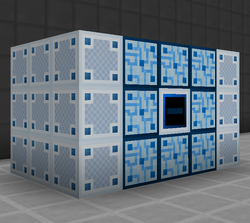
The Data Bank is a TecTech multiblock that can be used to store large quantities of Data Sticks for the Assembly Line, as well as to spread the same Data Sticks between many different Assembly Lines. The latter capability can be used to relatively easily add new Assembly Lines or Advanced Assembly Lines to speed up slower recipes that are needed in large quantities, such as LuV and ZPM components like motors and pumps.
Void Miners
Void Miners (VMs) are a new way to collect ore that become available once a Mk2 Fusion Reactor is used to produce Tritanium. They resemble Ore Drilling Plants, but unlike those they do not actually take ore from the world: instead, they generate infinite amounts of ore based on the dimension they are built in, making them extremely useful as a passive source of most resources in the game. Players unlocking VMs should be cautious that they will produce far more ore than anything before them, so a robust ore processing system is necessary to avoid being overwhelmed by unprocessed ore; even Meteors will not strain an ore processing system as much as VMs do, since VMs produce ore constantly.
Toxic Everglades
The Toxic Everglades can be visited by making a portal out of Containment Frames and lighting it with an Alkalus Disk, which requires a ZPM Alloy Blast Smelter to make. On versions prior to 2.9 the dimension has a unique method of ore generation that was different from vanilla and GT. This makes regular prospecting and mining less predictable, although the Electric Prospector's Scanner is capable of highlighting veins as they appear. Notably, the Toxic Everglades features a large amount of GT++ ores, many of which produce rare earths as well as on-tier materials such as Europium when processed. By placing a Void Miner, all of these rare materials can be harvested easily.
Neutronium
Neutronium is a new material that is needed in very large quantities in UV and UHV for components and other machines, and it is extremely slow to smelt, taking over two minutes at UV even with the best possible noble gas, and closer to three or four with worse ones. Because of how slow it is and how much it is used, most players passive it, setting up either a Mega Electric Blast Furnace (MEBF) or a large Volcanus array dedicated to passively smelting Neutronium Ingots. The MEBF can be scaled more easily and is much simpler to set up, but due to the high voltage and heat requirements for the Neutronium recipe and the 120% speed bonus of the Volcanus, the latter is more efficient. It is also possible to smelt Neutronium entirely on demand, but doing so requires extremely robust smelting and freezing capacity, or it will be a massive bottleneck.
Noble Gases
Both smelting (including Neutronium smelting) and Void Miners can be vastly improved by using a high-tier noble gas. Oganesson is not practically obtainable in ZPM, but the next steps down, Xenon and Krypton, are. There are two methods of obtaining these gases: their respective bees or the Planetary Gas Siphon (PGS). The PGS is best used for Xenon, which requires a Tier 6 Rocket; each PGS can collect 350 L/s of Xenon when fed with 2A of ZPM. Bees are much more efficient on power, but the Xenon Bee cannot be used yet because it requires the Mega Apiary, meaning Krypton is the best noble gas available from bees in ZPM.
UU-Matter
UU-Matter begins to see significant use in UV as a crafting component, particularly for circuits, in addition to its existing use in replicating elements. Because of this fact and how slow UU-Matter is to make, it's recommended to set up a singleblock Mass Fabricator to produce UU-Matter passively in order to prepare for UV, although it is also possible to make the Matter Fabrication CPU in ZPM by overclocking some machines and obtaining a Quantum Anomaly.
Sidequests
Wetware Circuits
Wetwares are the next circuit line after Crystal Circuits, spanning from LuV to UHV. The first three of them can be made in ZPM, but the fourth requires UV in order to make the Research Station for the Assembly Line Data Stick; this is the start of a pattern that will continue until the endgame of only being able to make circuits one tier up, rather than two as has been the case since HV. It is possible to replace Crystals with Wetwares for LuV to UV, but this is not recommended, as Wetwares are much slower and much more expensive than their same-tier Crystal counterparts.
Other Multiblocks
- PCB Factory: The PCB Factory is a multiblock that can produce circuit boards much cheaper than the Large Chemical Reactor; it is especially useful for the expensive Wetware boards. However, it is unable to run any overclocks or parallels at all until UHV, or UV with meteors, which makes it impractically slow to use in ZPM, although Wetwares are expensive enough to potentially justify it.
- Large Scale Auto-Assembler v1.01: This multiblock, also known as the LSAA, as a multiblock assembler. While it has many fewer parallels than the Precise Auto-Assembler, it can be tier skipped with additional energy. So the LSAA should be built prior to entering UV to act as a faster UV assembler before obtaining a UV energy hatch. A similar case happens in UHV, where a UHV assembler is needed before the energy hatch can be obtained, so the LSAA will also be useful.
- Energy Infuser: The Energy Infuser is a TecTech multiblock that can be used to charge electric GregTech items extremely quickly, as well as repair most items using UU-Matter.
Beam Line
The Beam Line is an optional line that can be used instead of the Hyper-Intensity Laser Engraver to engrave wafers for circuits. It is significantly cheaper on resources and can be scaled much more easily, but is very expensive initially and much more complex to get working.
Zero Point Module Quests
There is an optional quest line in ZPM to obtain a filled Zero Point Module item, which is a ZPM battery that can produce one amp of ZPM for 8.8 days of real-life time. In order to reach it, the player needs to complete four hidden quests. Each quest will be revealed when the player holds at least one of its required item, and consumes some amount of that item to complete. The required items for the hidden quests are:
- 1 Singularity (from AE2)
- 4 Shard of Creation
- 8 Life Shard and 8 Soul Shard
- 32 Unknown Crystal Shard
The quest line also requires a few foods from Pam's HarvestCraft, and a few cheap GT items.