GT New Horizons · High Voltage (HV)
Distillation Tower
The Distillation Tower (DT) is an HV tier multiblock for distilling fluids into ALL of its constituent fractions simultaneously. The structure is built as a series of layers with the input on bottom and each layer above that dedicated to a unique output. The order of the outputs follows the NEI preview of the recipe and the number of outputs determines the minimum height of the structure. The DT is a direct upgrade from the singleblock distillery because it produces all fractions at the exact same ratio as distilling each one individually which effectively increases the yield, speed, and energy efficiency of recipes. The DT significantly boosts oil and benzene processing so it is highly recommended to build as soon as possible. The DT is superseded by the Dangote Distillus in IV, or the Mega Distillation Tower.
Construction
The DT consists of a single type of casing and has no tiered components. The height ranges from 3-12 layers depending on the number of outputs. The bottom layer is only for the controller, the input bus/hatch, and the output bus. The remaining layers must have only ONE output hatch for each of the different output fluids. For example, distilling raw oil yields four different fluids which means the structure must be at least 5 layers tall with an output hatch on layers 2-5. Multi-amp and laser energy hatches are not supported, but there can be multiple regular energy hatches for overclocking. Use the Multiblock Structure Hologram Projector to visualize/build the structure with subchannel "height" to specify the total height of the structure.
Structure
- Controller: Front bottom center
- 16-79 Clean Stainless Steel Machine Casing
- 1+ Energy Hatch: Any casing
- 1 Maintenance Hatch: Any casing
- 0+ Input Bus: Any bottom casing
- 1+ Input Hatch: Any bottom casing
- 0+ Output Bus: Any bottom casing
- 2-11 Output Hatch: One per layer, except the bottom layer
- Mandatory Air: Interior of the structure
Wallsharing
DTs may wallshare each of their sides to save on casings and buses/hatches. That includes the many output hatches and maintenance hatch. No recipe uses more than 1A of power so it is also possible to share one energy hatch between two machines.
Extended Cost Breakdown
Assuming that rods and pipes are made in an extruder and the structure is built with the minimum number of buses/hatches, a DT requires stainless steel ingots to build. Subtract 29 from the total if the controller block has already been crafted. The minimum size (h=3) requires 173 ingots and the largest size (h=12) requires 677 ingots, as seen in the following table.
| Height | Output Hatches | Casings | Stainless Steel |
| 3 | 2 | 16 | 173 |
| 4 | 3 | 23 | 229 |
| 5 | 4 | 30 | 285 |
| 6 | 5 | 37 | 341 |
| 7 | 6 | 44 | 397 |
| 8 | 7 | 51 | 453 |
| 9 | 8 | 58 | 509 |
| 10 | 9 | 65 | 565 |
| 11 | 10 | 72 | 621 |
| 12 | 11 | 79 | 677 |
Usage
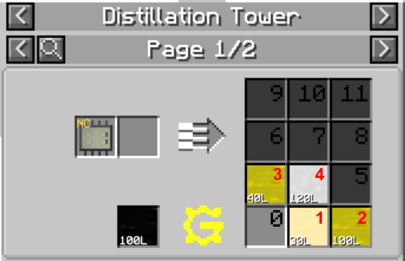
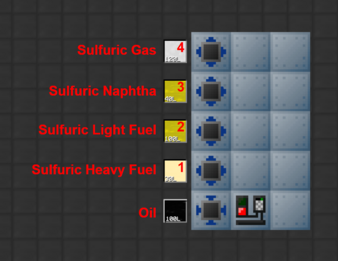
The DT distills fluids into all of its constituent fractions simultaneously, as opposed to one at a time with a singleblock distillery. Each fraction is outputted at a different layer of the structure based on the NEI preview of the recipe. The order is left-to-right and bottom-to-top as seen in the following images. For example, the order of outputs when distilling oil is sulfuric heavy fuel, sulfuric light fuel, sulfuric naphtha, and sulfuric gas. Those correspond to layers 2-5 on the structure since the bottom layer is for the input.
 |
 |
If the DT is too short to accommodate all the potential outputs OR one of the output hatches is full, it displays the error message "not enough output space" in the GUI of the controller. It is highly recommended to place a super tank in front of each output hatch to create a large buffer for each fluid, then enable void overflow on any that are less desirable to keep the DT running until the more desirable fluids are backed up.
If using ME output hatches instead of regular output hatches, right-click them with wirecutters to allow ME channels to connect to any side. This saves from having to run a cable up the entire side of the machine for recipes with 8 or less outputs.
Trivia
- It is technically possible to have multiple output hatches on each layer, but not for all of them because that would not meet the required minimum number of casings for the DT.