GT New Horizons · Low Voltage (LV)
Low Voltage (LV)
Low Voltage (LV) is the first electric tier in GregTech: New Horizons. With access to electricity comes new hazards and mechanics, but also far more variety of specialized machines that can process materials into new parts with greater efficiency.
Goals
Some of the primary milestones for this tier are as follows:
- Batch craft Electronic Circuits
- LV components - Motor, Piston, Pump, Robot Arm, Sensor, Emitter
- LV Machines - Bending Machine (priority), Wiremill (priority), Lathe, Assembler, Electrolyzer, Chemical Reactor, Fluid Extractor, etc.
- Acquire Lithium and Lead for Batteries
- Pump Oil for Polyethylene and Light Fuel
- Upgrade Power Generation
- Build Good Circuits
- Locate Mica (or make the more expensive Alumino Silicate Wool)
- Construct an Electric Blast Furnace & maintenance tools to get Aluminum
Optional Side Quests:
- Increase Hearts by eating a variety of foods
- Plan for a larger base to accommodate MV machines / multiblocks
- Make multiple Backpacks (Forestry/ModdedNetwork)
- Hang Glider, Piston Boots, Healing Axe (if not already acquired)
- Visit the Twilight Forest
- More storage with drawer/barrel upgrades, Diamond Chests
- Sound Mufflers, Chandeliers
- Tool & Armor Upgrades
- Item Dislocator (or another Magnet)
EU (Energy Units) Mechanics
GregTech energy consists of Voltage and Amperage. A Low Voltage (LV) GT generator will output 32 volts (32V) in 1 amperage (1A/1 amp). Four generators on the same cable will output 32 volts in 4 amps combined. 32 volts in 4 amps is not the same thing as MV (Medium Voltage - 128 volts per amp). This can be compared to four cables containing 32 volts each, or one 4x Cable. The x rating of a cable (x1, x2, x4, etc.) denotes its maximum amperage. The general rule of thumb is your cables should have an equal Amp capacity to the number of generators/batteries attached. Battery Buffers output 1A per battery, while virtually every generator puts out 1A. Having a cable with enough Amperage capacity for all of them at once prevents fires and explosions.
For more advanced and complete information, see Electricity.
Energy Loss
The tooltip for GT cables show their max voltage, max Amperage and Loss per Meter/Ampere. A cable or wire will catch fire if it receives more than its max voltage or max amperage. A normal 1x Tin Cable will lose 1 volt for each block (meter) length of the cable. Uncoated wires lose even more per block and present a shock hazard, so never use bare wire to connect machines. If the distance between the power input and machine is 10 blocks long, and the generator is generating 32 volts in 1 amp, then there will only be 22 volts in 1 amp remaining on the other end of the cable. With a LV battery buffer with 4 LV batteries inside, it would send 32 volts in up to 4 amps, but after 10 blocks there will only be 22 volts each amp remaining. Lossless cables are gated behind Redstone Alloy and the Electric Blast Furnace, so until available players are well advised to keep cables as short as possible.
Battery Buffers
Battery Buffers are used to store EU Energy, at a 5% loss cost. Battery Buffers can be made in variable capacities between 1x and 16x internal slots. The Buffer itself does not store power; batteries matching the tier have to be inserted into the Battery Buffer to make it function. Each battery added will increase the buffer's capacity by +2 amps input and +1 amp output. Since buffers can have a variable amperage output based on the number of inserted batteries, care must be taken to ensure the cable has sufficient capacity to handle the buffer's maximum output. This becomes more relevant when multiple machines are all requesting amps at the same time over a longer cable.
GT Electric Machines
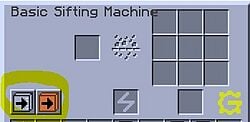
LV Electric machines have some new features that were not available with Steam-age machinery. For example, the steam exhaust is replaced with an automatic output. This output's facing can be changed with a wrench similar to how the exhaust was configured on Steam machines. Just like their Steam counterparts, all electric GT machines cannot be input or output from their front face. To enable automatic output, open the GUI of the machine and click on the button at the lower left corner. There are two automatic output toggle buttons; the left one is for liquid and the right one is for items.
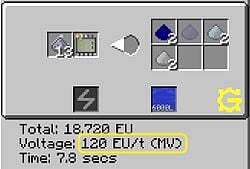
GregTech machinery is divided by tier, which corresponds to a specific voltage - LV (32 V), MV (128 V), HV (512 V) etc. Most recipes are gated to a specific voltage/tier or higher, which is shown with the recipe in NEI (Not Enough Items). If the recipe requires more than one amp it will also be listed here. Pay careful attention to what tier a recipe requires - with LV machinery, MV and higher recipes are inaccessible.
For example, putting Clay Dust through the Electrolyzer to get Aluminium dust requires 120 EU/t (MV). Since the Basic Electrolyzer is only able to do 32EU/t, this recipe is unavailable until the Advanced Electrolyzer (MV).
Recipes close to the voltage limit for LV (32 EU/t) may cause the machine to request multiple amps, especially if there is any cable loss. A single LV generator will often not be capable of supplying enough power if the machine is placed too far away. Most GT machines will accept up to 2 amps. A second generator or Battery Buffer may be needed to keep a a high cost recipe running. If a machine runs out of power, it will stall resetting any progress but not losing the materials. A soft mallet can be used to temporarily disable a machine to give a buffer time to recharge or wait until more power generation is available.
Some machines require multiple amps to run at all, such as the Arc Furnace and Electric Blast Furnace. The Arc Furnace requires 3 amps to function and can accept up to 7 amps. Checking any recipe for the Arc Furnace will show Usage XX/t, voltage 32 EU/t and amperage X. The Electric Blast Furnace is even more demanding, taking four amps of LV minimum for its most basic recipes.
Explosions
Machines, wires and cables can overload, resulting in fires and explosions.
Rain will make your electric machines explode if the rain is on any adjacent blocks to the machine, so put your machinery under a proper roof. Uninsulated wires will also catch on fire from rain. Fire adjacent to machines will cause them to explode, potentially taking out more machines and causing significant Pollution. Water does not cause fires/explosions; it's perfectly safe to have water blocks adjacent to machines.
Giving machines a higher voltage than they are rated for will make them explode. This won't become an issue before unlocking MV, but it's important enough to mention early and often. Excess Amperage on a cable is not an issue, as long as it doesn't exceed the cable's rating. Machines will only accept as many Amps as they need.
Energy Conversion
IC2 EU
To transform IC2 energy into GT energy you simply need to place a GT transformer or power storage next to the IC2 power source. Keep in mind that IC2 generation is typically only 1 amp, therefore the Transformer should be in Step-Down mode. GT cables/wires can be used to connect IC2 machines, but pay attention to the EU output. Some devices such as the Stirling Generator output more than 32EU, and thus require at least x2 cable.
GT EU to Others
GT Cables can be attached to almost any machine that requires some kind of energy, allowing a single power network to run machines from most mods in the pack including IC2, EnderIO, Forestry, Railcraft, Galacticraft and more. Due to the idiosyncrasies of ENet, at least one GT machine (a machine hull will do the job nicely) has to be present for power to transfer on GT cables/wires. Placing the cable last sometimes also helps the setup register as valid.
Revisiting Steam
The LV Age opens up full automation for Steam and new machines like the Assembler and Bender provide substantial discounts to crafting costs, especially for the Multiblocks.
Steam Power Upgrades
Up until LV your most automated options for generating Steam involved either regularly resetting Solar Boilers or collecting wood manually to feed Coke Ovens, the LV Crop Manager and tree bonsais allow for easy and cheap automation of Wood, enabling fully automatic power. Look into powering it with a semifluid generator directly with creosote, its a bit more power efficient and saves on pipe distance in most builds. You can try and breed the bonsais for max stats but that won't be necessary, even one 11x11 layer of 1/1/1 bonsais will provide more than enough wood for a max size RC Boiler. Speaking of RC boilers, the tank recipe gets substantially cheaper in LV, with the screw requirement being dropped with the assembler; the casing required for the tanks can also be made cheaper by utilising the Bender and the Cutting Machine.
After visiting the Twilight Forest, the player can utilise the lead found to make Potin fluid pipes, which offer substantially more throughput than Bronze pipes of the same size. You can utilise the Fluid Extractor and Solidifier to produce pipes substantially quicker than with the Bender.
Revisiting Multiblocks
Steam Multiblocks are made substantially cheaper in LV with the Bender and Assembler, most of these multiblocks are not superseded until HV or later so it is well worth the investment to build them. After unlocking the EBF, Steel production is trivialised and the player should consider upgrading Steam Multiblocks accordingly for a speed upgrade. If you are having issues getting enough oxygen, electrolysing Magnetite and Limonite ores should get the player through to MV.
Progression
Progression to MV requires the player to obtain 3 essential materials:
• Gallium -
There is no renewable way to obtain Gallium in LV. The best way is to electrolyze Sphalerite dust, giving an 11% chance for Gallium. Gallium is also obtainable as a byproduct of Zinc ore processing, Zinc Gravel can be purchased with Blacksmith coins at regular enough intervals that it shouldn't be a major issue for now. You can also use XP buckets if you're desperate. With an HV macerator you can obtain more byproducts from ore processing, making Gallium much easier to obtain.
• Arsenic -
Cobaltite is the primary way of obtaining Arsenic in LV. When Cobaltite is blasted in an EBF with oxygen it produces roasted cobalt and arsenic dust. Running roasted arsenic dust through the EBF again results in 3 arsenic ingots per 2 cobaltite. This process is oxygen neutral after electrolyzing the carbon dioxide produced.
• Aluminum -
Aluminum has 2 ways to be obtained in LV, one involves compressing Aluminum dust and blasting the "raw Aluminum" into 1 Aluminum ingot. This recipe is slow and not recommended. The other recipe uses 10 Alumina and 5 cryolite to produce 4 Aluminum ingots. While being more involved, this recipe offers much faster and more power efficient Aluminum.
New Materials
Many new materials are available in LV that were unrealistic or unobtainable in Steam. Most originate in the Twilight forest, a dimension unlocked in LV.
| Resources | How to obtain |
|---|---|
| Lead, Silver, Cryolite | Twilight Forest ore vein |
| Thaumcraft shard ores | |
| Oil | Small fluid pump |
| Redstone Alloy, Dark Steel, Vanadiumsteel etc. | Mixer alloying and EBF blasting |