GT New Horizons · Ludicrous Voltage (LuV)
Neutron Activator
The Neutron Activator is an LuV tier multiblock that induces radioactivity in materials to excite them. Neutron Activator recipes do not require EU/t but rather a specific amount of neutron kinetic energy (NKE) measured in electron volts (eV). Too little or too much NKE produces nothing but radioactive waste and could even explode the whole machine. Increase NKE with a neutron accelerator and control it with a neutron sensor, which are basically an energy hatch and redstone emitter hatch, respectively. Increasing the height of the structure slightly increases the power cost of the machine but greatly increases the processing speed. The Neutron Activator is primarily used for processing Naquadah, Enriched Naquadah, and Naquadria but can also deplete thorium based liquid fuel very quickly for harvesting praseodymium.
Construction
The Neutron Activator's height can extend from 6 blocks tall (4 speeding pipe casings) to the world height limit, if built vertically. There is no maximum if built horizontally. Increasing the height of the structure slightly increases the power cost of the machine but greatly increases the processing speed. The glass can be any tier and has no effect on the operation of the machine. Inputs are limited to the top edge casings and all remaining buses/hatches are limited to the bottom edge casings. Use the Multiblock Structure Hologram Projector to visualize/build the structure with subchannel "glass" to specify the tier of the glass and the projector stack size to specify the height (number of speeding pipe casings).
Unique to the Neutron Activator is the neutron accelerator and neutron sensor hatches. The neutron accelerator is effectively an energy hatch that constantly draws power even when the machine is idle to add NKE. The neutron sensor is effectively a redstone emitter hatch that generates a redstone signal when the machine's NKE reaches an explicit threshold value. Pair these together to automatically toggle the neutron accelerator when the NKE is within the desired range.
Base Structure
- Controller: Front bottom center
- 32 Any Tiered Glass
- 7-27 Clean Stainless Steel Machine Casing
- 18 Processor Machine Casing
- 16 Steel Frame Box
- 4 Speeding Pipe Casing
- 1+ Neutron Accelerator: Any bottom edge casing
- 0+ Neutron Sensor: Any bottom edge casing
- 1 Maintenance Hatch: Any bottom edge casing
- 1+ Input Bus/Hatch: Any top edge casing
- 1+ Output Bus/Hatch: Any bottom edge casing
Each Additional Layer
- 8 Any Tiered Glass
- 4 Steel Frame Box
- 1 Speeding Pipe Casing
Wallsharing
Neutron Activators may wallshare each of their sides to save on casings, frame boxes, and buses/hatches. However, do NOT share the neutron accelerator and neutron sensor because that causes them to not function correctly and often leads to the incorrect NKE. Sharing the Neutron Activator is typically unnecessary anyway because it can always be made taller to increase its processing speed.
Usage
The Neutron Activator does not consume any power itself to process recipes, but it does require a very specific amount of neutron kinetic energy (NKE) to produce anything other than radioactive waste. NKE is measured in electron volts (eV) and ranges from 0 eV to 1,200 MeV. View the current NKE in the GUI of the controller or by right-clicking the controller with a Portable Scanner.
 Caution: | Exceeding 1,200 MeV causes the Neutron Activator to explode! |
Neutron Kinetic Energy
Increase NKE by providing power to a neutron accelerator, which constantly runs even while the machine is idle. The exact amount of eV added per tick is randomized based on the maximum EU/t of the hatch and the height of the structure, as seen in the following equation where is the number of speeding pipe casings. Put simply, every EU is converted into 10-20 eV, but that is reduced by 5% (multiplicative) per speeding pipe casing above four. The absolute minimum is +10 eV/t for very tall structures.
Decrease NKE by disabling the neutron accelerator with a machine controller cover and letting it fall naturally in the absence of power, or by breaking the controller to immediately reset it back to zero. The Neutron Activator also accepts graphite or beryllium dust through an input bus to immediately reduce the NKE by 10 MeV per dust consumed.
| Accelerator | ULV | LV | MV | HV | EV | IV | LuV | ZPM | UV | UHV | UEV | UIV | UMV |
| Max EU/t | 6 | 25 | 102 | 409 | 1,638 | 6,553 | 26,214 | 104,857 | 419,430 | 1,677,721 | 6,710,886 | 26,843,545 | 107,374,182 |
Speed
The benefit for increasing the height of the Neutron Activator is that it increases processing speed by 10% (multiplicative) per speeding pipe casing above four, as seen in the following equation. There is no other way to increase the speed of the machine because there is no energy hatch for overclocking, but this scales much better anyway. It is highly recommended to increase the batch size in the GUI of the controller when the duration is less than one second to reduce lag.
| Pipe Casings | C=4 | C=8 | C=16 | C=32 | C=64 | C=128 | C=256 |
| Average eV/t | 100% | 81.5% | 54.0% | 23.8% | 4.61% | 0.17% | ~0.00% |
| Duration | 100% | 65.6% | 28.2% | 5.23% | 0.18% | ~0.00% | ~0.00% |
Consider a Neutron Activator with 64 speeding pipe casings. The average eV/t is reduced to 4.61% of its original value and the processing speed is reduced to 0.18% of its original value. That means this Neutron Activator takes approximately 21.7x longer to reach the desired NKE range but the recipe is 556x faster. The tradeoff is extremely favorable, especially after reaching a steady state.
Automation
The challenge in using the Neutron Activator effectively is maintaining the NKE within a limited range for any particular recipe. It is impossible to hold the NKE constant so it must oscillate within the acceptable range.
Method 1: GregTech
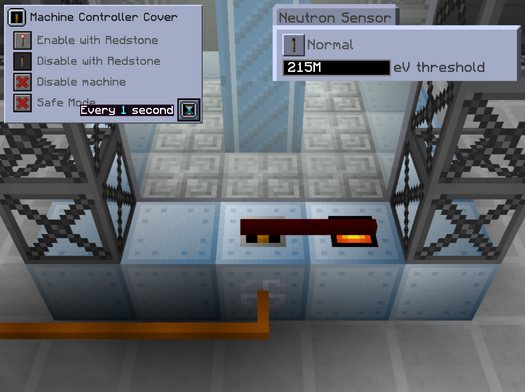
The core mechanic of this approach is using a neutron sensor to disable the neutron accelerator with a machine controller cover once it exceeds the midpoint of the acceptable range. This approach is simple, compact, cheap, and scales well. There are no significant downsides.
| STEP 1 | |
| Place the neutron accelerator and neutron sensor adjacent to each other on the bottom layer of the structure. Power the neutron accelerator with a standard cable.
Place a machine controller cover set to DISABLE WITH REDSTONE on top of the neutron accelerator. Change the tick rate to 1 second to save on TPS, unless that causes the NKE to leave the acceptable range. Set the eV threshold inside the neutron sensor to the midpoint of the acceptable range. The example to the right is specifically for naquadah-adamantium solution. The neutron sensor may face directly into the machine controller cover. Red alloy wire is only used here as a visual aid. |
|