The Industrial Arc Furnace (IAF) is an LuV tier multiblock for extreme heating and disassembling of materials with an electric arc. The IAF is a direct upgrade from the singleblock arc furnace because it runs up to 1,000% speed, grants generous overclock factors, and offers up to 1,024 parallels. The exact bonuses depend on the tier of the electrode in the electrode hatch. Only one electrode is required but they have limited durability and need to be occasionally replaced. Additionally, electrodes below 30% durability have a 5% chance for a random arc surge and electrodes below 10% durability have a 2% chance to void items in the random arc surge. Use an electrode detector hatch to measure the current durability of the electrode and automate its removal when it gets too low.
The IAF also has an alternate blast mode and ore mode. Blast mode processes Electric Blast Furnace recipes at 16x the power cost regardless of the heat capacity required and ore mode quickly processes ore-based furnace recipes. Ore mode has a startup time of 10 seconds during which the queued ore cannot exceed the maximum capacity and there must be at least one ore entering the machine every 5 ticks. Neither of these modes are really worth it when the Volcanus, Exothermic Hearth, and Multi Smelter exist.
Construction
The IAF has no tiered components. The heating coils can be any tier and has no effect on the operation of the machine, even in blast mode. Buses/hatches may replace any solid steel machine casing anywhere on the structure. Laser energy hatches are not supported, but there can be several multi-amp or regular energy hatches for overclocking. There is no mandatory air inside the structure which makes it perfect for hiding any automation setups. Use the Multiblock Structure Hologram Projector to visualize/build the structure with subchannel "coil" to specify the tier of the heating coils.
Unique to the IAF is the electrode hatch and electrode detector hatch. The former is effectively a ULV input bus for an electrode and the latter emits a redstone signal when the durability of the current electrode is greater than the durability threshold. The signal can be inverted and the threshold can be entered as an absolute value or a percentage.
Structure
Controller: Front center, 4th layer
175 Steel Frame Box
10-172 Solid Steel Machine Casing
101 Steel Pipe Casing
72 Bolted Naquadah Casing
30 Heating Coil
17 Blast Smelter Heat Containment Coil
Wallshared IAFs15 Refined Graphite Block
12 Insulated Fluid Pipe Casing
12 Heat Proof Coke Oven Casing
1 Electrode Hatch: Any steel machine casing
0+ Electrode Detector Hatch: Any steel machine casing
1+ Energy Hatch: Any steel machine casing
1 Maintenance Hatch: Any steel machine casing
1+ Input Bus/Hatch: Any steel machine casing
1+ Output Bus/Hatch: Any steel machine casing
Wallsharing
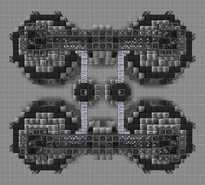
IAFs may wallshare both substructures behind the main body to save on casings, frame boxes, heat containment coils, and buses/hatches. However, do not share an energy hatch because the startup surge and unique overclock factors would cause both machines to powerfail.
Usage
The IAF has three operating modes, listed below. Switch modes in the GUI of the controller or by right-clicking the controller with a screwdriver. Blast mode is not recommended for bulk crafting and should only be used for recipes that require a higher heat capacity than currently available. Ore mode is never recommended because it is much easier to just use the Multi Smelter or even the Forge of the Gods for the few ores that do have a furnace recipe.
Normal - Runs arc furnace recipes.
Blast - Runs blast furnace recipes at 16x power cost regardless of the heat capacity required.
Ore - Runs ore-based furnace recipes with nearly unlimited throughput as long as ores are supplied every 5 ticks or less for at least 10 seconds.
The IAF is a direct upgrade from the singleblock arc furnace because it runs up to 1,000% speed, grants generous overclock factors, and offers up to 1,024 parallels. However, the IAF has a six second warm-up phase prior to processing any recipe and a six second cool-down phase after all work is complete. This temporarily halts processing to safely ignite and extinguish the arc inside the machine, but it consumes the maximum power cost during the entire warm-up phase. No power is consumed during the cool-down phase.
Electrodes
In addition to the warm-up and cool-down phases, an electrode is required in the electrode hatch to run any recipe in the IAF regardless of mode. Electrodes have limited durability and must be replaced occasionally, but they each offer their own unique bonuses, as seen in the following table. Only one electrode may be active at a time and it cannot be removed or swapped out while the IAF is running, or else the machine immediately shuts down and voids the current recipe. Electrodes also cannot be repaired and lack integrity at low durabilities:
When < 30% durability, there is a 5% chance for an arc surge to occur.
When < 10% durability, there is a 2% chance to void the current recipe in an arc surge (0.1% chance overall).
Electrode
Durability
Speed
Parallels
Overclocks
Surge EU/t
Amps
Special Effect
Per Parallel
Total Required
Energy Hatches
Graphite
200
100%
4
2.0 / 4
x1.00
1.0 A
4 A
1x 4A
Bread and Butter: No Surge Penalty.
Tantalum
500
120%
2
4.0 / 4
x4.00
1.2 A
9 A
1x 16A
None
Molybdenum
400
90%
16
3.0 / 4
x6.00
0.8 A
24 A
1x 64A
None
Tungsten
1,000
100%
128
1.0 / 4
x2.00
1.1 A
135 A
3x 64A
None
Tungstensteel
1,600
80%
256
1.0 / 4
x2.00
1.2 A
180 A
3x 64A
None
Graphene
900
250%
16
2.0 / 4
x1.00
1.0 A
15 A
1x 16A
Bread and Butter: No Surge Penalty.
YBCO
900
120%
8
6.0 / 4
x11.0
0.8 A
53 A
1x 64A
Rapid Oxidation: Doubles electrode damage per overclock.
Netherite
1,500
220%
64
1.5 / 4
x10.0
1.3 A
225 A
4x 64A
Hot Restart: No cool-down phase and skip the warm-up phase entirely if the machine is off for less than four seconds.
Tritanium
1,200
300%
48
2.0 / 4
x5.00
1.7 A
149 A
3x 64A
None
Infinity
2,000
420%
1
1.0 / 4
x2.00
1.0 A
2.0 A
1x 4A
To Infinity!: Doubles parallels after every recipe until power failure or machine shutdown. Power usage is based on max parallels instead of total inputs.
Hypogen
2,500
650%
256
1.0 / 4
x4.50
1.5 A
468 A
7x 64A
None
Neutronium Nanite
1,750
500%
64
2.0 / 4
x6.00
2.0 A
480 A
7x 64A
Nanite Repair: Optionally consumes one neutronium dust per operation for a 70% chance to restore durability instead of lose.
Transcendent Nanite
3,500
750%
512
4.0 / 4
x1.50
2.0 A
720 A
12x 64A
Nanite Maintenance: Optionally consumes one transcendent metal dust per operation for a 90% chance to restore durability instead of lose.
Universium Nanite
5,000
1,000%
1,024
8.0 / 4
x1.00
2.0 A
960 A
15x 64A
Nanite Recovery: Optionally consumes one universium dust per operation to fully repair the electrode.
Caution:
The special effect from the infinity electrode can void outputs if not managed properly. Additional protections are required.
Surge refers to the power multiplier applied to the machine during the six second warm-up phase and any random arc surges caused by a low durability electrode. The throughput or speed is NOT increased during these periods so it is strictly a penalty. Surges should never cause the IAF to powerfail because the maximum power consumption is required to generate the initial arc before any recipes are processed; it is factored in at the very beginning.
The minimum power consumption always assumes the max number of parallels so it is extremely wasteful to process small batches of recipes. That is also why so many multi-amp energy hatches are required for the machine to run despite parallels never consuming more than 2A of power each.
Overclock factor refers to the speed bonus with every overclock. For example, an imperfect overclock is 2x speed for 4x power (2/4) but a molybdenum electrode boosts that to 3x speed for 4x power (3/4). A few electrodes such as tungsten and tungstensteel have an overclock factor of 1/4 which does not increase the speed at all with each overclock and therefore encourages using the lowest tier energy hatch possible.
Automation
The challenge in using the IAF effectively is measuring the durability of the current electrode and replacing it once it gets too low without causing the machine to shutdown or void the current recipe. At a minimum, use an inverted electrode detector hatch to emit a redstone signal when the durability is less than the durability threshold.
Method 1: GregTech
The core mechanic behind this approach is using an electrode detector hatch and machine controller cover to disable the IAF once the durability of the electrode is less than 20%. An activity detector cover then triggers a swap once the machine reaches an idle state. This approach is simple, compact, and flexible. There are no significant downsides.
STEP 1
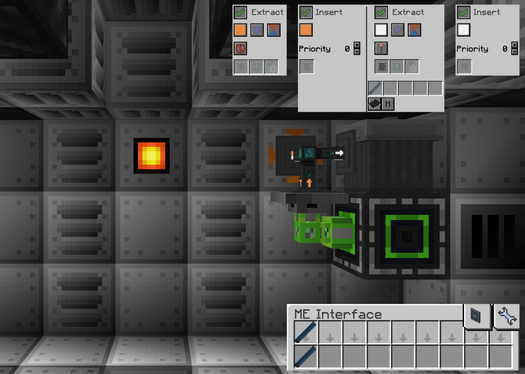
Around the back side of the controller inside the IAF, place an electrode detector hatch, electrode hatch, trash can, and ME interface connected to the main network (green) as shown.
Request electrodes through the ME interface and place an item conduit between it and the trash can with the settings shown. Ensure the extraction (white) is ACTIVE WITH SIGNAL and blacklists any full durability electrodes.
This automatically pushes healthy electrodes from the main network (green) into the electrode hatch and only pulls out damaged electrodes once it receives the signal to do so.
STEP 2
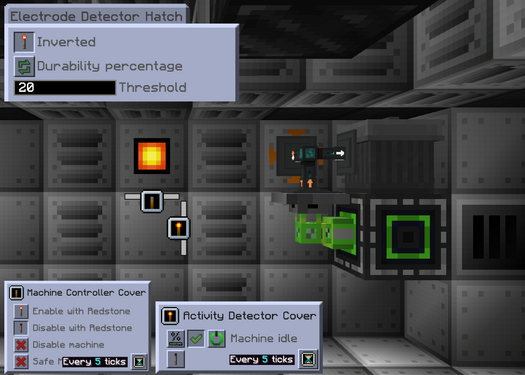
Place a machine controller cover set to DISABLE WITH REDSTONE on top of the controller and an activity detector cover set to MACHINE IDLE on the side of the controller. Set both tick rates to 5 ticks to save TPS.
Set the durability threshold in the electrode detector hatch to 20% of the electrode's durability and change the redstone behavior to INVERTED. This allows random arc surges below 30% durability but eliminates the probability of voiding items below 10% durability. Increase the threshold if the decrements are greater than 10% of the total durability per iteration.
Use a soldering iron on the activity detector cover to set the signal strength to STRONG, allowing it to transmit through the casing on the side of the controller.
STEP 3
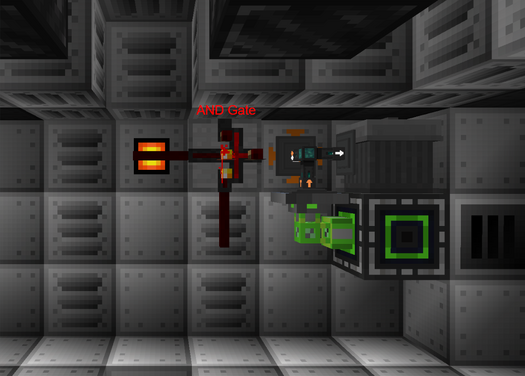
Place red alloy wire in front of the electrode detector hatch and over the pipe casing next to the controller. Place an AND gate between them and sneak right-click it with a screwdriver to disable the unused input.
Once the electrode reaches 20% durability, the IAF is disabled and the first leg of the AND gate is enabled. Once the IAF reaches an idle state, the other leg is enabled and a swap is triggered with the item conduits.
The electrode detector hatch is able to toggle the machine controller cover because it emits redstone from all sides, not just the front.
Force a structure check through the GUI of the controller to manually update the electrode detector hatch if it is ever outputting the incorrect signal.
 Caution: