GT New Horizons · Extremely Ultimate Voltage (UEV)
Extremely Ultimate Voltage (UEV)
 | WIP! This page is a Work In Progress. You can help out by adding more information to the page. |
Extremely Ultimate Voltage (UEV) is the tenth electric tier in GregTech: New Horizons. It unlocks the final circuit line, Optical Circuits, as well as materials like Hypogen and Transcendent Metal. The overall goal is the construction of the Dimensionally Transcendent Plasma Forge (DTPF) which unlocks Transcendent Metal (the UIV tier material) as well as easier recipes for several materials.
Progression
Tengam
The first step in UEV progression is using the Mothership to travel to Seth, which is the only planet where Raw Tengam Ore can be found. Raw Tengam is then processed in the Magnetic Flux Exhibitor into Purified Tengam, which is the magnetic material for UEV, UIV, and UMV Electric Motors. Once the player obtains their first Purified Tengam, they can make a Tengam Electromagnet, which greatly speeds up the separation process.
Waterline
Like LuV, ZPM, and UV, UEV brings two new steps to the Waterline, one of which is required in the tier and one of which is not required until the next tier but increases yield of components for optical circuits. The Residual Decontaminant Degasser Purification Unit and its associated Grade 7 water are needed to process Optically Enriched Crystalline Boules to make UIV circuits. After making the DTPF, the Absolute Baryonic Perfection Purification Unit and its Grade 8 water and Stabilised Baryonic Matter can increase the yield of raw optical enhanced chips by 2.25x per boule over Grade 7, and are required for Dimensionally Shifted Superfluid, which is used in many recipes beginning at UIV.
Optical Circuits
Optical Circuits are the final circuit line, going from UV to UIV, and are required for advanced machines in UEV as well as everything in UIV and above; UMV and UXV circuits are made from Optical Mainframes, although they are not themselves part of the Optical circuit line. Optical Processors, the UV circuit, are the slowest Circuit Assembly Line recipe in the game, and will be the vast majority of the player's CALs in the endgame; the remaining three circuits in the line all require the Assembly Line and have very slow recipes, encouraging players to scale Advanced Assembly Lines to meet the circuit demand.
Optical circuits require many new materials and machines to make. Optical SMDs, which were optional for Wetware and Bio circuits, are mandatory for Optical ones, introducing a requirement for Xenoxene and many new foils of different materials. Optical Processors require Optically Compatible Memory and Optically Perfected CPU, which are made in the Space Assembler; both of them have three different recipes, with better recipes requiring higher-tier materials and Space Assemblers but being faster to produce. Finally, they require Raw Exposed Optical Chips, which need Grade 7 or Grade 8 water as well as a Tier 2 Nano Forge.
The many slow recipes involved in making Optical circuits, especially those in the Space Assembler, leads most players to avoid using them for circuits below UIV at first, although doing so becomes more viable with better recipes as well as higher tier Space Assemblers.
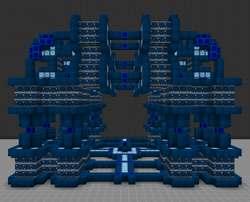
Dimensionally Transcendent Plasma Forge (DTPF)
The DTPF is the endpoint of UEV progression, and will be central to progression for the rest of the game. Crafting the DTPF requires Optical Mainframes and Eternal Singularities, but is otherwise not particularly expensive. However, the casings used in the DTPF require UIV power in the Assembly Line, meaning they cannot be crafted in an Advanced Assembly Line yet; parallelizing multiple Assembly lines is necessary to be able to craft them in a reasonable amount of time.
The DTPF uses heating coils, similar to multiblocks like the EBF, to determine the recipes it can run. In UEV, the only heating coil tiers that are available and allow any recipes are Awakened Draconium and Infinity. Awakened Draconium coils can be used to make Cosmic Neutronium much cheaper, as well as Infinity with robust fuel production, but Infinity coils are needed to make Tesseracts, Hypogen, and Dimensionally Shifted Superfluid, all of which are needed for further progression.
Once the DTPF is operational, it can be used to make many key materials much faster, much more cheaply, or both: the aforementioned Cosmic Neutronium and Infinity, as well as Neutronium, Bedrockium, Chromatic Glass, and LuV-UV Superconductor Base, with Awakened Draconium coils, and UHV Superconductor Base and Hypogen are added with Infinity coils. Hypogen is needed in UIV for the next coil upgrade, and should be a priority; the DTPF Hypogen recipe is much faster than the Fusion Reactor one, in addition to being eight times cheaper on Infinity.
Fueling the DTPF
Almost all recipes in the DTPF require a fuel, known as a catalyst, in order to run. There are five tiers of catalyst, known as Crude, Prosaic, Resplendent, Exotic, and Stellar, but only the first four are available until the Eye of Harmony in UMV. Crude catalyst requires four plasmas made in the Fusion Reactor, Helium, Iron, Calcium, and Niobium, and the next three tiers add four more plasmas each: Radon, Nickel, Boron, and Sulfur for Prosaic, Nitrogen, Zinc, Silver, and Titanium for Resplendent, and Americium, Bismuth, Oxygen, and Tin for Exotic; higher tiers of catalyst also require all the plasmas used by all previous tiers.
In UEV, the only way to make catalyst for the DTPF is through very slow recipes in the Industrial Mixing Machine and Hyper-Intensity Laser Engraver; due to how slow these processes are, and the amount of catalyst required, both the plasma production and the mixing should be run passively. In UIV, the Transcendent Plasma Mixer (TPM) can be used to immensely speed up catalyst mixing, but it requires materials from the DTPF as well as 2048 kL of each of the first four types of catalyst to craft. The DTPF builds up a discount on catalyst usage during continuous operation, up to 50% after 8 hours, which is very useful for stretching catalyst further before the TPM.
Fusion Reactor Mk4 and Mk5
The Fusion Reactor Mk4, which was optional in UHV, becomes required in UEV for the QFT and progressing the DTPF. Hypogen is much faster and more efficient to make in the DTPF, but the first DTPF recipe available is a loop that requires one ingot worth of Molten Hypogen to start, meaning the Mk4 Fusion Reactor is unavoidable to begin the loop. Neptunium Plasma and Fermium Plasma are required to craft QFT casings, and Hypogen is also used for the catalysts used in every QFT recipe. Neptunium, Fermium, Metastable Oganesson, and Rhugnor are all required to make the Mk5 Fusion Reactor, which is itself not required until UIV.
The Compact Mk4 is very useful, and should be preferred over the regular one if at all possible. It is much faster than previous tiers of Compacts, due to getting 4/4 overclocks instead of 2/2 overclocks on every recipe, and the many slow Mk4 recipes make its 64 parallels on Mk4 recipes very useful for crafting a QFT or Mk5 Fusion Reactor.
The most useful recipe in the Mk5 Fusion Reactor is Plutonium 241 Plasma, the best Space Elevator plasma, which is fast enough that a single regular Mk5 Fusion Reactor can support almost a dozen Mk2 Space Mining Modules. The other recipes are less useful in UEV. Fermium Plasma and Neptunium Plasma have much faster recipes, although when comparing a Compact 4 to a regular Mk5 they are only around 70% faster. Rhugnor and Metastable Oganesson have improved recipes as well, but both require a Godforge, which is well into UIV. Lead Plasma and Thorium Plasma are primarily used for the best DTPF catalyst, which requires an Eye of Harmony and therefore is gated to UMV, and otherwise have no use except processing Europium and Americium combs.
Infrastructure Improvements
Power
Power demands continue to scale in UEV, particularly on Advanced Assembly Lines and after making the DTPF. UEV does not introduce any new ways to generate power, leaving scaling existing ones as the only option, but it does introduce wireless power as a way to improve power transportation.
Generation
Naquadah Fuel and Plasma remain the only viable power sources in UEV. Naqfuel can be upgraded to Mk4, or even Mk5, by using Tier 2 coils in the Naquadah Fuel Refinery and combining Mk3 fuel with various materials. Prior to the DTPF, only the weaker recipes for both fuels are viable, but the DTPF can be used to produce Hypogen and Infinity fast enough to use the stronger recipes, improving the efficiency of Mk3 fuel. Plasma gains access to the Compact 4 to increase fuel production, but Infinity remains the best available rotor material.
UEV Capacitor
The UEV Capacitor has the same storage capacity as the UHV Capacitor, but 100 times the wireless download capacity, being able to download up to 1 trillion EU/t as compared to 10 billion for its predecessor. As a result, it can be used to transport power to distant setups wirelessly, rather than chaining Active Transformers; this greatly increases both the amount of power that can be transported and the ease of doing so.
Space Pumping
The Space Pumping Module is the endgame solution for producing any fluid previously obtained from a Fluid Drilling Rig or Planetary Gas Siphon, as well as a couple new ones like Radon. The Space Pump does not require any inputs except power, can be conveniently located in the player's base, and can be switched to different fluids, either automatically with OpenComputers or manually.
Component Assembly Line
The UEV Component Assembly Line (CoAL) is very useful for the large quantities of UEV Superconductor needed to make Optical Mainframes. However, its very high Infinity cost makes it difficult to afford early in the tier, and many players instead wait until they can use the DTPF for either Cosmic Neutronium or Infinity itself before constructing it. Few multiblocks in UEV itself take large amounts of UEV components, but the UEV CoAL should be built before making a tier 2 QFT or a Compact 5, as both take UEV components in bulk.
Crafting Input Buffers
The Crafting Input Buffer is a variant of the Crafting Input Bus with support for recipes containing fluids, unlocked after completing Grade 7 water. It is the best way of sending recipes to machines in the endgame, due to its infinite buffer, perfect isolation of recipes, and ability to take priority over every other recipe. However, it cannot be parallelized with Crafting Input Proxies until UIV, meaning it can only be used for cases where 1-4 machines, depending on wallsharing, are sufficient; otherwise, advanced stocking or interface P2P should still be used.
Eternal Singularities
Eternal Singularities are an item that is available as early as UHV, but generally not useful until UEV. They are made from 63 different Singularities, created from large amounts of a single material placed in a Neutronium Compressor, that are then combined in a Dire Crafting Table. They have many uses, but the most notable ones are that each DTPF controller requires 4 and that each QFT controller requires 1. Most of the materials should be already accumulated by the player from their Void Miners or Space Elevator, but a few may be difficult. Of particular note is Unstable, which can be obtained from either bees, crafting using a Pseudo-Inversion Sigil, or processing Barnarda E/F Stone Dust. In UIV, an immensely cheaper source of Eternal Singularities is unlocked in the form of the Black Hole Compressor.
Storage
Another use for Eternal Singularities that is available in UEV is various advanced bulk storage options: the Infinity Chest and Digital Singularity cells.
The Infinity Chest has 243 slots, equivalent to a Compressed Chest, but each slot can store 2.1 billion of one item type, not just 64, making it useful for storing large amounts of varied items when combined with a Storage Bus.
Digital Singularity cells, which have variants for items, fluids, and essentia, can store 4.61 quadrillion items/liters/essentia of a single type, making them effectively infinite storage. Because they only support one type, they should always be partitioned before use. In the endgame, Digital Singularities will be the only way to store materials in the quantities produced by multiblocks like the Eye of Harmony, but in UEV they are generally too expensive to be practical.
Quantum Force Transformer
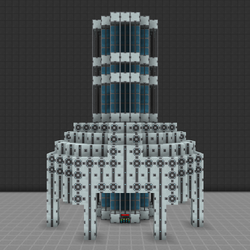
The Quantum Force Transformer (QFT), which is unlocked after Optical Mainframes, is a multiblock that can be used to run many chemical lines in the game in a single step. It can be built either before or after the DTPF, although the large amounts of Quantum Anomalies and DTPF catalyst required may make it difficult to do the QFT first. The skips available with a tier 1 QFT are:
- Adhesives (Soldering Alloy, Indalloy, Advanced Glue, Super Glue)
- Rubbers (Rubber, Silicone Rubber, Styrene-Butadiene Rubber, Polyphenylene Sulfide)
- Plastics (Polyethylene, PVC, Polystyrene, PTFE, Epoxid, PBI)
- Platinum Line
- Titanium/Tungsten Line
- Thorium/Uranium/Plutonium
The Adhesives recipe is also required to create Hyper-Stable Self-Healing Adhesive, which is used to make the tier 2 QFT. The tier 2 QFT is possible to make in UEV, albeit expensive, and unlocks these skips:
- Monazite Line
- Bastnasite Line
- Cerium-Rich Mixture
- Naquadah
- Enriched Naquadah
- Netherite
- Prismarine
Wireless Data
Optical Mainframes also unlock the Wireless Assembly line Reception Connector and Wireless Data Bank Transmission Connector. These wireless data hatches, unlike conventional data hatches, do not have to be in pairs: any number of Wireless Reception Connectors can pull from a single Wireless Transmission Connector, and vice versa, making them very convenient for setting up the large arrays of Advanced Assembly Lines needed in lategame.
Side Quests
Draconic Evolution
After obtaining Optical Mainframes, it is possible to make the Awakened Core Schematic, and thereby craft Awakened Cores in the Draconic Evolution Fusion Crafter, which are used to make the top-tier tools, armor, and equipment from Draconic Evolution.
Draconic armor provides many useful movement and utility options, including both vertical and horizontal speed modifiers, inertia cancellation, and built-in Night Vision, in addition to a shield that uses power to prevent all damage. Draconic tools and weapons are less useful, since the tasks they excel at (breaking blocks and dealing damage respectively) can be done in other ways, but are still worth noting.
There are also two other pieces of equipment: the Draconic Flux Capacitor, which stores a very large amount of RF and can charge RF-using equipment like that from Draconic Evolution, and the Enhanced Charm of Dislocation, which can store a large number of destinations and conveniently teleport to them.
Avaritia Equipment
Draconic Evolution equipment is also used to craft Avaritia tools and armor, which requires combining it with a variety of armors or tools from both tech and magic mods.
Infinity Armor provides (almost) complete invincibility with a full set equipped, even to the /kill command, but lacks many of the quality of life features of Draconic Armor. The Sword of the Cosmos can instantly kill anything in a single hit, including bosses like the Gaia Guardian or Chaos Guardian, and even including players wearing a full set of Infinity Armor.
The World Breaker, Nature's Ruin, and Planet Eater are tools capable of mining very large areas at a time, with the World Breaker being especially notable for its ability to break normally unbreakable blocks like Bedrock and its built-in Fortune 10. These features combined allow it to obtain Chaos Shards without actually defeating the Chaos Guardian, and increase the number of shards harvested from 4 to 20.
Old Stargate
UEV contains the second of the four old Stargate trophies, the Stargate of Polychrome Contest, corresponding to version 2.1.2.3qf. The materials required are largely similar to the Stargate of Split Origin in UHV, but in approximately four times the quantity: 625 Eternal Singularities, 167k Bio Mainframes, 964k Infinity, 5.9M Tritanium, and 21M UHV Superconductor, among many others. In addition, many of the parts in the Stargate of Polychrome Contest are very slow UIV Assembly Line recipes, meaning they cannot be run in the Advanced Assembly Line until the next tier.
Not a Noob Certificate
The Certificate of not being a noob anymore, more commonly known as the Not a Noob Certificate, is an optional item tied to a quest in the UEV chapter. Unlocking the quest requires the Killing Evolved quest in the Kill All the Things chapter, which itself requires finishing Twilight Forest and Galacticraft progression. The certificate itself is a very slow Extruder recipe; even an Industrial Extrusion Machine with 8 UEV Energy Hatches will take multiple hours to complete it. Other than completing the quest, the Not a Noob Certificate has no practical benefit.