GT New Horizons · Insanely Ultimate Voltage (UIV)
Dyson Swarm Ground Unit
The Dyson Swarm Ground Unit is a UIV tier multiblock and the absolute peak of solar energy with the capability to generate up to 337B EU/t. Only the Eye of Harmony, Large Naquadah Reactor (with max fuels), and Shielded Lagrangian Annihilation Matrix surpass this multiblock in terms of raw power. The Dyson Swarm Ground Unit gathers its immense radiant energy from nearby stars through finely crafted, heat-resistant Dyson Swarm Modules. The only challenge is that some modules need to be replaced every hour and the machine requires gelid cryotheum to withstand such extreme temperatures. Computation from Quantum Computers significantly reduce the amount of modules that need to be replaced.
Construction
The Dyson Swarm Ground Unit consists of three individual structures atop a large concrete platform. The exact locations of these structures are fixed in relation to the controller and all three are necessary for the structure to form. It is highly recommended to use cheap buses/hatches to replace as many casing blocks as possible. The mandatory air above the large dish is susceptible to meteorites; even if chunk protection is enabled meteorites can still disable a Dyson Swarm Ground Unit by occupying that space. Use the Multiblock Structure Hologram Projector to visualize/build the structure.
Capturing the maximum 337B EU/t requires at least a 65k UEV (or 16k UIV) laser source hatch per Dyson Swarm Ground Unit. Any laser source hatch with less throughput than that causes the machine to EXPLODE! The minimum number of casings requires 544 UIV Conveyors, 512 UIV Pumps, 32 UIV Robot Arms, 32 UIV Pistons, 392 Optical Mainframes, and 366 Bioware Mainframes to craft. The extremely primordial pearl is NOT consumed in the magical memory recipe.
Structure
- Controller: Front bottom center of receiver, 2nd layer
- 256 Ultra High Strength Concrete Floor
- 115-138 Control Center Base Casing
- 128 Control Center Toroid Casing
- 81 Energy Receiver Dish Block
- 62-72 Module Deployment Unit Base Casing
- 64 Superconductor Base UHV Frame Box
- 53-64 Energy Receiver Base Casing
- 32 Module Deployment Unit Superconducting Magnet
- 23 HSS-S Frame Box
- 20 Control Center Primary Winding
- 16 Titanium Frame Box
- 12 Control Center Secondary Winding
- 9 Awakened Draconium Coil Block
- 1 Module Deployment Unit Core
- 1 Hermetic Casing X
- 1+ Optical Reception Connector: Any center side casing on control center
- 1+ Laser Source Hatch: Any center side casing on receiver
- 1+ Input Bus: Any center side casing on deployment unit
- 1+ Input Hatch: Any center side casing on deployment unit
- Mandatory Air: All eight layers above the receiver dish
Not included in this list are the Quantum Computers (QC) that should accompany every 1-4 Dyson Swarm Ground Units, depending on how many are sharing the same control center. Also not included are any Lapotronic Supercapacitors required for uploading and downloading power wirelessly.
Wallsharing
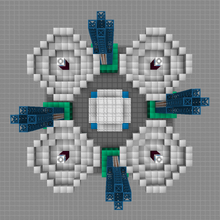
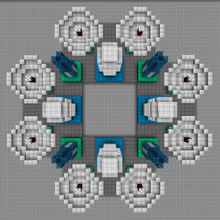
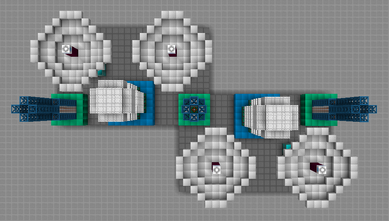
Dyson Swarm Ground Units may wallshare the module deployment center (cheaper cost) and/or the control center (less QCs), as seen in the following images. For the first version, rotate the controllers such that each one faces a different cardinal direction. For the second and third version, horizontally flip every other controller. Computation is never actually consumed and only ever "read" so any shared control centers only ever need 100k computation regardless of the number of Dysons using it. The Matter Manipulator can help with the building of QCs.
| Wallsharing v1 | Wallsharing v2 | Wallsharing v3 |
|
|
|
| 1 Control Center per 4 Dysons | 1 Control Center per 2 Dysons | 1 Control Center per 2 Dysons |
| 1 Deployment Unit per 1 Dyson | 1 Deployment Unit per 2 Dysons | 1 Deployment Unit per 2 Dysons |
Location
The location of the Dyson Swarm Ground Unit is very important for maximizing power generation, much like solar panels. However, the only thing that matters is the dimension that it is built in and NOT the day/night cycle of the planet or world. The following table lists all the possible locations for the Dyson Swarm Ground Unit and their associated power multiplier . Any location not listed has a 0.00x multiplier. Build all Dysons on Horus.
| Dimension | Multiplier | Dimension | Multiplier |
| Horus | 3.37x | Mars Space Stations | 0.89x |
| Barnarda C | 2.31x | Mars, Phobos, Deimos | 0.81x |
| Neper, α Centauri B | 2.28x | Asteroids | 0.61x |
| Mehen Belt | 2.11x | Ceres | 0.60x |
| Maahes, Seth, Vega B | 1.98x | Jupiter Space Stations | 0.48x |
| Venus Space Stations | 1.94x | Europa, Io, Ganymede | 0.44x |
| Anubis | 1.81x | Saturn Space Stations | 0.36x |
| Venus | 1.76x | Enceladus, Titan, Callisto | 0.32x |
| Mercury | 1.61x | Uranus Space Stations | 0.25x |
| Barnarda E | 1.41x | Oberon, Proteus, Miranda | 0.23x |
| T Ceti E | 1.34x | Neptune Space Stations | 0.20x |
| Barnarda F | 1.26x | Triton | 0.18x |
| Ross 128b, Ross 128ba | 1.12x | Pluto, Kuiper Belt | 0.16x |
| Earth Space Stations | 1.10x | Makemake, Haumea | 0.15x |
| Overworld, Moon | 1.00x | Garden, Mining, Void | 0.01x |
Dyson Swarm Modules
The Dyson Swarm Ground Unit controller holds up to 10,000 Dyson Swarm Modules at a time. They are inserted at the beginning of each hour-long "recipe" via the input bus and are directly proportional to the power output of the machine. Use the following equation to calculate the total EU/t from the number of modules where is the aforementioned dimension multiplier.
View the number of stored Dyson Swarm Modules by using a Portable Scanner on the controller. It will always be slightly less than 10,000. Extract Dyson Swarm Modules to the player's inventory by using a plunger on the controller. Sneak while extracting to dump the rest on the ground. With the maximum of 10,000 Dyson Swarm Modules and the 3.37x multiplier from Horus, the maximum power generated from a single Dyson Swarm Ground Unit is 337B EU/t or approximately 642k amps of UV power.
Costs
Harvesting such immense radiant energy from stars comes with some costs, listed below. The numbers are in terms of hours because enabling a Dyson Swarm Ground Unit is equivalent to running an hour-long recipe where all the inputs are consumed at the very start. Breaking the controller naturally stops any active recipe and voids the ingredients.
- Consumes 3,600,000L of Gelid Cryotheum per hour
- Consumes n of m modules per hour based on the following equation
The CPS variable refers to computation per second and effectively lowers the number of modules destroyed per hour, hence why the Dyson Swarm Ground Unit is often accompanied by QCs. The following graph shows the relationship between n and m for varying amounts of CPS between 0 and 100,000. Those are the minimum and maximum values, respectively.
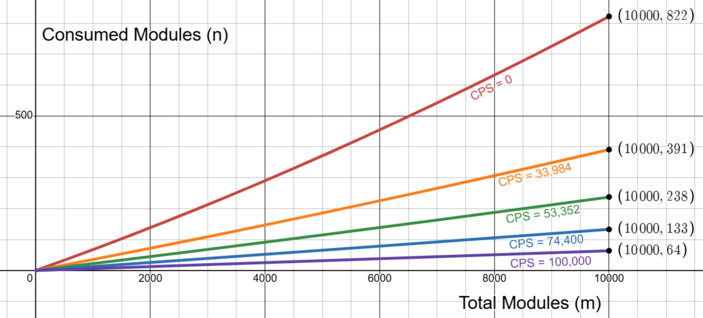
A Dyson Swarm Ground Unit with 10,000 modules and 0 CPS destroys 822 Dyson Swarm Modules per hour which is very expensive to sustain. However, a Dyson Swarm Ground Unit with 10,000 modules and 100,000 CPS destroys only 64 Dyson Swarm Modules per hour. This means modules live an average of 10,000/64 = 156 hours and produce 3.8 x 10¹⁴ EU each on Horus. The savings are well worth the cost of the Quantum Computers (QC) and the time to build them.
Recall that a maximum length QC with Pico Circuits generates up to 107,448 CPS so only one is required per control center. Alternatively, two maximum length QCs with Bioware Mainframes can also generate over 100,000 CPS. Use the Matter Manipulator to copy-paste entire QCs at a time, including any circuits and cooling cores within them.
Sending Power
Transferring power from a Dyson Swarm Ground Unit back to your main base requires tapping into the wireless EU network. This means building a Lapotronic Supercapacitor (LSC) equipped with at least a UHV capacitor near the machine. Once the internal capacity of the LSC exceeds the threshold of the capacitor(s), it uploads EU to the wireless network at the start of the next wireless rebalance cycle. Any other wireless-enabled LSC downloads EU from the wireless network up to the wireless threshold of the capacitor(s). Wireless rebalances occur every 6,000 ticks (five minutes).
Note that the wireless threshold mechanic really only limits the download speed of the LSC and NOT the upload speed. This means a single UHV capacitor is more than enough for any number of Dyson Swarm Ground Units uploading to the wireless network, but at least a UEV capacitor is required to download all the power from just one--and up to two more.
The following table summarizes the effective EU/t of each of the wireless capacitors based on their wireless thresholds and the time between rebalances. For example, an LSC equipped with a brand new UEV capacitor gains 6P EU at the start of the next cycle and should not use more than 476,837A UHV to avoid running out of power within the next 5 minutes.
| Capacitor | Threshold | Max EU/t | Amps (UHV) | Amps (UEV) | Amps (UIV) | Amps (UMV) | Amps (UXV) | |||||
| UHV | 6e+13 | 60 T | 1e+10 | 10 B | 4,768 | 1,192 | 298 | 74 | 18 | |||
| UEV | 6e+15 | 6 P | 1e+12 | 1 T | 476,837 | 119,209 | 29,802 | 7,450 | 1,862 | |||
| UIV | 6e+17 | 600 P | 1e+14 | 100 T | 47,683,715 | 11,920,928 | 2,980,232 | 745,058 | 186,264 | |||
| UMV | 6e+19 | 60 E | 1e+16 | 10 P | 4,768,371,582 | 1,192,092,896 | 298,023,224 | 74,505,806 | 18,626,451 | |||