GT New Horizons · Steam Age
Steam Machines
Steam Boilers
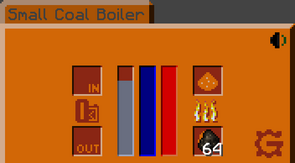
Steam Boilers evaporate water into steam with the heat from solid fuels, the sun, or lava. These are the only way to produce steam during the Steam Age prior to the Railcraft Boiler or Large Boiler. There are a few different types but they are all very similar in function and have nearly the same GUI, as seen in the image to the right.
The bottom right slot is for fuel, the top right slot is for ashes that are occasionally created by the fuel, the top left slot is for inserting water or extracting steam via fluid cells (optional), and the bottom left slot is for retrieving the fluid cells. The right tank is the heat gauge, the center tank is for water, and the left tank is for steam.
HEAT is equivalent to the internal temperature of the boiler and ranges from 20°C to either 500°C or 1,000°C depending on the type of boiler. Heat simultaneously increases (while active) and decreases every few ticks based on the boiler's heat up rate and cool down rate. The only way to view the exact heat is by using a portable scanner on the boiler and looking at its progress/load, but it can be reasonably estimated from the gauge itself. It is perfectly safe for the heat to increase and actually encouraged to reach its maximum value to reduce fuel consumption.
WATER is inserted through any side other than the top and is converted into steam at a 1:160 ratio if the heat is at least 100°C. Water is absolutely mandatory not only for steam production but also to prevent the boiler from overheating and exploding. ADDING WATER TO A HOT BOILER CAUSES IT TO EXPLODE so always ensure there is an excess amount of water available and break/replace the boiler to reset its heat if necessary.
STEAM is automatically pushed to adjacent tanks or fluid pipes on any side other than the front or bottom. Steam is not generated if the internal temperature is less than 100°C or there is no water present. It is perfectly safe for the steam to buildup if it has nowhere to go, but the boiler will vent 25% of the stored steam every time it reaches its maximum capacity. The size of the steam tank is always the same size as the water tank.
| Type | Heat | Water | Steam | Pollution | ||||
| Max | Heat Up Rate | Cool Down Rate | Tank | Input | Tank | Output | ||
| Small Coal Boiler | 500°C | +1°C per 12 Ticks | -1°C per 45 Ticks | 16,000 L | 0.75 L/s | 16,000 L | 120 L/s | 20 gibbl/s |
| Large Coal Boiler | 1,000°C | +1°C per 12 Ticks | -1°C per 40 Ticks | 32,000 L | 1.88 L/s | 32,000 L | 300 L/s | 30 gibbl/s |
| Simple Solar Boiler | 500°C | +5°C per 12 Ticks | -1°C per 9 Ticks | 16,000 L | 0.75 L/s | 16,000 L | 120 L/s | 0 gibbl/s |
| Advanced Solar Boiler | 500°C | +5°C per 12 Ticks | -1°C per 15 Ticks | 32,000 L | 2.25 L/s | 32,000 L | 360 L/s | 0 gibbl/s |
| Reinforced Lava Boiler | 1,000°C | +1°C per 12 Ticks | -1°C per 20 Ticks | 32,000 L | 3.75 L/s | 32,000 L | 600 L/s | 20 gibbl/s |
| Advanced Boiler (LV) | 1,250°C | +1°C per 10 Ticks | -1°C per 40 Ticks | 32,000 L | 4.69 L/s | 64,000 L | 750 L/s | 35 gibbl/s |
| Advanced Boiler (MV) | 1,500°C | +1°C per 10 Ticks | -1°C per 40 Ticks | 48,000 L | 9.38 L/s | 96,000 L | 1,500 L/s | 50 gibbl/s |
| Advanced Boiler (HV) | 1,750°C | +1°C per 10 Ticks | -1°C per 40 Ticks | 64,000 L | 14.1 L/s | 128,000 L | 2,250 L/s | 65 gibbl/s |
Basic Boilers
Coal Boilers generate heat by burning any type of coal, charcoal, or coke. That includes variations such as coal dust and cactus coke, but not logs or any other burnable items. They consume 10 ticks of fuel every time their heat increases by 1°C and therefore need significantly less fuel once they reach their maximum heat capacity. For example, one charcoal lasts 96 seconds in the small coal boiler while it is still heating up but then lasts 360 seconds as soon as it reaches 500°C.
Solar Boilers generate heat by absorbing sunlight. They do not consume fuel or produce pollution, but they require direct sky access and rapidly lose heat during the night or rainy weather. Pipes and other semi-transparent blocks do NOT block their view of the sky and can be placed directly above them, if necessary. The downside to solar boilers is that they start to calcify after 15 hours which linearly decreases their water consumption and steam production down to 33% of their maximum value over the course of the next 15 hours. Remove calcification by breaking and replacing the boiler with a wrench, or avoid it altogether by using distilled water instead of regular water. The silver needed to craft them can be difficult to find prior to the Twilight Forest in LV. The only available source early on is small silver ore in the overworld which spawns randomly at a rate of 20 per chunk between y=20 and y=60. Small ores are affected by fortune so it is highly encouraged to add lapis to your Tinkers pickaxe or hammer when searching for it.
Reinforced Lava Boilers generate heat by consuming lava. It has the highest steam production rate out of the Steam Age boilers, but lava is not very easy to sustain at this point so it is not worth crafting over the others. It consumes 3L of lava every time its heat increases by 1°C and therefore needs significantly less lava once it reaches its maximum heat capacity.
-
 Small Coal Boiler
-
 Large Coal Boiler
-
 Simple Solar Boiler
-
 Advanced Solar Boiler
-
 Reinforced Lava Boiler
Advanced Boilers
Advanced Boilers generate heat by burning any solid or liquid fuel with a burn time. That includes creosote buckets or even diamonds, but the buckets are consumed in the process. They consume 10 ticks of fuel every time their heat increases by 1°C and stop consuming fuel if their temperature is greater than 100°C. That means they reach a stable point much faster than the other boilers since they never reach their maximum heat capacity.
-
 Advanced Boiler LV
-
 Advanced Boiler MV
-
 Advanced Boiler HV
Steam Machines
Steam Machines are the first GregTech singleblock machines that the player encounters and function slightly differently from their electric counterparts. Not only do they consume steam instead of electricity to run, but they must vent the steam at the end of each recipe. Blocking the output side with a fluid pipe or anything else halts processing until the obstruction is cleared, or the output side is rotated with a wrench. There is also not a steam machine for every machine type so a few things may need to be done manually. For example, there is no steam mixer and the only alternatives are crafting table recipes or the Steam Blender multiblock.
Nearly all steam machines are available in two tiers: basic (T1) and high-pressure (T2). The high-pressure versions consume twice the amount of steam to run twice as fast. Use NEI to see how much each one consumes for any given recipe.
Steam Furnace
The steam furnace smelts raw food and other items similar to a vanilla furnace. The basic version consumes 160 L/s of steam to smelt 1 item per 12.8 seconds and the high-pressure version consumes 320 L/s of steam to smelt 1 item per 6.4 seconds. A vanilla furnace smelts 1 item per 10 seconds which means the basic version is actually worse and therefore not recommended. The steam furnace is superseded by the Steam Hearth.
-
 Basic
-
 High-Pressure
Steam Alloy Smelter
The steam alloy smelter produces alloys such as bronze or redstone alloy. The basic version consumes up to 1,200 L/s of steam and the high-pressure version consumes up to 2,400 L/s of steam. The duration of recipes range from 20-60 seconds. The steam alloy smelter is superseded by the Steam Fuser.
-
 Basic
-
 High-Pressure
Steam Macerator
The steam macerator crushes and grinds items into dusts. The basic version consumes 80 L/s of steam to macerate 1 ore per 40 seconds and the high-pressure version consumes 120 L/s of steam to macerate 1 ore per 20 seconds. Turning bones into bonemeal requires the maximum consumption or 1,200 L/s and 2,400 L/s, respectively. The steam macerator is superseded by the Steam Grinder.
-
 Basic
-
 High-Pressure
Steam Compressor
The steam compressor turns nuggets into ingots, or ingots into blocks. The basic version consumes up to 160 L/s of steam and the high-pressure version consumes up to 320 L/s of steam. The duration of recipes range from 2-110 seconds. Note that the steam alloy smelter can also turn nuggets into ingots and is actually 50% faster and more efficient than the steam compressor, but it requires a mold to do so. The Steam Compressor is superseded by the Steam Squasher.
-
 Basic
-
 High-Pressure
Steam Forge Hammer
The steam forge hammer presses ingots into plates and crushes ores. The basic version consumes up to 1,200 L/s of steam and the high-pressure version consumes up to 2,400 L/s of steam. The duration of ore crushing recipes are only 1 second long which makes this a significantly better option over the steam macerator for processing them. The steam forge hammer is superseded by the Steam Presser.
-
 Basic
-
 High-Pressure
Steam Extractor
The steam extractor pulls solid ingredients from items. The basic version consumes up to 320 L/s of steam and the high-pressure version consumes up to 640 L/s of steam. The steam extractor does not extract fluids and does not have a multiblock equivalent. The next upgrade is the LV extractor and fluid extractor.
-
 Basic
-
 High-Pressure