GT New Horizons · Insane Voltage (IV)
Solar Tower
The Solar Tower is an IV tier multiblock that converts cold solar salt into hot solar salt with the heat from the sun. The Solar Tower runs indefinitely on a fixed 10 second cycle for absolutely free. Heat is added at the beginning of each cycle based on the current heat, the number of solar reflectors with sky access, and the number of solar reflector rings around the central column. The heat gain is reduced by 50% in the rain and 100% during night. The Solar Tower then immediately uses as much heat as possible to convert the cold solar salt into hot solar salt at a perfect 1:1 ratio. Ideally, the heat stays at 50,000 and the amount of cold solar salt added per cycle is equivalent to the amount of heat gained per cycle. The maximum sustainable output is 883 L/s of hot solar salt which generates upwards of 16A of IV power with the Large Heat Exchanger and/or Thermal Boiler. Building additional Solar Towers to overcome the supercritical threshold of the Extreme Heat Exchanger allows each one to generate upwards of 6A of LuV power.
Spreadsheet: GTNH Power Planner 2.9
Construction
The Solar Tower has no tiered components, although the number of solar reflector rings (1-5) around the central column determines the overall tier of the structure. Higher tiers gain heat faster and therefore convert more cold solar salt into hot solar salt per cycle. The rotation of the solar reflectors is irrelevant but the controller can only face upwards. Buses/hatches are limited to the six casings on each side of the base of the structure. There is no energy hatch or muffler hatch but there is a maintenance hatch. Use the Multiblock Structure Hologram Projector to visualize/build the structure where the projector stack size determines the number of rings.
Structure
- Controller: Top center, 28th layer
- 36 / 88 / 156 / 240 / 340 Solar Reflector
- 229-250 Structural Solar Casing
- 66 Salt Containment Casing
- 60 Thermal Containment Casing
- 60 Thermally Insulated Casing
- 1 Maintenance Hatch: Any bottom side casing
- 1+ Input Hatch: Any bottom side casing
- 1+ Output Hatch: Any bottom side casing
Wallsharing
Solar Towers may wallshare each of their sides to save on solar reflectors. There is no mandatory air between the rings so they can overlap significantly. The hatches, however, are impossible to share due to the restrictions on their locations.
Usage
The Solar Tower converts cold solar salt into hot solar salt with the heat from the sun on a fixed 10 second cycle. No other types of fluid are allowed and it does not consume any power. The only challenge is managing the internal heat buffer to maximize throughput, but even that is fairly easy to accomplish by not inserting too much cold solar salt at once. See the automation section below for more details.
Each cycle increases the efficiency of the machine by 1% and runs all the following calculations in the order in which they are listed. Heat is always added at the beginning of each cycle, but nothing is consumed until the Solar Tower reaches 100% efficiency. That means it needs to be turned on for at least 16.7 minutes before it can do anything and starts with the maximum 100,000 heat. Adding more solar salt in the middle of a cycle has no effect until the next one begins.
Heat Efficiency
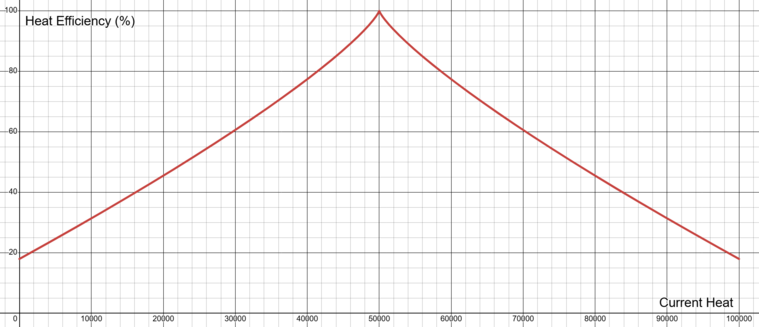
The heat efficiency of the Solar Tower depends solely on the current heat, as seen in the following equation and graph. The goal is to stay as close as possible to 50,000 heat for the maximum 100% heat efficiency. View the current heat by right-clicking the controller with a Portable Scanner, or by using an industrial information panel. The Solar Tower does NOT explode if it reaches 100,000 heat, although that yields an extremely poor efficiency of 17.9%.
Heat Change
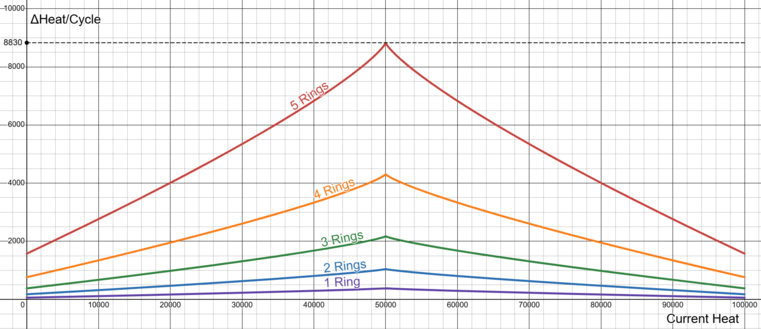
The heat change per cycle depends on the heat efficiency, the number of solar reflectors with sky access, and the number of solar reflector rings, as seen in the following equation and graph. The heat gain is reduced by 50% during rain/storms and 100% during the night, but the heat loss is constant. Therefore, the minimum heat change per cycle is -10 and the maximum heat change per cycle is +8,830. More is always better.
Solar Salt
The Solar Tower converts cold solar salt into hot solar salt at a perfect 1:1 ratio if the heat is at least 30,000. Every 1L converted reduces the internal heat buffer by 1 until it reaches zero. Excess cold solar salt is NOT consumed, but there is no way to prevent hot solar salt from voiding if the output hatch(es) are full. 100% of the hot solar salt is returned back to cold solar salt after passing through one of the four types of heat exchangers.
It would be incredibly wasteful to fully empty the internal heat buffer with up to 100,000L of solar salt because that minimizes heat efficiency. Instead, convert only the amount of heat gained per cycle to keep the machine at exactly 50,000 heat. A Solar Tower with 5 rings, for example should not receive more than 8,830L of cold solar salt every 10 seconds.
| Rings | Heat | Solar Salt | |
| Per Cycle | Average | ||
| 1 | 50,000 | 386 L | 38.6 L/s |
| 2 | 50,000 | 1,046 L | 104.6 L/s |
| 3 | 50,000 | 2,174 L | 217.4 L/s |
| 4 | 50,000 | 4,310 L | 431.0 L/s |
| 5 | 50,000 | 8,830 L | 883.0 L/s |
Power
The Solar Tower is a completely free and green source of energy. The only costs are building the structure and making enough cold solar salt to support a sustainable closed-loop system with any heat exchanger. The 883 L/s of hot solar salt is more than enough to generate superheated (SH) steam in a Thermal Boiler or Large Heat Exchanger and 1,766 L/s of hot solar salt is more than enough to generate supercritical (SC) steam in an Extreme Heat Exchanger. There is also the Whakawhiti Wera XL but its throughput requirements are a little high for the Solar Tower and the EHE is better for power anyway, even if it is more machines to build.
Conversion Ratios
- 1 L/t Hot Solar Salt = 1,000 L/t SC Steam (EHE) or 1,000 L/t SH Steam (Thermal Boiler, LHR, WWXL)
- 160 L/t SC Steam = 160 L/t SH Steam = 160 L/t Steam = 1 L/t Distilled Water
| Hot Solar Salt | Heat Exchanger | Amount | Max Input | Max Output | |
| 883 L/s | Thermal Boiler | 8.00 | 276 L/t Water | 44,150 L/t SH Steam | |
| 883 L/s | Large Heat Exchanger | 2.76 | 276 L/t Distilled Water | 44,150 L/t SH Steam | |
| 1,766 L/s | Extreme Heat Exchanger | 0.552 | 552 L/t Distilled Water | 88,160 L/t SC Steam | |
| 1,766 L/s | Whakawhiti Wera XL | 0.172 | 552 L/t Distilled Water | 88,300 L/t SH Steam |
The natural order of XL Turbo Steam Turbines is listed below. All three types of steam have the same conversion ratio so the output of one can feed directly into the input of the next. At maximum efficiency, 100% of the steam is recycled back into distilled water--forming a sustainable closed loop system. Both SC steam and SH steam generate 2x more EU than regular steam at the same optimal flow rate.
- The XL Turbo SC Steam Turbine generates power from SC steam and converts it to SH steam at a 1:1 ratio.
- The XL Turbo HP Steam Turbine generates power from SH steam and converts it to regular steam at a 1:1 ratio.
- The XL Turbo Steam Turbine generates power from regular steam and converts it to distilled water at a 160:1 ratio.
If the steam throughput is too high for steam valves or fluid pipes, use fluid P2P tunnels instead. They have no transfer limit and evenly distribute all fluids between all output connections.
Example Setups
The following are some example setups for various turbine materials. These tables only assume a few Solar Towers but this can be scaled up to meet higher optimal flow rates. Use the planner linked at the top for a complete list of turbine materials and full setup breakdowns.
| Solar Tower | LHE | LSTs | Power | ||||||||||||
| Amount | Hot Solar Salt | Amount | Distilled Water | SH Steam | Tier | Amount | Size | Material | Fitting | Flow Rate (per) | Net (total) | Amps | |||
| 1 | 883 L/s | 3 | 275.9 L/t | 44,150 L/t | IV | 9 ea | Large | Oriharukon | Tight | 4,906 L/t | 102,024 EU/t | 12.5A IV | |||
| 1 | 883 L/s | 3 | 275.9 L/t | 44,150 L/t | IV | 4 ea | Small | Ichorium | Tight | 11,038 L/t | 112,132 EU/t | 13.7A IV | |||
| 1 | 883 L/s | 3 | 275.9 L/t | 44,150 L/t | IV | 9 ea | Large | HSS-E | Tight | 4,906 L/t | 115,344 EU/t | 14.1A IV | |||
| 1 | 883 L/s | 3 | 275.9 L/t | 44,150 L/t | LuV | 2 ea | Large | Trinium | Tight | 22,075 L/t | 118,538 EU/t | 3.62A LuV | |||
| 1 | 883 L/s | 3 | 275.9 L/t | 44,150 L/t | LuV | 9 ea | Large | Gaia Spirit | Tight | 4,906 L/t | 148,293 EU/t | 4.53A LuV | |||
| Solar Tower | EHE | XLSTs | Power | ||||||||||||
| Amount | Hot Solar Salt | Amount | Distilled Water | SC Steam | Tier | Amount | Size | Material | Fitting | Flow Rate (per) | Net (total) | Amps | |||
| 2 | 1,776 L/s | 1 | 551 L/t | 88,160 L/t | LuV | 1 ea | Large | Oriharukon | Tight | 88,160 L/t | 291,087 EU/t | 8.88A LuV | |||
| 2 | 1,776 L/s | 1 | 551 L/t | 88,160 L/t | LuV | 1 ea | Large | HSS-E | Tight | 88,160 L/t | 328,647 EU/t | 10.0A LuV | |||
| 2 | 1,776 L/s | 1 | 551 L/t | 88,160 L/t | LuV | 1 ea | Large | Gaia Spirit | Tight | 88,160 L/t | 422,547 EU/t | 12.9A LuV | |||
| 4 | 3,532 L/s | 2 | 1,102 L/t | 176,320 L/t | LuV | 1 ea | Small | Ichorium | Tight | 176,320 L/t | 657,295 EU/t | 20.1A LuV | |||
| 7 | 6,181 L/s | 2 | 1,930 L/t | 308,800 L/t | LuV | 1 ea | Large | Trinium | Tight | 308,800 L/t | 1,420,760 EU/t | 43.4A LuV | |||
Automation
The challenge in using the Solar Tower effectively is maintaining 50,000 heat at all times. That involves predicting the amount of heat gained in the NEXT cycle and supplying only that much cold solar salt.
Method 1: GregTech
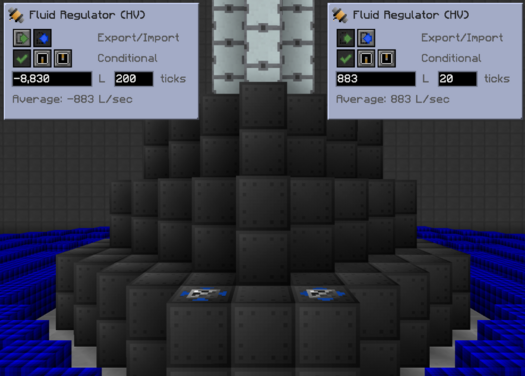
The core mechanic behind this approach is using a fluid regulator to insert 8,830L of cold solar salt every 10 seconds and another fluid regulator to extract 883L of hot solar salt every 1 second. Fluid P2P tunnels are then used to evenly distribute the hot solar salt between heat exchangers. This approach is simple and easily scalable, but it is sensitive to any changes or problems.
| STEP 1 | |
| Place an LV+ input hatch and IV+ output hatch on the base of the structure. Add fluid regulators with the settings shown, assuming that there is the maximum number of solar reflectors for the maximum possible heat gain.
The tick rates align with the 10 second cycle of the Solar Tower and the 1 second cycle of all heat exchangers. When starting, set the input fluid regulator to USE INVERTED MACHINE PROCESSING STATE to disable it temporarily. As soon as the machine's efficiency reaches 100% and it can start processing, add exactly 50,000L of cold solar salt and re-enable the fluid regulator within the same cycle. This drops the heat to 50,000 and keeps it there for every subsequent cycle. |
|
| STEP 2 | |
| Place an ME dual interface filtered to cold solar salt in front of the input fluid regulator. This simply buffers 16,000L of cold solar salt for the Solar Tower. It is also more than the maximum 8,830L per cycle.
Place another ME dual interface in front of the output fluid regulator. This simply receives the hot solar salt and sends it to the heat exchangers. |

|
| STEP 3 | |
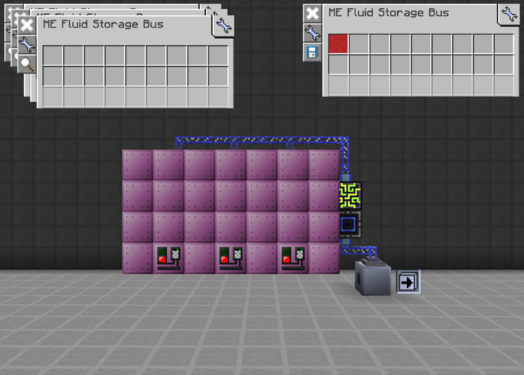
| Place ME fluid storage buses set to EXTRACT ONLY on the heat exchangers' output hatches with cold solar salt. This makes the cold solar salt available to the ME dual interface in the previous step.
Also place an ME fluid storage bus set to INSERT ONLY on a nearby super tank. Filter the storage bus to hot solar salt and enable auto-output in the super tank. This buffers the hot solar salt from the ME dual interface in the previous step. |
|
| STEP 4 | |
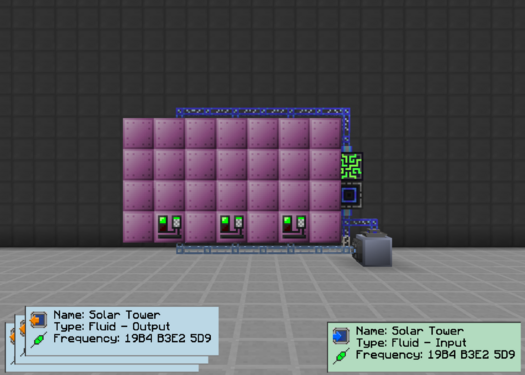
| Place fluid P2P tunnels on the heat exchangers' input hatches for hot solar salt as well as the output side of the super tank.
Link the fluid P2P tunnel on the super tank (input) to all the others (outputs). This naturally balances the hot solar salt between all heat exchangers. Scaling this approach is as easy as connecting more Solar Towers to the same subnetwork (blue) and adding more heat exchangers with the same P2P links. A single wireless hub can support up to 16 Solar Towers at once. Not shown is the distilled water and steam loop with the Large Steam Turbines. |
|