GT New Horizons · Stone Age
Ore Generation
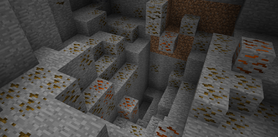
Ore Generation in GregTech New Horizons has been massively overhauled from the traditional vanilla experience. Instead of ores being sprinkled all across the world, they are concentrated in large ore veins that contain several hundred ores each and generate three chunks apart from one another. However, ore veins consist of only 1-4 types of ore at a time and their size/rarity depends on the vein's stats and the current dimension or planet. That means not every ore spawns in every ore vein and their composition is largely uniform; one may contain mostly copper while another contains mostly iron. The goal is finding each of the unique ore veins that are available and mark their locations on a map to repeatedly come back to them. There is no strip mining as in vanilla Minecraft.
There are also a few small ores that spawn per chunk which can be completely random or serve as an indicator for a nearby vein. Small ores drop either a crushed ore, an impure dust, or potentially even a gem if applicable. They are almost purely supplemental and should generally not be relied upon for specific ores, even if there are no regular ones of a particular type in that dimension or planet.
Ore Veins
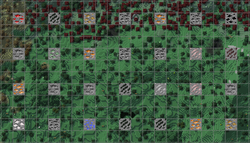
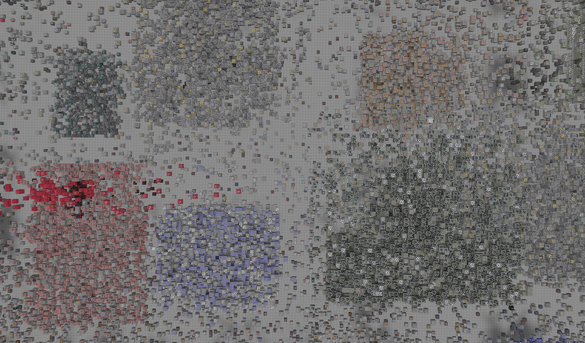
Ore veins are large clusters of hundreds of individual ores and generate exactly three chunks apart in a grid-like pattern starting from chunk (0,0). That means there are two non-ore chunks between every ore vein, as seen in the following images. The only exception is along the 0,0 axis both north-south and east-west which have one less non-ore chunk between ore veins. Expect underground layers to be incredibly sparse or incredibly dense--there is no inbetween.
 |
 |
 |
The ores themselves only generate in stone blocks which includes but is not limited to stone, red/black granite, basalt, marble, netherrack, and endstone. Ores cannot generate in dirt, gravel, sand, air, etc. The type of stone an ore generates as is usually irrelevant, except for netherrack and endstone which have twice the yield as everything else.
Due to the tremendous amount of ores in GTNH, they are defined as non-ticking MetaTileEntities with unique TileEntity data instead of having their own block ID or metadata. In other words, ores are all the same block but have different data assigned to them that make them function differently. That means x-ray resource packs or mods do not work. Changing stone textures to be invisible turns the ores invisible too, as they do not exist as ores until exposed or interacted with. Each ore contains an internal ID and a true/false value whether they were placed by the world generator or by other means. This is mainly used to determine drops for Small Ores. Rarely, a meta ore may fail to update, especially if insta-mining. Placing anything adjacent or touching the meta ore block usually fixes it.
Shape and Composition
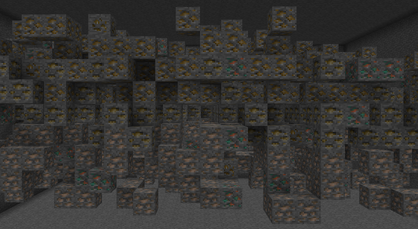
Ore veins are rectangular cuboids that are typically nine blocks tall, but that could unintentionally be reduced by air gaps at high elevations, randomly generated structures, etc. The majority of ore veins in The End, for example, are completely voided because the dimension is mostly air. Ore veins that are partially reduced do not overfill the remaining part of the vein to compensate.
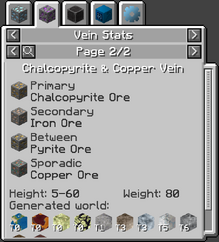
Ore veins are composed of a primary, secondary, between, and sporadic ore which could all be the same or different depending on the vein. The primary ore spawns only in the top four layers, the secondary ore spawns only in the bottom four layers, the between ore spawns only in the middle four layers, and the sporadic ore spawns rarely on any of the nine layers. Veins always have the same composition regardless of dimension or planet and have their information listed in NEI. For example, the primary ore in a coal vein is always coal ore regardless of where its found.
|
 |
 | ||||||||||||||||||||||||||||||
Types
The following table lists all 118 ore veins in GTNH by their composition, height, weight, and minimum rocket tier. Not every ore vein is available in every dimension and a few have their height adjusted specifically for the Twilight Forest to prevent them from voiding for being too high. The tier of a planet corresponds to the tier of the rocket required to reach it. For example, T3 Ceres requires a T3 rocket or better. Biome has no effect on ore generation.
 Important: | See here for a list of dimension IDs. See here for a breakdown of each Planet. See here for Void Miner drop rates. |
| Ore Vein | Primary | Secondary | Between | Sporadic | Height | Weight | Rocket |
|---|---|---|---|---|---|---|---|
| Lignite Coal | Lignite Coal Ore | Lignite Coal Ore | Lignite Coal Ore | Coal Ore | 80-210 | 160 | None |
| Magnetite | Magnetite Ore | Magnetite Ore | Iron Ore | Vanadium Magnetite Ore | 60-180 | 160 | None |
| Magnetite & Gold | Magnetite Ore | Magnetite Ore | Vanadium Magnetite Ore | Gold Ore | 30-60 | 160 | None |
| Brown Limonite & Iron | Brown Limonite Ore | Yellow Limonite Ore | Banded Iron Ore | Malachite Ore | 10-40 | 120 | None |
| Sulfur | Sulfur Ore | Sulfur Ore | Pyrite Ore | Sphalerite Ore | 5-20 | 100 | None |
| Basaltic Mineral Sand | Basaltic Mineral Sand | Granitic Mineral Sand | Fullers Earth | Gypsum Ore | 50-60 | 80 | None |
| Cassiterite Sand & Tin | Cassiterite Sand | Garnet Sand | Asbestos Ore | Diatomite Ore | 50-60 | 80 | None |
| Chalcopyrite & Copper | Chalcopyrite Ore | Iron Ore | Pyrite Ore | Copper Ore | 5-60 | 80 | None |
| Chalcopyrite & Vermiculite | Chalcopyrite Ore | Vermiculite Ore | Cassiterite Ore | Alunite Ore | 80-200 | 80 | None |
| Coal | Coal Ore | Coal Ore | Coal Ore | Lignite Coal Ore | 30-80 | 80 | None |
| Nether Quartz | Nether Quartz Ore | Nether Quartz Ore | Nether Quartz Ore | Quartzite Ore | 40-80 | 80 | None |
| Tetrahedrite | Tetrahedrite Ore | Tetrahedrite Ore | Copper Ore | Stibnite Ore | 80-120 | 70 | None |
| Almandine & Sapphire | Almandine Ore | Pyrope Ore | Sapphire Ore | Green Sapphire Ore | 10-25 | 60 | None |
| Apatite | Apatite Ore | Apatite Ore | Tricalcium Phosphate Ore | Pyrochlore Ore | 40-60 | 60 | None |
| Bentonite & Olivine | Bentonite | Magnesite Ore | Olivine Ore | Glauconite Ore | 10-25 | 60 | None |
| Kaolinite | Kaolinite | Zeolite Ore | Fullers Earth | Glauconite Sand | 50-70 | 60 | None |
| Redstone | Redstone Ore | Redstone Ore | Ruby Ore | Cinnabar Ore | 5-40 | 60 | None |
| Rock Salt & Salt | Rock Salt Ore | Salt Ore | Lepidolite Ore | Spodumene Ore | 50-70 | 50 | None |
| Tin & Cassiterite | Tin Ore | Tin Ore | Cassiterite Ore | Tin Ore | 60-220 | 50 | None |
| Dolomite | Dolomite Ore | Wollastonite Ore | Trona Ore | Andradite Ore | 150-200 | 40 | None |
| Galena & Cryolite | Galena Ore | Silver Ore | Lead Ore | Cryolite Ore | 5-20 | 40 | None |
| Garnierite & Nickel | Garnierite Ore | Nickel Ore | Cobaltite Ore | Pentlandite Ore | 10-40 | 40 | None |
| Graphite & Diamond | Graphite Ore | Graphite Ore | Diamond Ore | Coal Ore | 5-20 | 40 | None |
| Lazurite & Lapis | Lazurite Ore | Sodalite Ore | Lapis Ore | Calcite Ore | 20-50 | 40 | None |
| Oilsands | Oilsands Ore | Oilsands Ore | Oilsands Ore | Oilsands Ore | 50-80 | 40 | None |
| Saltpeter & Electrotine | Saltpeter Ore | Diatomite Ore | Electrotine Ore | Alunite Ore | 5-45 | 40 | None |
| Soapstone | Soapstone Ore | Talc | Glauconite Ore | Pentlandite Ore | 20-50 | 40 | None |
| Beryllium | Beryllium Ore | Beryllium Ore | Emerald Ore | Thorium Ore | 5-30 | 30 | None |
| Naquadah | Naquadah Ore | Naquadah Ore | Naquadah Ore | Enriched Naquadah Ore | 10-90 | 30 | None |
| Grossular & Manganese | Grossular Ore | Spessartine Ore | Pyrolusite Ore | Tantalite Ore | 20-30 | 20 | None |
| Kyanite & Mica | Kyanite Ore | Mica Ore | Cassiterite Ore | Pollucite Ore | 20-40 | 20 | None |
| Quartzite | Quartzite Ore | Barite Ore | Certus Quartz Ore | Certus Quartz Ore | 80-120 | 20 | None |
| Aqua, Ignis, & Amber | Aqua Infused Stone | Ignis Infused Stone | Amber Ore | Cinnabar Ore | 5-20 | 16 | None |
| Perditio & Ordo | Perditio Infused Stone | Ordo Infused Stone | Amber Ore | Cinnabar Ore | 5-20 | 16 | None |
| Terra & Aer | Terra Infused Stone | Aer Infused Stone | Amber Ore | Cinnabar Ore | 5-20 | 16 | None |
| Scheelite & Tungstate | Scheelite Ore | Scheelite Ore | Tungstate Ore | Lithium Ore | 20-60 | 10 | None |
| Sheldonite & Platinum | Sheldonite Ore | Palladium Ore | Platinum Ore | Iridium Ore | 40-50 | 5 | None |
| Wulfenite & Molybdenum | Wulfenite Ore | Molybdenite Ore | Molybdenum Ore | Powellite Ore | 20-50 | 5 | None |
| Bauxite | Bauxite Ore | Ilmenite Ore | Aluminium Ore | Ilmenite Ore | 10-80 | 80 | T1 |
| Galena & Silver | Galena Ore | Galena Ore | Silver Ore | Lead Ore | 5-45 | 40 | T1 |
| Bastnasite & Monazite | Bastnasite Ore | Bastnasite Ore | Monazite Ore | Neodymium Ore | 20-40 | 30 | T1 |
| Quartzite & Quartz | Quartzite Ore | Barite Ore | Certus Quartz Ore | Certus Quartz Ore | 40-80 | 20 | T1 |
| Ilmenite | Ilmenite Ore | Chromite Ore | Uvarovite Ore | Perlite Ore | 10-70 | 16 | T1 |
| Arsenic | Arsenic Ore | Bismuth Ore | Antimony Ore | Antimony Ore | 40-60 | 60 | T2 |
| Draconium | Draconium Ore | Electrotine Ore | Jade Ore | Vinteum Ore | 20-40 | 40 | T2 |
| Oriharukon | Oriharukon Ore | Tanzanite Ore | Vyroxeres Ore | Mirabilite Ore | 30-60 | 40 | T2 |
| Pitchblende | Pitchblende | Pitchblende | Uraninite Ore | Uraninite Ore | 30-60 | 40 | T2 |
| Desh | Desh Ore | Desh Ore | Scheelite Ore | Tungstate Ore | 5-40 | 30 | T2 |
| Uraninite & Uranium 238 | Uraninite Ore | Uraninite Ore | Uranium 238 Ore | Uranium 238 Ore | 20-30 | 20 | T2 |
| Magnesite | Magnesite Ore | Banded Iron Ore | Sulfur Ore | Opal Ore | 55-65 | 110 | T3 |
| Djurleite | Djurleite Ore | Bornite Ore | Wittichenite Ore | Tetrahedrite Ore | 40-70 | 80 | T3 |
| Nitrogen | Nitrogen Ice | Ammonia Ice | Hydrogen Ice | Hydrogen Ice | 30-180 | 80 | T3 |
| Oxygen | Oxygen Ice | Hydrogen Ice | Oxygen Ice | Hydrogen Ice | 30-180 | 80 | T3 |
| Forsterite | Forsterite Ore | Fayalite Ore | Orange Descloizite Ore | Red Descloizite Ore | 20-90 | 50 | T3 |
| Hedenbergite | Hedenbergite Ore | Fayalite Ore | Orange Descloizite Ore | Red Descloizite Ore | 20-90 | 50 | T3 |
| Callisto Ice | Callisto Ice Ore | Topaz Ore | Blue Topaz Ore | Alduorite Ore | 40-60 | 40 | T3 |
| Carbon Dioxide | Carbon Dioxide Ice | Oxygen Ice | Carbon Ore | Carbon Ore | 30-180 | 40 | T3 |
| Fayalite | Fayalite Ore | Green Fuchsite Ore | Red Zircon Ore | Red Fuchsite Ore | 10-80 | 40 | T3 |
| Methane | Methane Ice | Hydrogen Ice | Carbon Ore | Carbon Ore | 30-180 | 40 | T3 |
| Bismuthinite | Bismuthinite Ore | Stibnite Ore | Bismuth Ore | Bismutite Ore | 5-80 | 30 | T3 |
| Ledox | Ledox Ore | Opal Ore | Orichalcum Ore | Rubracium Ore | 55-65 | 30 | T3 |
| Sulfur Dioxide | Sulfur Dioxide Ice | Oxygen Ice | Sulfur Ore | Oxygen Ice | 30-180 | 20 | T3 |
| Thorianite | Thorianite Ore | Uraninite Ore | Lepidolite Ore | Spodumene Ore | 30-60 | 17 | T3 |
| Platinum & Palladium | Platinum Ore | Chrome Ore | Sheldonite Ore | Palladium Ore | 5-30 | 10 | T3 |
| Chrome | Chrome Ore | Tungstate Ore | Molybdenum Ore | Manganese Ore | 5-15 | 5 | T3 |
| Graphite | Graphite Ore | Diamond Ore | Coal Ore | Graphite Ore | 5-25 | 5 | T3 |
| Uranium 238 & Plutonium 239 | Uranium 238 Ore | Plutonium 239 Ore | Thorium Ore | Thorium Ore | 5-40 | 5 | T3 |
| Arsenopyrite | Arsenopyrite Ore | Ferberite Ore | Loellingite Ore | Roquesite Ore | 30-50 | 3 | T3 |
| Olenite | Olenite Ore | Fluor-Buergerite Ore | Chromo-Alumino-Povondraite Ore | Vanadio-Oxy-Dravite Ore | 5-80 | 15 or 60 | T3 |
| Ferberite | Ferberite Ore | Huebnerite Ore | Loellingite Ore | Scheelite Ore | 5-40 | 10 or 60 | T3 |
| Mytryl | Mytryl Ore | Jasper Ore | Ceruclase Ore | Vulcanite Ore | 10-30 | 40 | T4 |
| Gold & Infused Gold | Gold Ore | Gold Ore | Infused Gold Ore | Platinum Ore | 15-40 | 30 | T4 |
| Quantium | Quantium Ore | Amethyst Ore | Rutile Ore | Ardite Ore | 5-25 | 30 | T4 |
| Nickel & Iridium | Nickel Ore | Iridium Ore | Palladium Ore | Mithril Ore | 15-40 | 10 | T4 |
| Pyrolusite | Pyrolusite Ore | Apatite Ore | Tantalite Ore | Pyrochlore Ore | 20-30 | 10 | T4 |
| Rutile | Rutile Ore | Titanium Ore | Bauxite Ore | Meteoric Iron Ore | 5-20 | 8 | T4 |
| Vanadium | Vanadium Ore | Magnetite Ore | Gold Ore | Chrome Ore | 10-50 | 60 | T5 |
| Amethyst | Amethyst Ore | Olivine Ore | Prasiolite Ore | Hedenbergite Ore | 5-80 | 35 | T5 |
| Galena & Sphalerite | Galena Ore | Sphalerite Ore | Fluorspar Ore | Barite Ore | 10-80 | 35 | T5 |
| Tungsten | Tungsten Ore | Raw Silicon Ore | Deep Iron Ore | Shadow Iron Ore | 5-25 | 16 | T5 |
| Nickel & Osmium | Nickel Ore | Osmium Ore | Iridium Ore | Nickel Ore | 5-30 | 10 | T5 |
| Tiberium | Tiberium Ore | Tiberium Ore | Enriched Naquadah Ore | Enriched Naquadah Ore | 30-60 | 6 | T5 |
| BArTiMaEuSNeK | BArTiMaEuSNeK Ore | BArTiMaEuSNeK Ore | BArTiMaEuSNeK Ore | BArTiMaEuSNeK Ore | 30-60 | 1 | T5 |
| Niobium | Niobium Ore | Yttrium Ore | Gallium Ore | Gallium Ore | 5-30 | 60 | T6 |
| Thorium | Thorium Ore | Uranium 238 Ore | Plutonium 241 Ore | Uranium 235 Ore | 10-30 | 60 | T6 |
| Geikielite & Cryolite (F) | Geikielite Ore | Cryolite (F) Ore | Gadolinite (Ce) Ore | Agardite (Nd) Ore | 0-60 | 40 | T6 |
| Agardite (Cd) | Agardite (Cd) Ore | Agardite (La) Ore | Demicheleite (Br) Ore | Irarsite Ore | 0-60 | 30 | T6 |
| Agardite (Nd) | Agardite (Nd) Ore | Agardite (Y) Ore | Kashinite Ore | Cerite Ore | 0-60 | 30 | T6 |
| Cerite & Nichromite | Cerite Ore | Nichromite Ore | Xenotime Ore | Hibonite Ore | 0-60 | 30 | T6 |
| Cerite & Alburnite | Cerite Ore | Alburnite Ore | Miessiite Ore | Hibonite Ore | 22-58 | 20 | T6 |
| Fluorite (F) | Fluorite (F) Ore | Kashinite Ore | Zircon Ore | Cryolite (F) Ore | 18-58 | 20 | T6 |
| Geikielite & Yttrocerite | Geikielite Ore | Yttrocerite Ore | Lanthanite (La) Ore | Barite (Ra) Ore | 20-50 | 20 | T6 |
| Hibonite | Hibonite Ore | Yttrialite Ore | Zirconolite Ore | Cerite Ore | 15-58 | 20 | T6 |
| Honeaite | Honeaite Ore | Miessiite Ore | Samarskite (Y) Ore | Samarskite (Yb) Ore | 20-58 | 20 | T6 |
| Lanthanite (Ce) | Lanthanite (Ce) Ore | Fluorite (F) Ore | Lafossaite Ore | Florencite Ore | 10-30 | 20 | T6 |
| Titanite | Titanite Ore | Zimbabweite Ore | Zircon Ore | Florencite Ore | 0-40 | 20 | T6 |
| Xenotime | Xenotime Ore | Zirkelite Ore | Crocoite Ore | Irarsite Ore | 0-40 | 20 | T6 |
| Neutronium | Neutronium Ore | Adamantium Ore | Naquadah Ore | Titanium Ore | 5-30 | 10 | T6 |
| Demicheleite (Br) | Demicheleite (Br) Ore | Perroudite Ore | Irarsite Ore | Barite (Ra) Ore | 10-20 | 8 | T6 |
| Cryolite (F) | Cryolite (F) Ore | Barite (Ra) Ore | Honeaite Ore | Florencite Ore | 5-15 | 5 | T6 |
| Fluorcaphite | Fluorcaphite Ore | Lafossaite Ore | Gadolinite (Ce) Ore | Gadolinite (Y) Ore | 5-25 | 5 | T6 |
| Florencite | Florencite Ore | Lautarite Ore | Samarskite (Yb) Ore | Polycrase Ore | 10-35 | 4 | T6 |
| Gadolinite (Ce) | Gadolinite (Ce) Ore | Gadolinite (Y) Ore | Agardite (La) Ore | Agardite (Cd) Ore | 15-40 | 4 | T6 |
| Runite | Runite Ore | Runite Ore | Runite Ore | Runite Ore | 0-20 | 4 | T6 |
| Yttrocerite | Yttrocerite Ore | Lepersonnite Ore | Lautarite Ore | Fluorite (F) Ore | 0-25 | 4 | T6 |
| Iron | Iron Ore | Iron Ore | Iron Ore | Iron Ore | 20-40 | 1 | T6 |
| Garnet Sand & Nether Star | Garnet Sand | Nether Star Ore | Red Garnet Ore | Yellow Garnet Ore | 20-60 | 60 | T7 |
| Black Plutonium | Black Plutonium Ore | Red Garnet Ore | Yellow Garnet Ore | Borax Ore | 5-25 | 40 | T7 |
| Red Garnet | Red Garnet Ore | Yellow Garnet Ore | Chrysotile Ore | Realgar Ore | 10-30 | 40 | T7 |
| Cadmium & Rare Earth | Cadmium Ore | Caesium Ore | Lanthanum Ore | Cerium Ore | 30-60 | 40 | T8 |
| Samarium | Samarium Ore | Neodymium Ore | Tartarite Ore | Tartarite Ore | 10-40 | 10 | T8 |
| Raw Tengam | Raw Tengam Ore | Raw Tengam Ore | Electrotine Ore | Samarium Ore | 30-180 | 80 | T9 |
| Certus Quartz | Certus Quartz Ore | Certus Quartz Ore | Charged Certus Quartz Ore | Quartz Sand | 40-80 | 60 | T9 |
| Naquadah & Naquadria | Naquadah Ore | Enriched Naquadah Ore | Naquadria Ore | Trinium Ore | 10-90 | 40 | T9 |
| Dilithium | Dilithium Ore | Dilithium Ore | Mysterious Crystal Ore | Vinteum Ore | 30-100 | 30 | T9 |
| Draconium & Awakened Draconium | Draconium Ore | Draconium Ore | Awakened Draconium Ore | Nether Star Ore | 20-40 | 20 | T9 |
| Neutronium & Cosmic Neutronium | Neutronium Ore | Cosmic Neutronium Ore | Black Plutonium Ore | Bedrockium Ore | 5-20 | 15 | T9 |
| Neutronium & Infinity Catalyst | Neutronium Ore | Adamantium Ore | Infinity Catalyst Ore | Bedrockium Ore | 5-20 | 15 | T9 |
Small Ores
| Global Small Ores | |||
| Overworld | Nether | Twilight Forest | The End |
| Diamond | Redstone | Amber | Gold |
| Redstone | Silver | Amethyst | Silver |
| Lapis | Iron | Blue Topaz | Iron |
| Gold | Copper | Emerald | Nickel |
| Silver | Zinc | Green Sapphire | Copper |
| Iron | Tin | Jade | Zinc |
| Nickel | Sulfur | Jasper | Tin |
| Copper | Certus Quartz | Olivine | Lead |
| Zinc | Saltpeter | Opal | |
| Tin | Realgar | Red Garnet | |
| Coal | Nether Quartz | Ruby | |
| Lead | Tanzanite | ||
| Bismuth | Topaz | ||
| Sapphire | |||
| Yellow Garnet | |||
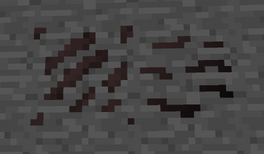
Small ores are relatively common single blocks that spawn throughout a dimension or around a matching vein. Their textures are thin and stripy compared to regular ores, as seen in the image to the right. Small ores are almost purely supplemental and should generally not be relied upon for specific ores, even if there are no regular ones of a particular type in that dimension or planet.
Small ores drop either a crushed ore, an impure dust, or even a gem if applicable. They may also drop a dust or impure dust of the stone type they were found in. Small ores cannot be harvested with silk touch, but fortune increases their overall yield. Small ores are always one mining level lower than their regular ore equivalent. For example, a copper-level pickaxe can mine iron-level small ores if necessary.
Small ores can be split into two different categories. Global small ores are random, sporadic, and not affected by nearby ore veins. Indicator small ores are also sporadic but they concentrate around ore veins and correspond to one of its ore types. The latter can be used to identify nearby ore veins if they are clearly not a global ore. For example, ruby small ores are not global ores in the Overworld so their presence indicates a nearby redstone vein. The following are all the global small ores in the first few dimensions. For a full list of global small ores, visit the Planets page.
Tools
There are several different tools available for locating and mapping ore veins. Overlays help identify where to look before mining or digging anything, JourneyMap records the locations of discovered ore veins on an easily accessible map, and prospecting gadgets identify the composition or ore veins without having to manually left-click ores.
Overlays
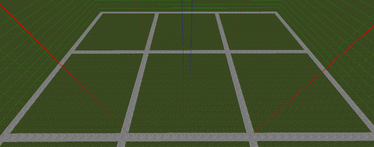
The GT Ore Vein chunk overlay is built into GTNH by default and is the recommended method for locating ore veins. To enable the overlay, press F9 three times while in-game. There should be several different colored lines all over the screen and the chat should say "Chunk Overlay: GT Ore Veins". The green lines mark the boundaries of the ore vein, the red lines mark the boundaries of the individual chunks, and the blue lines mark the center. Simply dig down (or up) around the blue lines to find the ores. Press F9 one more time to disable the overlay.
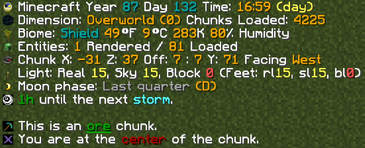
Alternatively, use the InGame Info XML overlay to identify which chunks are ore chunks without filling the screen with a bunch of lines. The overlay is in the top left corner of the screen by default and very clearly states "This is an ore chunk" when standing inside of one. Standing at the very center of the chunk additionally states "You are at the center of the chunk" which is again where you should start digging to find the ores. Adjust the settings or size of the overlay in mod options.
 |
 |
JourneyMap
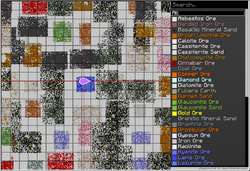
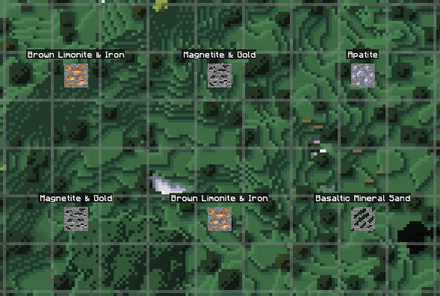
Once you find an ore vein, left-click one of the ores to formally discover it and add its location to Journeymap. A message should also appear in chat with the specific ores in the vein. Open the fullscreen JourneyMap by pressing "J" and select the "Show GT Ore Veins" option at the top. Zoom in to see the vein names or use the search bar in the bottom left corner to locate a specific one on the map. Double-click an ore vein to automatically set a waypoint and press the delete key to mark ore veins as depleted.
 |
  |
Prospecting
Prospecting tools identify the composition of ore veins within their range and automatically add their location data to JourneyMap without having to manually dig down and left-click one of the ores. These can save a lot of time and a lot of digging if used correctly. All but the Ore Finder Wand can also help identify fluid reservoirs for the Fluid Drilling Rig.

|
(Stone Age) The Ore Finder Wand alerts the player when they are near the specific raw ore, crushed ore, dust, or block in its filter. The Wand can sit anywhere in the player's inventory but only one is allowed at a time. Its search radius is 4 blocks horizontal and 60 blocks vertical for a total volume (LxWxH) of 9x9x121. When it finds the filtered ore, it flips upside down and makes a loud pulsing sound. |

|
(LV) The Prospector's Scanner can prospect all chunks within its range by right-clicking on stone or rock. However, the scanner loses durability in the process and there is a chance the scan fails and needs to be repeated. The tier of the scanner ranges from LV-UHV to improve its durability, range, success rate. |

|
(LV) The Seismic Prospector is a singleblock machine that prospects all chunks within its range but through a rather long and convoluted process. Activate the machine with explosives, right-click it with a data stick once finished, scan the data stick in a scanner, print the data with a printer, and finally assemble the printed pages into a readable book. The tier of the machine ranges from LV-EV to improve its range. |

|
(LuV) The Electric Prospector's Scanner can prospect all chunks within its range by right-clicking the air, or prospect the current chunk by right-clicking on stone or rock. The electric scanner also loses durability in the process but its range is much farther and is guaranteed to succeed. It even has a GUI for locating specific ores within the ore veins. The tier of the electric scanner ranges from LuV-UHV. |
Utility
Utility tools either make the wearer faster or provide some sort of utility to accelerate the process of running around and discovering new ore veins. These can save a lot of time and food if used correctly. Not included in this list is using /home from ServerUtilities to teleport around instantly.
In addition to these tools, do not forget to upgrade your pickaxe/hammer parts. Higher tier materials have a higher durability, mining level, and speed. See here for a list of all the best materials for each part. Also switch to a Tinker's Construct Hammer as soon as possible to mine nine blocks at a time instead of just one. That only requires a Tool Forge which is available after building the Bricked Blast Furnace.

|
(Steam Age) Piston Boots provide a jump boost, increase run speed, and grant a step-up enchantment. Together, that allows the wearer to jump up to three blocks in height and climb a single block without jumping at all. Piston Boots lose durability like all armor does, but can be repaired with leather in an anvil. |

|
(Steam Age) Forestry Digger and Miner Backpacks provide 15 extra slots of inventory space each and can automatically store certain items inside when picked up. The digger backpack is limited to dirt, gravel, stone, sand, etc. and the miner backpack is limited to ores, gems, nuggets, dusts, etc. The capacity of the backpacks can be upgraded to 45 slots each with woven silk in a carpenter. |

|
(MV) The Traveler's Belt provides an additional hotbar that can be instantly swapped out at the press of a keybind. This not only provides an additional 9 slots of inventory space, but it is extremely helpful for switching between different types of tools. Expect to use this throughout the entire game even after mining is no longer a manual task. Equip the belt as a bauble. |

|
(MV) The Traveler's Gloves does nothing by default but it comes with five modifier slots which can be used for haste to increase the mining speed of any tool. Simply combine the gloves with redstone in a crafting station or tool forge similar to any other Tinker's Tool and equip it as a bauble. Additional modifiers cannot be added to the gloves which means the maximum is 500 redstone. |
Tips
Once an initial ore chunk has been discovered, further placements are easy to find since there are always two empty chunks in between ore veins that do not lie on the (0,0) axis. Early on the only way of assessing the vein's content is to dig a two-block shaft straight down until the ore layer is reached. Bring ladders and remember they are only necessary every second block in 1.7.10. Another option is to make the shaft 2x2 blocks in size, creating a staircase that can safely be mined downwards in but also usable to get back up and down again at a later time if needed. Local deposits close to the player's base can be connected with underground tunnels for greater safety from mobs and quick travel.
There is no need to strip mine or search caves for resources. Each vein location can only have a maximum of a single vein unless adjacent ones overlap. This rarely happens except in the Deep Dark. Therefore, a single vertical shaft down the center of the chunk from the surface (or near surface) to bedrock generally covers all the possible y-coordinates that a vein could have generated at. If a vein is found before reaching bedrock, there is no reason to continue mining downward at that location.
Nether
When mining in the Nether, netherrack can be broken at much faster rates than any other dimension, especially when MV tier is reached and the Tinkers Construct Hammer can be crafted. On top of this, the Nether's world generation causes massive open areas which could easily lead to a lethal fall when mining shafts. Thus it's recommended to mine horizontally within the y-coordinate ranges for whichever ore vein types are sought. So if the mix type that contains Sulfur Ore generates between y5 and y20, mine horizontal tunnels within that range. Since veins are nine blocks high, mining at y12 with a hammer will expose any veins.
Another consideration is that Zombie Pigmen will aggro when mining ores in the Nether. One solution is using Miners which are incapable of being damaged by them, regardless of how many surround the machine and stare menacingly at it.
 Caution: | Very technical documentation ahead. This marks the end of the article for most players. |
Vein Composition
Mix Veins can be a varying width and length depending on randomness and a configuration value called size. Each different mix type has a size value set for it. For programmers the min and max x and z values are defined by the following code, regular users can just read the table after.
Due to the way random chunk sizes are generated, it is more likely for a chunk to be of average width or length than to have an exceedingly high or low width or length.
// Determine West (inclusive)/East (exclusive) ends of orevein
int wXVein = aChunkX - aRandom.nextInt(this.mSize);
int eXVein = aChunkX + 16 + aRandom.nextInt(this.mSize);
// Where aChunkX is just the world (block) x-coordinate of the western side of the chunk where the vein is being generated

// This code is duplicated for the Z values
// Determine North (inclusive)/South (exclusive) ends of orevein
int nZVein = aChunkZ - aRandom.nextInt(this.mSize);
int sZVein = aChunkZ + 16 + aRandom.nextInt(this.mSize);
// Where aChunkZ is just the world (block) z-coordinate of the northern side of the chunk where the vein is being generated

// Note that nextInt() generates a random number from 0 (inclusive) to the parameter (exclusive)
| Size | minWidth | maxWidth |
|---|---|---|
| 8 | 16 | 32 |
| 12 | 16 | 40 |
| 16 | 16 | 48 |
| 24 | 16 | 64 |
| 26 | 16 | 68 |
| 30 | 16 | 76 |
| 32 | 16 | 78 |
As you may have seen a pattern, the minimum is always 16 blocks, and the max is (2 * size) + min
Let's use the Iron mix type as an example. This mix type has a size value of 24. Meaning that the width could be anywhere between 16 and 64 meters/blocks, and same with the length (width and length could be the same, but more commonly will not match due to the random factor.)
The one exception is size 32. The reason is that after calculating the width/boundaries, the ore vein is moves 2 blocks east and 2 blocks south, to "avoid worldgen cascade" (?). However, chunks more than 32 blocks away from an ore chunk in either the x or z direction do not actually generate ores from that ore vein, so 2 blocks are cut off from the vein.
Mix Veins have varying densities depending on the distance of the chunk from the ore chunk and a configuration value called density. Each different mix type has a density value set for it. For programmers the local density of a chunk is defined by the following code, regular users can just see the grid after with the factors by which density is affected (with rounding down).
//aChunkX, aChunkZ: x and z coordinates of the northwestern block of the chunk
//aSeedX, aSeedZ: x and z coordinates of the northwestern block of the ore chunk
int localDensity = Math.max(1,
            this.mDensity / ((int) Math
                .sqrt(2 + Math.pow(aChunkX / 16 - aSeedX / 16, 2) + Math.pow(aChunkZ / 16 - aSeedZ / 16, 2))));
| 1/3 | 1/2 | 1/2 | 1/2 | 1/3 |
| 1/2 | 1/2 | 1 | 1/2 | 1/2 |
| 1/2 | 1 | 1 | 1 | 1/2 |
| 1/2 | 1/2 | 1 | 1/2 | 1/2 |
| 1/3 | 1/2 | 1/2 | 1/2 | 1/3 |
The maximum size of any existing vein is 32, which is 2 chunks either side of the ore chunk. The local density is only reduced by the factor in the grid if it will result in a density of at least 1 when rounding down. So only ore veins with a density of at least 3 see the full effect at the corners and only ore veins with a density of at least 2 see any effect at all. As is about to be demonstrated, a reduction in the local density by a factor of 1/2 actually corresponds to a reduction in density by a factor of 1/4, and 1/3 by 1/9, and there are further reductions as the chance of an ore generating is then affected by its distance from the center of the ore vein. An ore spawns at (tX,tZ) if both random numbers between 0-placeX and 0-placeZ exclusive are 0, where placeX and placeZ are calculated using:
// tX, tZ: block coordinates
// wXVein (inc), eXVein (exc), nZVein (inc), sZVein (exc): coordinates of edges of ore vein
int placeX = Math.max(1, Math.max(MathHelper.abs_int(wXVein - tX), MathHelper.abs_int(eXVein - tX)) / localDensity);
int placeZ = Math.max(1, Math.max(MathHelper.abs_int(nZVein - tZ), MathHelper.abs_int(sZVein - tZ)) / localDensity);
Since the maximum localDensity for any ore vein is 7, and the minimum width for any ore vein is 16, we will never have to use the first branch of the max condition, so the proportion chance of an ore generating simplifies to localDensity^2/([(wx + 1) // 2 + dx]*[(wz + 1) // 2 + dz]). Here wx and wz are the widths of the vein, and dx and dz are the distance from a center block in the vein, where if the corresponding width is even the center block is the easternmost/northernmost center block, and if the corresponding width is odd the center blocks are the center block and the block to the east/north of the center block. The distance from a center block to itself is 0. The maximum ore generation proportion you can have is 0.765625 at the very center of the smallest possible Lignite Coal vein, and the minimum is 0.0009765625 at the northwestern edge of a maximum size magnetite or gold vein. Note that the proportion is before checking if the block is actually valid to place an ore in (is stone, netherrack, end stone, granite, etc.).
The code determines whether to attempt to generate an ore type using the proportion using the priority: inbetween, primary/secondary, sporadic. The code only decides whether to generate the next type if the previous types were not attempted to be generated. Inbetween ores have an additional multplier of 1/2 to their generation and sporadic ores have an additional multiplier of 1/7. If the code decides to attempt to generate an ore type, it will check if the block is one that can be replaced with an ore (stone, netherrack, end stone, granite, etc.) and replace it if so. If this fails, the code does not try to generate any more of the ore types; it only does so when it decided not to attempt placing the other types of ore at all.
Ore Generation Process
Vein generation takes place as a series of steps. First the world generator locates a position for a new vein to be generated based on a formula (Vein Location). Next the generator creates a random number that is used to select which mix type should be used for this new vein. If the selected mix type is not allowed to generate in the dimension, this process is repeated in that a new random number is generated to hopefully select a new mix type. This process is repeated eight times until a valid mix type is found for the dimension. If after eight attempts a mix is not found, the generator will move onto the next location and start over. If a mix is found that works in the dimension, a new random number is created to determine the y-coordinate (vertical position) for where the vein should be generated; as well as generating the width and length values of the vein as explained in Mix Veins. Finally, the vein is generated. However remember that a mix vein requires a stone type to be able to generate. If the vein places 0 ores in the bottom layer, another mix is attempted (up to a maximum of eight placement attempts). So if the y-coordinate generated positions the veins in the air, or in non-stone type blocks, the ores will not be generated.
Detailed Explanation
Before the explanation, note that in addition to the size value assigned to each mix type, there is also a minY, maxY, weight, and density value.
The world generator looks for any ore chunks, whose locations are based on the formula explained in (Vein Location), and whose veins could overlap with a chunk it is generating. Since the maximum size of ore veins is 32, this means looking in a 2 chunk radius around the chunk. For each nearby ore chunk, the generator then begins a loop that we will call LoopA, which will run until placementAttempts is incremented 8 times, or until stopped due to a successful placement of an ore vein. Since the loop runs for each ore chunk all overlapping ores in the ore chunk will be placed, traversing nearby ore chunks from northwest to southeast by running lines west to east. I am not sure if placed ores can be rewritten, but my prior is that they cannot. For each cycle in this loop, a random number is generated between 0 (inclusive) and the total weight (exclusive) of ALL mix types loaded in memory (regardless of dimension). This number is assigned to a variable that we will call W.
While still inside LoopA, a new loop, which we will call LoopB is started which loops through every mix type (again, regardless of dimension). Each cycle will subtract the mix type's weight from W and reassign it to the new value. W = W - mixWeight; Then it checks if W is equal to or less than 0; if yes, then the generator will attempt to use the last used mix type to fill in the chunk. If the generation succeeds or the ore vein does not overlap with the chunk and there is no air block in a certain spot described later, LoopA is stopped and the generator moves to the next ore chunk to restart the whole process. If the generation fails because of incorrect dimension, then LoopA repeats, generating a new W value and so on. If the generation fails because no ores could be placed on the bottom layer of the ore chunk due to air or dirt, placementAttempts is incremented and compared against 8, then LoopA repeats, and so on. If the ore vein does not overlap with the chunk but the block at the southwestern center of the chunk and on the 2nd-most bottom layer of the ore vein is an air block, placementAttempts is incremented and compared against 8, then LoopA repeats, and so on. This is the only part of the code where the ore vein generation is not determined by the ore chunk itself, and has the effects of biasing ore generation towards ore veins with larger sizes which overlap with air-blocked nearby chunks and avoid the re-selection of a new mix type. It also biases against high-altitude veins, since those are more likely to have air blocks in nearby chunks at their y-level, but this is also probably the reason this is done, since it means attempting to generate a high-altitude vein in a low-altitude location doesn't use up a placementAttempts. These biases only occur if the chunks around the ore chunk are loaded before the ore chunk itself. If LoopA executes 8 times without generating a vein, an empty vein will be placed. Note that the RNG for mix types is always the same since it is only dependent on the world seed, dimension, chunk X and Z coordinates, and the primary ore, so attempting to place the same mix type at an ore chunk will always either fail or succeed. Successfully generated veins are saved so that other nearby chunks to the ore chunk don't generate new veins.
Upon generating the vein, the generator first picks where the vein will generate along the y-axis (vertically). The location is yet again random, however is confined using the minY and maxY values and defined using this formula:
yPos = minY + aRandom.nextInt(maxY - minY - 5);

// Note that nextInt() generates a random number from 0 (inclusive) to the parameter (exclusive)
An example: Some mix type has the min and mix values of 10 and 90. According to this formula, the position (vertically) could be any number from 10 to 84.
The bottom-most layer of the vein is generated 1 block below the y-position generated by this formula.
Ore Vein Location
The locations of veins are extremely important to know in order to mine efficiently. All mix veins are generated at specific locations defined by a mathematical formula. For programmers you can see the formula from the code here:
if ((Math.abs(this.mX / 16) % 3 == 1) && (Math.abs(this.mZ / 16) % 3 == 1)) {...}
In simpler form, the world generator will attempt the generation process wherever the formula holds true for any given chunk coordinates. Block coordinates you should be familiar with already, they are used to identify the 3-Dimensional location of any block in the world. Chunk coordinates however are used to identify the 2-Dimensional location of any chunk in the world. A chunk has a volume of 16 blocks wide, by 16 blocks long, by 256 blocks tall. Block coordinates can be represented like this (x, y, z) where x and z are horizontal, and y is vertical (from bedrock to the sky). Since chunks are always 256 blocks tall, the height of the world, a Chunk coordinate is represented like (x, z), with only an x and z.
The formula is true whenever a chunk's x and z coordinates follow the following comparison: |x| mod 3 = 1, and |z| mod 3 = 1. Now what does this mean? First check if either x or z is negative, and make it positive. So for example, if x is -5, change it to positive 5 instead. Next divide the new x and z values by 3 and count any remainders. If the remainder of the x division, and the remainder of the z division, both equal 1, then that chunk is where the generator would have attempted to generate a vein.
Trivia
- The only non-GregTech ore generation that remains enabled is sporadic emerald ore in the overworld, hollow hills in the Twilight Forest, and nether quartz around hives in the Nether.