GT New Horizons · Highly Ultimate Voltage (UHV)
Integrated Ore Factory
The Integrated Ore Factory (IOF) is a UHV tier multiblock that does all ore processing in a single step. It is designed to completely replace any existing ore processing setups, improve overall throughput, and save on lag. The IOF is unlocked shortly after the Space Elevator which is when the player begins accumulating a massive amount of ore and needs an easier/faster way to process it all into dusts. The IOF supports all ore variants (crushed, purified, etc.) and can even process different recipes simultaneously if there are enough parallels available. The total number of parallels scales linearly with the input power and has no upper limit. Byproducts are generated based on the current mode of the IOF. There are seven modes in total for the seven different ore processing paths (sifting, ore washing, chemical bathing, etc).
Construction
The IOF has no tiered components. The glass can be any tier and has no effect on the operation of the machine. Buses/hatches may replace any stainless steel machine casing anywhere on the structure. Multi-amp and laser energy hatches are supported for serious throughput. Use the Multiblock Structure Hologram Projector to visualize/build the structure with subchannel "glass" to specify the tier of the glass.
Assuming the Component Assembly Line is NOT used for component parts, one IOF requires 7.21k neutronium, 3.89k iridium, 3.03k cosmic neutronium, 3.02k naquadria, and 880 bedrockium to build, among other things.
Structure
- Controller: Front center, 3rd layer
- 462 Advanced Iridium Plated Machine Casing
- 0-163 Clean Stainless Steel Machine Casing
- 98 Iridium Sheetmetal
- 90 Any Tiered Glass
- 23 Stainless Steel Frame Box
- 7 Awakened Draconium Coil Block
- 7 Titanium Gear Box Casing
- 7 Large Sieve Grate
- 7 Grate Machine Casing
- 7 Centrifuge Casing
- 1 Energy Hatch: Any stainless steel casing
- 1 Maintenance Hatch: Any stainless steel casing
- 1 Muffler Hatch: Any stainless steel casing
- 1+ Input Bus: Any stainless steel casing
- 1+ Input Hatch: Any stainless steel casing
- 1+ Output Bus: Any stainless steel casing
Wallsharing
IOFs may wallshare each of their sides to save on casings, sheetmetal, frame boxes, and buses/hatches. Overlapping the bottom layer with another one directly underneath and upside down is the most effective and highly recommended. However, do not share the energy hatch because the machine pulls as many amps as possible while there are still parallels available.
Usage
The IOF can process almost any ore in GTNH including their variants (crushed, purified, etc). Every ore costs a flat 30 EU/t, 2L of lubricant, and 200L of distilled water. Recipes with other inputs, such as sodium persulfate for chemical bathing, still require them in addition to the default costs. The processing speed depends on the power provided and the mode of the machine.
There are seven modes in total for the seven different ore-processing paths, listed below. Switch between modes in the GUI of the controller or by right-clicking the controller with a screwdriver. Sneak right-click the controller with a screwdriver to automatically void stone dust.
| Mode | Path | Duration | Max Throughput |
 M1 |
Macerate → Ore Washer → Thermal Centrifuge → Macerate | 30 s | 357,914 /s |
 M2 |
Macerate → Ore Washer → Macerate → Centrifuge | 15 s | 715,828 /s |
 M3 |
Macerate → Macerate → Centrifuge | 10 s | 1,073,742 /s |
 M4 |
Macerate → Ore Washer → Sifter | 20 s | 536,871 /s |
 M5 |
Macerate → Chemical Bathing → Macerate → Centrifuge | 17 s | 631,613 /s |
 M6 |
Macerate → Chemical Bathing → Thermal Centrifuge → Macerate | 32 s | 335,544 /s |
 M7 |
Forge Hammer → Forge Hammer → Simple Washer | 1 s | 10,737,418 /s |
All ore processing recipes are LV tier which is where the base times and power costs originate. The IOF does NOT overclock at all but it adds one parallel for every 30 EU/t provided. There is technically no upper limit on the number of parallels, but it still caps out at 10,737,418 or 322,122,540 EU/t due to the max integer limit on distilled water. That means exceeding 256A UHV has no effect on the operation of the machine, and adding more ME stocking input hatches to supply more than 2B distilled water at once also does not help.
Automation
Most (if not all) ores are sourced from Space Elevator Mining Modules and Void Miners in the Deep Dark by this stage in the game. Therefore, the following guide assumes that those are the only sources of ore and that everything enters the ore processing subnetwork through an AE2 wireless connector or quantum bridge. Other sources of ore may not follow these filters exactly as intended.
An alternative to the following is to ignore subnetworks altogether and process all ores on mode 2 (to maximize byproducts) or mode 7 (the quickest). However, that completely neglects any mode-specific byproducts, such as zirconium from tin ore, and returns only dusts. At least have a sifting mode so gems do not always have to be made in the Electric Implosion Compressor.
| STEP 1 | |
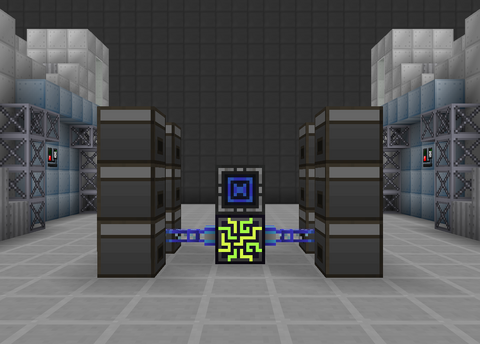
| Build the main ore network (blue) with an ME controller and 1-3 ME Chests per IOF mode. Ores are inputted through a wireless hub, but there could also be a quantum bridge.
Prepare a 16,384k ME storage cell for each ME chest, but do not insert them yet. Their high capacity and types is perfect for ore processing. |
|
| STEP 2 | |
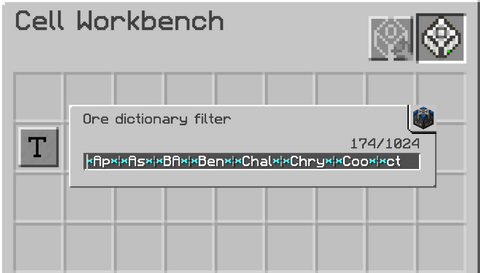
| Use a cell workbench to partition each storage cell in accordance with the table below, or use the ore dictionary strings at the very bottom. Do not include any storage cells without at least one ore filtered unless it has a lower priority than the rest and serves as a catchall.
Regardless of the filtering method used, this allows for maximum control over each ore and is highly flexible to changes. Filtering storage buses is NOT recommended because then the settings cannot be copy-pasted and there needs to be storage cells to hold the ores anyway. |
|
| STEP 3 | |
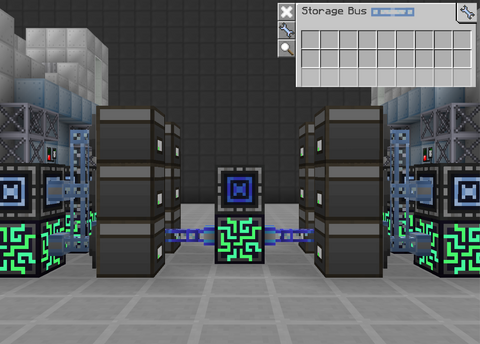
| Build each of the four ore subnetworks (light blue) with an ME controller, wireless hub, and ME storage buses set to EXTRACT ONLY.
The subnetworks only see the ores in the adjacent ME chests, which have already been filtered in the previous step. Link the wireless hub on each subnetwork to an advanced stocking input bus on the IOF(s). Do not forget to change their operating mode and sneak right-click with a screwdriver to automatically void stone dust. |
|
| STEP 4 | |
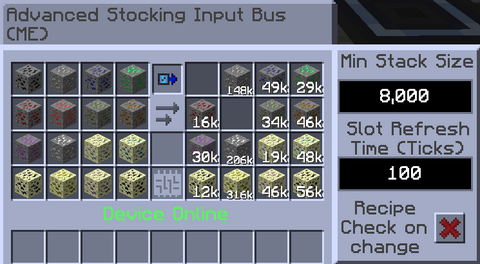
| Configure the advanced stocking input bus to AUTO-PULL with a MINIMUM STACK SIZE of 8,000 (may need to increase later on). Reducing the refresh time could also help but that is bad for performance.
Parallelize this setup by connecting more IOFs to the same subnetworks. An ME stocking input hatch and the ME output bus (not shown) connect directly to the main storage network. |
|
Sorting (Optional)
The following table is the recommended sorting for all ores in GTNH, almost entirely based on byproducts. Partition storage cells in a cell workbench or use the oredictionary strings at the bottom to automatically filter ores as they enter the network. Always use the GregTech version of the ores unless specifically told otherwise or there is only a Bartworks version.
- Ores not highlighted require only their OVERWORLD variant filtered.
- Ores highlighted yellow require their OVERWORLD and END variant filtered.
- Ores highlighted red require their OVERWORLD, NETHER, and END variant filtered.
The ores labeled [MABS] under M4 are returned as their purified variants which are then used in the Mega Alloy Blast Smelter to make other rare metals. The ores in the "Other" column are those that should be filtered elsewhere because they are either useless or serve a very specific purpose.
Bastnasite and monazite ore are integral to the Bastnasite Line and Monazite Line, respectively. Crushed Lead ore is smelted into Tellurium nuggets in the Exothermic Hearth, but can be voided as soon as Tellurium is available directly. Cheese ore is used to craft the portal to the Deep Dark but can otherwise be voided. Rubidium ore is used to craft the T10 Deep Dark planet block for the Eye of Harmony but otherwise can be processed in M2 for mixing Mellion. Pumice ore is also used to craft the T10 Deep Dark planet block but otherwise can be voided. The remaining ores may all be voided, especially oilsands ore because it breaks the IOF, and the dusts/items may all be sent directly to the main network for storage.
| M1 (30s)
|
M2 (15s)
|
M3 (10s)
|
M4 (20s)
|
Other |
|
|
|
|
|
Ore Dictionary Strings
Instead of filtering every individual ore by hand, enter each of the following bullets into ore dictionary cards and insert them into storage cells or ME storage buses. Each mode totals under 1,024 characters but both M2 and M3 are split up across three bullets because they require more than 63 types anyway. The string for the other category does not include clay, the draconic core, or the draconic core schematic because those do not have an oredict tag. Triple left-click to highlight the entire bullet at once.
 Important: | The following is designed for an ore subnetwork connected to Space Elevator Mining Modules and/or Void Miners in the Deep Dark. Other sources of ore may not follow these filters exactly as intended. |
| Mode | Ore Dictionary Strings |
| M1 (30s)
|
|
| M2 (15s)
|
|
| M3 (10s)
|
|
| M4 (20s)
|
|
| Other |
|
Trivia
- The Multi Smelter and Entanglement Apparatus are the only other multiblocks that can process different recipes simultaneously.