GT New Horizons · Insane Voltage (IV)
Tree Growth Simulator
The Tree Growth Simulator (TGS) is an IV tier multiblock for automatically growing and harvesting trees digitally. The TGS is a direct upgrade from the EnderIO Farming Station or the Crop Manager because it is significantly faster and more efficient. The trees are also not physically placed in the world to prevent lag. The TGS only requires a sapling in the controller, a specific GregTech Tool in the input bus to specify what to harvest, and power. Saws produce logs, branch cutters produce saplings, shears produce leaves, and knives produce fruits. Some trees naturally produce more resources than others, like the giant sequoia which produces far more logs than any other sapling. The recipe length is fixed at 5 seconds, but more power and better tools can significantly multiply the number of outputs per iteration.
Construction
The TGS has no tiered components. The glass can be any tier and has no effect on the operation of the machine. Buses/hatches may replace any casing anywhere on the structure. Stocking input buses and crafting input buses are not supported. Multi-amp and laser energy hatches are also not supported, but there can be multiple regular energy hatches for overclocking. The oak logs and leaves are spawned for free once the structure is formed and therefore do NOT need to be placed manually. Use the Multiblock Structure Hologram Projector to visualize/build the structure with subchannel "glass" to specify the tier of the glass.
Structure
- Controller: Front bottom center
- 60 Steel Frame Box
- 57 Any Tiered Glass
- 45-55 Sterile Farm Casing
- 25 Dirt or Grass
- 1+ Energy Hatch: Any casing
- 1 Maintenance Hatch: Any casing
- 1 Muffler Hatch: Any casing
- 0+ Input Bus: Any casing
- 0+ Output Bus: Any casing
- Mandatory Air: Interior center column
Wallsharing
TGSs may wallshare each of their sides to save on casings, frame boxes, glass, and buses/hatches. No recipe uses more than 1A of power so it is possible to share one energy hatch between two machines.
Usage
The TGS is a direct upgrade from the EnderIO Farming Station or the Crop Manager because it is significantly faster and more efficient at growing and harvesting trees. The recipe length is fixed at 5 seconds, but there is an output multiplier based on the tier of the energy hatch to scale production. The base outputs vary with the type of tree being grown although it is generally 5 logs, 5 saplings, 2 leaves, and 2 fruits.
| LV | MV | HV | EV | IV | LuV | ZPM | UV | UHV | UEV | UIV | UMV | UXV | MAX | MAX+ | |
| Multiplier | 5 | 9 | 17 | 29 | 45 | 65 | 89 | 117 | 149 | 185 | 225 | 269 | 317 | 369 | 425 |
The tool in the input bus determines the specific output that the TGS produces. There can be multiple tools and even different types in the same input bus to collect multiple outputs simultaneously. Some tools are better than others and apply a second multiplier on the output. The list of supported tools and their multipliers are listed below. Electric tools that run out of energy are passed to the output bus for retrieval.
- Logs - Saw (x1), Buzzsaw (x2), Chainsaw (x4)
- Saplings - Branch Cutter (x1), Grafter (x4)
- Leaves - Shears (x1), Wire Cutter (x2), Automatic Snips (x4)
- Fruit - Knife (x1)
The best sapling is the giant sequoia because it has the highest base amount of logs (80) while still producing a base 5 saplings and 2 leaves like every other tree. For comparison, that is nearly twice as much as the second best option and much greater than the usual 5-10 logs with most trees. The Barnarda C sapling is another very common choice because Barnarda C wood is required for radox.
Automation
The challenge in using the TGS effectively is separating any electric tools from the rest of the products, recharging them, and inserting them back into the machine. GregTech methods for charging tools (battery buffers, turbo chargers, etc.) do not make their contents available for extraction and therefore cannot be used for automation.
Alternatively, use multiple non-electric tools with a very high durability. They may produce less resources but they hardly ever need to be replaced. Oriharukon, orichalcum, and draconium are all good options. Even multiple electric tools do not need to be recharged very often.
Method 1: IndustrialCraft
The core mechanic of this approach is using an MFSU to recharge tools. The MFSU and the MFE are the only charging stations that work with GregTech tools and make their contents available for extraction. The input bus to the TGS is limited to one slot to prevent any tools from leaving the MFSU before they are fully charged. This approach is simple and scales well, but it requires two of each tool to work. For example, two chainsaws are needed instead of one to maximize runtime and block the input bus.
| STEP 1 | |
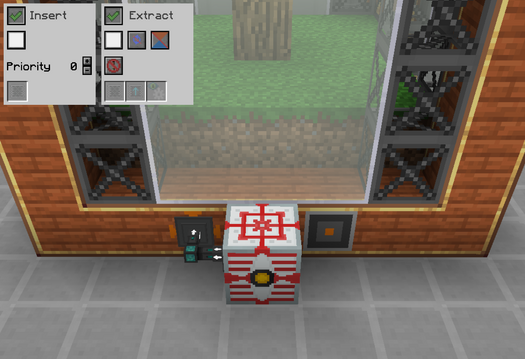
| Build the TGS with a ULV input bus and ME output bus. This intentionally prevents more than one tool from entering the machine, but could be larger based on the number of tools available. Craft at least 2 tools.
Place an MFSU nearby and charge it with any GregTech cable at any voltage. An MFE also works although it is slightly slower. Use an item conduit to pull tools from the MFSU and send them to the input bus. The tool charging inside the MFSU does not leave until there is room inside the input bus. That only happens when the active tool runs out of charge and is moved to the output bus. |
|
| STEP 2 | |
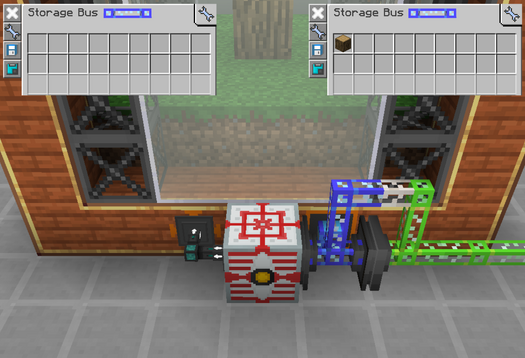
| Build out the TGS subnetwork (blue) in front of the ME output bus. Place a storage bus set to INSERT ONLY on the MFSU with no filter. Non-electric items cannot go in the MFSU so this is a way to filter for any electric tools.
Place another storage bus set to INSERT ONLY facing into an ME dual interface on the main network (green). Filter this storage bus to the resource(s) being produced to store them elsewhere, or use an ME chest with a partitioned storage cell to store them on the subnetwork instead. Power the TGS subnetwork with a quartz fiber cable. Upgrade to a neutronium energy anchor later on for better performance in the late game. |
|