GT New Horizons · Insanely Ultimate Voltage (UIV)
Insanely Ultimate Voltage (UIV)
Insanely Ultimate Voltage (UIV) is the eleventh electric tier in GregTech: New Horizons. Its focus is scaling the DTPF, unlocked in the previous tier, with improved coils and new sources of catalyst, in order to afford more advanced materials and progress to UMV. It also introduces new, extremely powerful multiblocks such as the Forge of the Gods, as well as the final Creative items and the end of Draconic Evolution progression. UIV is generally considered to mark the transition from lategame to endgame.
Progression
DTPF Coils
At the start of UIV, the player's DTPF is likely equipped with a set of Infinity coils, which can be used for the Hypogen loop in addition to being required for Tesseracts. The first goal is to use the Hypogen loop to produce the 19,008 ingots worth of Hypogen required to make Hypogen coils.
With Hypogen coils, new recipes become available, the most notable of which is SpaceTime, needed for the final coil upgrade, Eternal coils. The SpaceTime recipe available with Hypogen coils is incredibly inefficient, requiring one Tesseract, 16 Infinity, 8 Hypogen, and 10 kL of Dimensionally Transcendent Residue for a single ingot of SpaceTime. A much better recipe is unlocked with Eternal coils, which removes the Hypogen input and is four to eight times as efficient on other inputs, including time, but a full Eternal DTPF requires 20,064 ingots of SpaceTime to make, assuming the much better Black Hole Compressor recipe is used for the Eternal Singularities. In order to achieve this, SpaceTime should be passived and overclocked, and spending SpaceTime on anything other than Eternal coils should be avoided whenever possible.
Eternal coils are effectively the gate for UMV because of how much SpaceTime the tier's components use, and because they are needed for UMV Superconductor Base and Shirabon, both materials required in UMV.
Transcendent Plasma Mixer
The Transcendent Plasma Mixer (TPM) is a multiblock specialized for making DTPF catalyst extremely quickly. It can make each tier of catalyst in a single step, taking 5 seconds per recipe, and can run any number of parallels as set in the GUI, similar to the Waterline multiblocks. Rather than drawing power every tick, like most multiblocks, it draws power directly from the wireless network at the start of each recipe cycle; as a result, players who have not already started moving power storage into the wireless network will need to do so to run the TPM. The TPM is very power-hungry, even with its perfectly efficient parallels, and will likely be the largest power consumer in most players' bases in UIV. It is also used to produce three new materials, of which only Creon is relevant in UIV: Creon and its counterpart Mellion are needed for the Godforge.
UMV Circuits
Pico Circuits, the only UMV circuit, can be made in the Assembly Line as soon as it is equipped with UIV Energy Hatches to overclock it to UMV. Each circuit takes 500 seconds, and cannot be run in the Advanced Assembly Line until it has a UMV Laser Target Hatch, so it is recommended to use a large amount of 8-hatched regular Assembly Lines for early Pico Circuits. Another option is to prioritize UMV Laser Hatches with the first few Pico Circuits in order to be able to produce them in an Advanced Assembly Line; Laser Hatches do not require superconductors, and therefore can be made before Eternal Coils, albeit at a steep SpaceTime cost.
Fusion Mk5
The Mk5 Fusion Reactor, optional in UEV, becomes more important in UIV, although still not strictly required. It is primarily needed for the Godforge, which requires Creon (which needs Thorium Plasma), Lead Plasma, and Plutonium 241 Plasma, all of which require a Mk5 Fusion Reactor to make. The Compact Mk5 also provides an at least 4x speedup on all previous fusion recipes, which is especially important for many slow Mk4 recipes that are heavily used in UIV, so it should be prioritized even though it's not strictly required yet.
Black Hole Compressor
The Pseudostable Black Hole Containment Field (typically called the Black Hole Compressor or BHC for short) is a highly advanced multiblock version of the Compressor and Neutronium Compressor. It is required for new, more efficient recipes for the Eternal Singularity, Sphaghettic Singularity, and Cryptic Singularity, as well as for Superdense Plates of some high-tier materials such as SpaceTime and Transcendent Metal. The Eternal Singularity recipe, which only requires 72 L of SpaceTime, is of particular interest due to the requirement for Eternal Singularities for Eternal Coils. However, it is fairly complicated to automate, and requires inserting a Black Hole Seed every time a recipe is run, and a Black Hole Collapser some time after to prevent recipes from being voided; as a result, it is rarely used for recipes that do not require it, despite the large improvements to speed and efficiency that it offers over the Hot Isostatic Pressurization Unit and Neutronium Compressor.
Forge of the Gods
See More: Forge of the Gods

The Forge of the Gods (Godforge for short) is an extremely powerful multiblock for smelting and related operations. The Godforge itself is only the central structure, and cannot run any recipes; recipes are instead processed by modules that can be fit around the tube-like structure between the front and the rings. Like the TPM, all Godforge modules draw power directly from the wireless network.
The Godforge has an upgrade tree, where upgrades that allow for new modules, improved processing capability, and other improvements can be purchased using a currency called Graviton Shards. Graviton Shards are unlocked by completing milestones relating to using the Godforge and improving its structure. In order to enter UXV, it is necessary to reach the END upgrade, the final upgrade in the Godforge's upgrade tree. Because this requires completing most of the Godforge's milestones, it is recommended to build it and begin progressing its milestones sooner rather than later.
Helioflare Power Forge
The Helioflare Power Forge is a very powerful EBF with access to thousands of parallels and billions of EU/t for each, making slow EBF recipes like Transcendent Metal no longer a bottleneck. It is also required for Saturated Phononic Crystal Solution, which has a heat requirement too high to reach in any other machine, and which is needed for all other Godforge modules.
Helioflux Melting Core
The Helioflux Melting Core is a variant of the Helioflare Power Forge that outputs molten metal directly instead of hot ingots, and therefore allows skipping the often-slow Vacuum Freezer. Other than this output change, the recipes are identical to standard EBF recipes, meaning there is no speed penalty to switching recipes to the Melting Core other than the different stats between each Godforge module. These stats can be seen in the calculator in the main Godforge GUI, but the Melting Core is generally better due to how poorly the Vacuum Freezer scales.
Heliothermal Plasma Fabricator
The Heliothermal Plasma Fabricator converts materials into their plasma forms directly. It can only make simple plasmas at first, and requires Godforge upgrades to unlock T4-T5, multi-step, and exotic plasmas. It can be used to make plasmas that have no fusion recipe, such as Copper Plasma for an improved Metastable Oganesson recipe, as well as to improve on the speed of plasmas whose fusion recipe is particularly slow, such as Calcium Plasma.
Heliofusion Exoticizer
The Heliofusion Exoticizer is used to produce two types of exotic matter: Quark-Gluon Plasma (QGP) and Magmatter. Both types require a complex automation challenge to be solved in order to produce the material. QGP has only one use before making the Stargate, an improved Rhugnor recipe, making it not a high priority, and Magmatter is only unlocked with the END upgrade but is needed to advance to UXV. Despite the fact that neither material is immediately useful, it is still beneficial to make and place a Heliofusion Exoticizer to advance the Composition milestone.
Infrastructure
Power
UIV continues to scale power demands, causing Naquadah Fuel to begin to fall off and plasma to fall out of viability. However, unlike UEV, it also introduces two new methods of power generation: Dyson Swarms and Antimatter. It also adds the first Wireless Energy Hatches, which greatly simplify power distribution logistics.
Naquadah Fuel
Naqfuel is still viable in UIV, but it struggles to keep up with the new power generation options added in the tier. The DTPF can be used to produce Chromatic Glass and Hypogen for the improved recipes for Naq3 and Naq4, as well as Infinity for Naq5, and with the TPM it is possible to make Creon and Mellion for the improved Naq5 recipe as well. In addition, Transcendent Metal can be used to make Tier 3 coils for the Naquadah Fuel Refinery, which are necessary for the improved Naq5 recipe and quadruple the speed of previous recipes. Naqfuel can also build into Antimatter, as depleted Naq5 and Naq6 are both additives that can be used to improve antimatter production in the SSASS.
Dyson Swarm
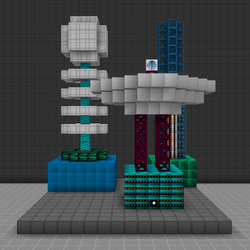
The Dyson Swarm Ground Unit (Dyson) is a new power generation multiblock that is unlocked with UMV circuits. It can produce 337B EU/t when placed on the planet Horus, which is the only place Dysons should be built, at the cost of 3.6 ML of Gelid Cryotheum and 64 Dyson Swarm Modules every hour, as well as one or more Quantum Computers making at least 100,000 Computation. In order to transport the power back from Horus, a Lapotronic Supercapacitor should be used to send it into the wireless network; this can be replaced with an Energized Wireless Dynamo Hatch in UMV.
Antimatter
Antimatter, which is one of the two viable sources of power in the endgame (the other being the Eye of Harmony), is first unlocked in UIV. Producing power with antimatter requires first generating it using a Semi-Stable Antimatter Stabilization Sequencer with various additives, and then annihilating it with regular matter in a Shielded Lagrangian Annihilation Matrix. Although antimatter can be extremely powerful in later tiers, in UIV it is fairly weak due to not having access to UMV- and UXV-tier additives like Magmatter, Eternity, Shirabon, and UMV Superconductor Base, being limited to only a couple tens of trillions of EU/t, making it much more effort than comparable power production from Dysons.
Wireless Energy
Wireless Energy Hatches can be made using SpaceTime; they are energy hatches that draw power directly from the wireless network, simplifying logistics and preventing lag from wire network calculations. However, in UIV, the only wireless energy hatches available are non-multiamp ones for UEV and below, since UIV Wireless Energy Hatches require UXV circuits, and multi-amp Wireless Energy Hatches require Shirabon. The UIV Capacitor is also unlocked in UIV, and can provide up to 100T EU/t to very power-hungry multiblocks like the DTPF, CoAL, and AAL for which the 1T EU/t of the UEV capacitor can be insufficient.
Crafting Input Proxy
The Crafting Input Proxy is the endgame solution for on-demand parallelization of multiblocks. Crafting Input Proxies can be placed on any multiblock and linked to a Crafting Input Bus or Buffer (Crib) using a Data Stick. When AE2 pushes a recipe to a machine using a Crib, it will push that same recipe to all linked Crafting Input Proxies as well. Crafting Input Proxies do not require power or channels, and an unlimited number of them can be linked to the same Crib, making them extremely powerful for scaling processing capacity to meet the demands of lategame.
Space Elevator
The first Space Elevator improvement available in UIV is Mk3 motors, which only require Transcendent Metal and some UEV components. These motors unlock three new module slots, for a total of 15, requiring the expansion to the Space Elevator to be built in order to use them. They also provide the ability to use upgraded versions of all three module types.
The Mk3 Mining Module works twice as fast as the Mk2 one, but its main selling point is its access to Tier 3-gated asteroids. The most notable resources it unlocks include Americium, Ichorium, Tengam, and pure Platline dusts.
The Mk2 Assembler Module is much faster than its Mk1 counterpart, up to 16 times depending on recipe. It also unlocks improved recipes for Optically Compatible Memory and Optically Perfected CPU that are faster and more efficient, at the cost of using higher-tier materials.
The Mk2 Pumping Module has the ability to run four recipes at a time, each of which runs at the same speed as a Mk1 Pumping Module. Multiple recipes can target the same fluid, meaning that the Mk2 Pumping Module can be as much as four times the speed of a Mk1 if all recipes are for the same fluid, or it can be used to collect many more distinct fluids at the same time. However, it requires SpaceTime to craft, making it more expensive than the other two modules above.
Component Assembly Line
The UIV Component Assembly Line (CoAL) is generally not considered very useful. It requires large amounts of Transcendent Metal, which is very slow to produce before the Godforge, and there are few recipes that specifically require UIV components outside of the Dyson Swarm and Godforge. Because the UMV CoAL is fairly cheap after getting Eternal coils on a DTPF, most players wait to upgrade their CoAL until they can make the UMV casings instead.
Nano Forge and PCB Factory
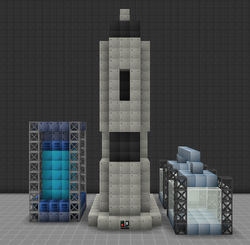
The Tier 3 Nano Forge can be built in early UIV by constructing a second addition to the structure and inserting a Transcendent Metal Nanite into the controller. It unlocks a few new Nanites, but the only ones relevant in UIV are Gold Nanites (needed for QFT catalysts and the tier 3 PCB Factory) and Six-Phased Copper Nanites (required for most Godforge modules). It also provides a perfect overclock on all Tier 2 Nanites, which is particularly valuable for the large amount of Glowstone Nanites needed for Optical circuits.
The PCB Factory can be upgraded to Tier 3 after obtaining a Gold Nanite, using a completely new structure. The Tier 3 PCB Factory is similar to the Tier 2, but it gets more circuit boards for the same amount of resources, and uses Gold Nanites instead of Silver Nanites to determine its parallel amount. After obtaining SpaceTime, it can also be upgraded by replacing the Liquid Cooling Tower with the Thermosink Radiator, which allows for perfect overclocks.
Quantum Force Transformer
The Tier 3 Quantum Force Transformer is unlocked with UIV components and a running Tier 2 QFT, and unlocks three new line skips:
- Wetware
- Particles (notably including Unknown Particles and Gravitons)
- Naquadria (also required for the tier 4 QFT)
In addition to QFT progression, the Superconductor Rare-Earth Composite produced from the Monazite QFT is used for the Godforge.
Sidequests
Deep Dark
The Deep Dark is a dimension added by Extra Utilities; it is accessed with the Deep Dark Portal, which is made through Thaumcraft infusion using UIV Field Generators. Its most noteworthy feature is that it contains every ore in the game when mined using a Void Miner, including some ores that are otherwise completely unobtainable, such as Tritanium. It is not immediately required, but some Deep Dark-exclusive ores are needed for progression later on, beginning with Deep Dark Iron at the end of UMV to produce Eternity.
Chaotic Core
The Chaotic Core, which is unlocked with UMV Circuits and SpaceTime, is the final core used in Draconic Evolution crafts. It requires Chaos Shards to make, which can only be obtained at first from a Chaos Guardian, a very powerful boss that spawns on islands in the End that are located at integer multiples of 10,000 on the X and Z axes. Avaritia equipment can be used to improve this method. The first few Chaos Shards can be used to make the Draconic Reactor, which can convert Awakened Draconium Ingots into more Chaos Shards.
The Chaotic Core itself only unlocks a few things. It can be used to make the Chaotic Fusion Casing, the final tier of casing for the DEFC; this casing does not unlock any new recipes, but does provide a speed boost over the Awakened Draconium Fusion Casing on all recipes. It is used for the Chaotic Capacitor Bank, a source of infinite RF, which has limited uses due to being impossible to convert to EU, but can help with some setups. The Reactor Stabilizer is required for the Draconic Reactor, but is also used in the Singularity Crafting Storage, an infinitely large storage for AE2 Crafting CPUs. In addition, both the Chaotic Capacitor Bank and Singularity Crafting Storage are needed to craft the Stargate.
Uncertainty Resolution
The Uncertainty Resolution is an improved version of the Uncertainty Resolver for Quantum Computers. With the Uncertainty Resolution, the puzzle will be solved instantly as soon as the QC is turned on, and will never spontaneously unsolve, making it especially useful for setting up Dyson Swarms. It requires UIV Field Generators, and therefore is gated behind UMV circuits.
Thaumometric Essentia Cell
The Thaumometric Essentia Cell is a creative cell for essentia. By placing it into an ME Drive, the connected network will have access to infinite essentia of all 69 aspects. It also requires UMV circuits to craft, in addition to some Thaumcraft progression.