GT New Horizons · Insanely Ultimate Voltage (UIV)
Forge of the Gods
 | WIP! This page is a Work In Progress. You can help out by adding more information to the page. |
The Forge of the Gods is a UIV tier multiblock that can perform a wide variety of smelting-related operations. It uses exclusively wireless power, and pulls energy directly from the player's wireless storage.
Construction
The Forge of the Gods is built with up to three rings for increasing the total number of module slots. Modules are effectively their own structure and built around the smaller rings leading up to the much larger main rings. Buses/hatches are limited to specific casings around the controller and there must be exactly one of each. The output bus must also be ME specifically and there is no energy hatch because the Forge of the Gods uses too much power to be handled with conventional means. Instead, it interacts directly with the owner's wireless EU network. Use the Multiblock Structure Hologram Projector to visualize/build the structure where the projector stack size determines the number of rings.
To build additional rings, you have to disable the animation, which also disables and un-forms the multiblock. You can either use a screwdriver on the controller, or click the power button in the cosmetics menu. Then the existing rings will materialize so you can build the new one. When done, re-activate with a soft hammer.
Base Structure (T1)
- Controller: Front center, 15th layer
- 3949 Transcendentally Amplified Magnetic Confinement Casing
- 2799-2815 Singularity Reinforced Stellar Shielding Casing
- 345 Remote Graviton Flow Modulator
- 272 Celestial Matter Guidance Casing
- 130 Boundless Gravitationally Severed Structure Casing
- 36 Stellar Energy Casing
- 9 Spatially Transcendent Gravitational Lens Block
- 0-8 Forge of the Gods Module: Any side center shielding casing
Second Ring (T2)
- 3336 Transcendentally Amplified Magnetic Confinement Casing
- 2012 Singularity Reinforced Stellar Shielding Casing
- 357 Medial Graviton Flow Modulator
- 240 Celestial Matter Guidance Casing
- 45 Spatially Transcendent Gravitational Lens Block
- 14 Boundless Gravitationally Severed Structure Casing
- 0-12 Forge of the Gods Module: Any side center shielding casing
Third Ring (T3)
- 3728 Transcendentally Amplified Magnetic Confinement Casing
- 1736 Singularity Reinforced Stellar Shielding Casing
- 395 Central Graviton Flow Modulator
- 312 Celestial Matter Guidance Casing
- 101 Spatially Transcendent Gravitational Lens Block
- 14 Boundless Gravitationally Severed Structure Casing
- 0-16 Forge of the Gods Module: Any side center shielding casing
Each Module
- Controller: Front center, 4th layer
- 0-20 Singularity Reinforced Stellar Shielding Casing
- 20 Boundless Gravitationally Severed Structure Casing
- 5 Celestial Matter Guidance Casing
- 5 Unique Casings[1]
- 1 Stellar Energy Siphon Casing
- ↑ The material depends on the type of module.
Modules
Modules are separate multiblocks that have to be built into the Godforge structure at their designated spots. Each module extends a circular structure in one of the four small rings, with the controller on the outside. Once built, these modules have to connect to the Godforge, which happens automatically if all requirements for the respective module are met and the forge is turned on. Alternatively, there is a button to refresh their status without waiting for the timer. Each of these modules has its specialized functionality & requirements and is affected differently by certain upgrades. Overclocks cannot be directly controlled; each module will overclock up to using the full 2 billion EU/t base voltage capacity. This voltage capacity is upgradeable.
Initially the Godforge can use up to 8 modules; this increases to 12 after the second ring is built, and 16 with all three rings built. Module placement does not matter; modules can be placed in any of the sixteen module slots. If more modules are placed than unlocked, a scanner or industrial info panel may display that there are the expected number of modules but all modules will disconnect until the number of modules is within the allowed amount.
Helioflare Power Forge
The Helioflare Power Forge can function as either a blast furnace more powerful than the ExH or as a hyper powerful multi-smelter. This module is unlocked with the START upgrade (obtainable after the Forge is fully formed) and has 1024 base parallels. It cannot function in both blast furnace and furnace mode simultaneously; you'll need to build two for that.
In blast furnace mode it functions identically to an EBF or ExH, except with increased parallels and a different heat capacity calculation (see the Heat Capacity section below). In furnace mode it does not contribute to milestones.
Helioflux Melting Core
The Helioflux Melting Core also acts as a blast furnace except that it outputs molten metal instead of ingots or hot ingots. If an output does not have a molten form, it will be output in its solid form. The recipes for the Helioflux Melting Core are identical to their corresponding EBF recipes in all other ways, including recipe time, fluid input requirements, and heat requirements. This module has to be unlocked by the FDIM upgrade to function and has 512 base parallels.
Heliothermal Plasma Fabricator
The Heliothermal Plasma Fabricator directly converts material (either dust or fluids) to plasma rather than requiring the usual fusion inputs. Recipes are restricted based on fusion tier and steps required. Initially (after GPCI is unlocked) the module is restricted to T3 and single-step plasma; TPTP unlocks multi-step plasmas; SEDS allows t5 plasmas; and END allows exotic plasmas. This module has 384 base parallels.
Heliofusion Exoticizer
The Heliofusion Exoticizer produces quark gluon plasma and magmatter. This module is unlocked by the QGPIU upgrade, and the ability to produce magmatter is unlocked by the END upgrade. The modules have independent automation procedures and are locked to either of the materials, so its recommended to have two. This module has 64 base parallel.
*The common rule for both modes' automation challenges is as follows: the module outputs materials at the start of a recipe cycle and waits for the correct inputs to arrive before starting the actual processing of the output material. If producing quark-gluon plasma, the module outputs up to 7 different fluids/dusts with amounts between 1-64 and 1-7 respectively, and their corresponding plasmas and amounts have to be returned in order for the recipe to process. For each L of fluid, a bucket of plasma and for each dust 9 ingots worth of plasma must be returned for the recipe to work.
*If magmatter mode is active, the automation challenge changes. Now the module outputs 1-50L of tachyon rich temporal fluid, 51-100L of spatially enlarged fluid, and one dust of a high tier material. The challenge is to return both the tachyon rich and spatially enlarged fluids, plus as much plasma of the dust's material (in ingots) as the difference between the amounts of spatially enlarged and tachyon rich fluid. Once all of these have been returned in the correct amounts, the recipe will start to process and output magmatter.
Operation
Fuel
Once the structure of the Forge is built and the multiblock is formed, it must be supplied with Star Fuel (the item) to boot up. The amount of Star Fuel needed depends on the current fuel consumption factor, which can be set in the fuel configuration menu. The default maximum is 5; it increases with CFCH and GEM, and TSE. The Star Fuel needed to start (or for rebooting after fuel loss) is where f is the fuel consumption factor. Star Fuel is supplied via an input bus on the main structure. If all Stellar Fuel (the fluid) is consumed and the internal storage is empty, the Forge will shut down and need to be booted up with Star Fuel again.
Once booted up, the Forge has an internal battery of stellar fuel, displayed in the controller GUI. Valid fuels are Dimensionally Transcendent Residue, Condensed Raw Stellar Plasma Mixture, and Molten Magnetohydrodynamically Constrained Star Matter. The amount of Stellar Fuel stored internally can be increased by enabling the battery mode in the controller GUI; this will double fuel consumption while storing half. The battery mode will automatically turn off when the internal storage is full. The formula for conversion of fuel supplied to units of battery fill is the inverse of the Stellar Fuel consumption formulae (see below); in other words, the amount of fuel units added to the battery is equal to the fuel consumption factor.
The Fuel Consumption Factor is the main determining factor in calculating the total Stellar Fuel consumption per second. Each fuel type has different scaling, represented by the following formulae (where f is the fuel consumption factor):
- Dimensionally Transcendent Residue:
- Condensed Raw Stellar Plasma Mixture:
- Magnetohydrodynamically Constrained Star Matter:
This factor also determines the base heat of the multiblock, with the following formula:
| Fuel Consumption Factor | Base Heat Capacity | Fuel Consumption/5sec (no upgrades) | Fuel Consumption/5sec (with STEM upgrade) |
| 1 | 12601 | 1725 | 1380 |
| 2 | 14310 | 3967 | 3174 |
| 3 | 15310 | 6843 | 5475 |
| 4 | 16020 | 10494 | 8395 |
| 5 | 16570 | 15085 | 12608 |
| 6* | 17020 | 20817 | 16654 |
*Note that a fuel consumption factor of 6 requires the Cosmic Fuel Chamber Expansion upgrade.
Upgrades can influence these formulas; the changes are listed in the respective upgrades' descriptions.
Heat Capacity
The heat capacity of the Forge is calculated by where f is the fuel consumption factor. The heat bonus capacity referred to in upgrades is the maximum heat capacity to which bonuses will be applied. For example, Dimensionally Transcendent Residue with a fuel factor of 6 has a base heat capacity of 17020K, but bonuses will only applied to recipes at 15000K or lower.
Voltage
Because of overflow concerns, actual processing voltage follows this formula:
This voltage is modified by the GISS upgrade and can later be manually set by the TBF upgrade.
Upgrades
Upgrades are the heart and soul of the Godforge, and they unlock most of its functionality and processing power. The upgrade tree can be accessed via its button in the controller GUI and each upgrade node can be clicked for more information on its effects and unlock requirements. In general, each upgrade can only be unlocked if the prior one is unlocked and there are enough available graviton shards. The first upgrade (START) is exempt from this requirement, as it does not have a previous upgrade; however, it does have a material cost.
Some upgrades can also have extra material costs, which are denoted next to the unlock button if applicable. Blue connections indicate at least one of the connected previous upgrades is required; red connections indicate all connected previous upgrades are required.
The block of upgrades following the unlock of the Heliofusion Exoticizer module are special, as they are what is considered the Split. As the name suggests, only one path out of the three may be chosen at first, and the others will be locked. A second path is unlocked when the second ring is unlocked and built, and all three are unlocked after the third ring is unlocked and built. Each path has specialized buffs that are primarily targeted towards a specific module, and thus affect other module types with reduced effect unless stated otherwise.
- The purple (left-hand) path focuses on the Helioflare Power Forge, upgrading the heat capacity scaling and heat bonus capacity;
- The yellow (center) path focuses on increased parallel capacity;
- The green (right-hand) path focuses on the Plasma Fabricator, giving energy cost and recipe time reductions.
Upgrades can be refunded by simply pressing the unlock button again, but this only works if ALL connected later upgrades are not active/unlocked.
Milestones
Milestones are the source of Graviton shards, which are the main currency for unlocking upgrades. There are 4 types of milestones, each referring to a stat of the Godforge, and each type has 7 tiers of increasing difficulty. Milestones grant Graviton shards equal to their tier (so a tier 1 milestone grants 1 shard, a tier 2 milestone grants 2 shards, etc).
Charge
Scales off of the total power consumption of all modules combined. The first tier milestone is unlocked at 1e15 EU consumed, with each subsequent milestone scaling by 9x.
Conversion
Scales off total recipes processed across all modules (excluding the Helioflare Power Forge's furnace mode). The first tier milestone is unlocked at 10M processed recipes, with each subsequent milestone scaling by 4x.
Catalyst
Scales off of the Forge's fuel consumption, counted in Stellar Fuel units (the number entered in the fuel config menu). The first tier milestone is unlocked at 10,000 fuel units consumed, with each subsequent milestone scaling by 3x.
Composition
Scales off the Forge's structure. Milestone levels are granted for each unique type of module present in the structure (Heliofusion Exoticizer modules on quark-gluon and magmatter mode count as unique), and for each additional ring built.
| Level | Charge | Conversion | Catalyst | Composition |
| 1 | 1e15 | 10 M | 10,000 | 1 |
| 2 | 9e15 | 40 M | 30,000 | 2 |
| 3 | 8.1e16 | 160 M | 90,000 | 3 |
| 4 | 7.29e17 | 640 M | 270,000 | 4 |
| 5 | 6.56e18 | 2560 M | 810,000 | 5 |
| 6 | 5.90e19 | 10,240 M | 2,430,000 | 6 |
| 7 | 5.31e20 | 40,960 M | 7,290,000 | 7 |
Inversion
Once all milestones of the Forge reach tier 7, inversion activates. This uncaps the maximum tier of all milestones and allows them to scale infinitely. The scaling of each milestone changes from exponential to linear, but the granted Graviton shard amount keeps increasing. The amount of progress needed for each subsequent milestone is as much as needed for the 7th tier of each milestone.
The Composition milestone is an exception, as that continues to scale by 1 each tier with its own formula for calculating progress. Each module type is given a value, ranging from 1 for the Helioflare Power Forge to 5 for the Heliofusion Exoticizer in magmatter mode, then the amount of each module present is subtracted by 1 and multiplied by its value. These values are added up and divided by 5, this is the final milestone tier on top of the base 7.
List of Upgrades
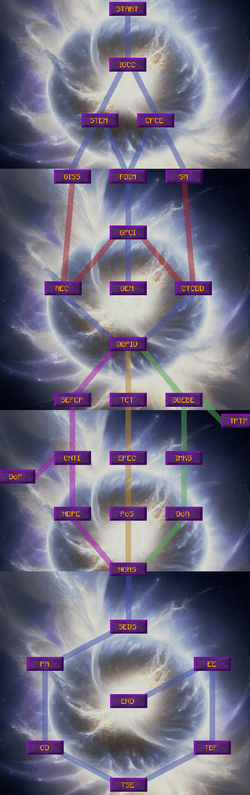
| Upgrade Tag | Graviton Cost | Addl Mats? | Upgrade Name | Effect |
| START | 0 | Yes | 8 module slots, 1 ring, the Helioflare Power Forge module, 2 billion EU/t processing voltage and 15,000K heat bonus cap. | |
| IGCC | 1 | Improved Gravitational Convection Coils | Unlocks a recipe time reduction multiplier based on the current heat the multi is running at:
| |
| STEM | 1 | Spacetime Topology Expansion Modulator | Increases fuel efficiency by multiplying the actual fuel consumption by 0.8 | |
| CFCE | 1 | Cosmic Fuel Chamber Expansion | Multiplies the maximum fuel consumption by 1.2 | |
| GISS | 1 | Graviton-Induced Superconductivity System | Increases the base processing voltage of all modules by: Stellar Fuel Units/sec * 10^8 EU/t | |
| FDIM | 1 | Yes | Fluid Dynamics Integration Module | Unlocks the Helioflux Melting Core module. |
| SA | 1 | Superluminal Amplifier | Unlocks a multiplier to maximum parallel based on fuel consumption rate:
| |
| GPCI | 2 | Yes | Gravitational Plasma Containment Inductor | Unlocks the Heliothermal Plasma Fabricator module and basic element -> plasma processing (1 step plasmas, T3 fusion maximum). |
| REC | 2 | Relativistic Electron Capacitor | Unlocks a configuration window for maximum battery size and increases the limit to max int. Unlocks an energy discount multiplier that scales with battery size (capped to 5%):
| |
| GEM | 2 | Graviton Entanglement Monitor | Increases maximum fuel consumption by 1 Stellar Fuel Unit/sec for every purchased upgrade. | |
| CTCDD | 2 | Closed Timelike Curve Disruption Device | Adds a x2 multiplier to maximum parallel. | |
| QGPIU | 2 | Yes | Quark-Gluon Plasma Isolation Unit | Unlocks the Heliofusion Exoticizer module and quark gluon plasma creation. At this point this module is not affected by any other multipliers or bonuses from other upgrades. |
| SEFCP | 3 | Singularity Exposure Fuel Compression Process | Improves the fuel consumption -> heat conversion formula:
| |
| TCT | 3 | Transfinite Construction Techniques | Improves the formula of SA to: Multiplier = 1 + (Stellar Fuel Units/sec) / 5 | |
| GGEBE | 3 | Gravitationally Guided Electron Beam Emitter | Improves the overclock formula from 4/2 OCs to 4/2.3 OCs | |
| TPTP | 4 | Temporal Plasma Transformation Process | Allows the Heliothermal Plasma Fabricator to process multi step plasmas. Tier restriction still applies. | |
| DoP | 4 | Duplicity of Potency | Allows the Helioflare Power Forge to receive the full benefits of the Helioflux Melting Core upgrade path. | |
| CNTI | 3 | Critical Neutrino Tunnelling Integration | Increases the cap of EBF heat bonuses to 30,000K. | |
| EPEC | 3 | Extreme Pulsar Exposure Chambers | Unlocks a multiplier to maximum parallel based on current heat:
| |
| IMKG | 3 | Internal Micro-Kugelblitz Generator | Improves the EBF energy reduction heat bonus from 5% to 8% and adds an energy discount based on the fill level of the internal battery:
| |
| NDPE | 3 | Neutron Degeneracy Pressure Exposure | EBF heat bonuses are granted above 30,000K, but the heat value used in heat bonus calculations is determined by this formula:
| |
| PoS | 3 | Parity of Singularity | Unlocks a multiplier to maximum parallel based on total amount of purchased upgrades. This bonus is calculated via this formula:
| |
| DoR | 3 | Disparity of Rarity | Improves IGCC based on current maximum parallel. Improved Formula:
| |
| NGMS | 4 | Null-Gravity Modulation Sheath | Multiplies maximum processing voltage by 4 per active ring. Applied after other bonuses. | |
| SEDS | 5 | Synthetic Element Decay Stabilization | Allows the Heliothermal Plasma Fabricator to process up to T5 plasmas. | |
| PA | 6 | Paradoxical Attainment | Allows the Heliofusion Exoticizer to be affected by other upgrade benefits, but those benefits are square rooted first. The overclock bonus is adjusted via the following formula:
| |
| CD | 7 | Yes | Cosmically Duplicate | Allows construction of the second ring and adds 4 module slots. |
| TSE | 8 | Transfinite Stellar Existence | Uncaps maximum fuel consumption, but fuel consumption used in bonus calculations scales according to this formula:
where FC refers to fuel consumption and max FC refers to the max fuel consumption without this upgrade. | |
| TBF | 9 | The Boundless Flow | Uncaps maximum processing voltage. Voltage can be set in each module's GUI. | |
| EE | 10 | Yes | Effortless Existence | Allows construction of the third ring and adds 4 module slots. |
| END | 12 | Yes | Orion's Arm Genesis Schema | Unlocks Magmatter production in the Heliofusion Exoticizer, creation of exotic plasmas in the Heliothermal Plasma Fabricator and Graviton Shard ejection & injection. |
Material Requirements
START
- 64 Superconductor Base UIV Frame Box
- 32 Superconductor Rare Earth Composite
- 16 Metastable Oganesson Gear
- 8 Eternal Singularity
- 64 Robot Arm (UIV)
- 64 Field Generator (UEV)
FDIM
- 16 MABS
- 64 Hypogen Coil Block
- 32 Harmonic Phonon Transmission Conduit
- 16 Eternal Singularity
- 48 Ultimate Field Restriction Coil
- 64 Robot Arm (UIV)
- 64 Field Generator (UEV)
GPCI
- 8 Stellar Energy Siphon Casing
- 8 FusionTech Mk V
- 64 Advanced Fusion Coil II
- 64 Ultra High Temperature Resistant Mesh
- 48 Dense Quantum Plate
- 32 Rhugnor Gear
- 16 Eternal Singularity
- 64 Robot Arm (UIV)
- 64 Field Generator (UEV)
QGPIU
- 16 Stellar Energy Siphon Casing
- 2 Compact Fusion Computer MK-V
- 64 Compact Fusion Coil Mk-II Finaltype
- 16 Harmonic Phonon Transmission Conduit
- 4 Transcendent Plasma Mixer
- 64 Rhugnor Gear
- 64 Ichorium Gear
- 32 Eternal Singularity
- 64 Robot Arm (UIV)
- 64 Field Generator (UEV)
CD
- 64 Spacetime Frame Box
- 64 Superconductor Base UMV Frame Box
- 64 Hypogen Frame Box
- 64 Dragonblood Frame Box
- 64 Reinforced Spatial Structure Casing
- 8 Infinite Spacetime Energy Boundary Casing
- 2 Mega Ultimate Battery
- 32 Field Generator (UMV)
EE
- 64 White Dwarf Matter Frame Box
- 64 Black Dwarf Matter Frame Box
- 16 Eternity Frame Box
- 2 Universium Frame Box
- 64 Infinite Spacetime Energy Boundary Casing
- 16 Exotic Stabilisation Field Generator
- 6 Mega Ultimate Battery
- 64 Field Generator (UMV)
END
- 32 Heliofusion Exoticizer
- 64 Stellar Energy Siphon Casing
- 48 Perfect Stabilisation Field Generator
- 8 Transdimensional Alignment Matrix
- 16 Mega Ultimate Battery
- 64 Robot Arm (UMV)
- 64 Conveyor Module (UMV)
Lore
In-game tooltips:
The Forge of the Gods is an immensely powerful structure constructed around a stabilized neutron star – it is so advanced that its full capabilities are not yet understood. However, through continued use, one can slowly upgrade and expand the range of abilities of the Forge, and learn the power hidden in the most extreme parts of the universe: graviton shards. This esoteric material can only be found where conventional matter and degenerate neutronium crust matter on the surface of a neutron star meet. At this point in space, gravitons are far more common and irradiate this material mixture to create highly unstable graviton shards, which can be used to internally upgrade the Forge. While these shards cannot yet exist outside the extreme conditions of the Forge, with continued research and utilization it may be possible to eventually isolate and extract them outside the Forge – but for what purpose?
The first major upgrade of the Forge of the Gods has allowed for greater processing speeds as the heat increases, thanks to the gravitational warping effects of graviton shards. This is the first of many applications of the shards, which will be discovered through continuous use of the Forge.
Graviton shards warp the surface area of fuels used in the Forge, increasing efficiency as more material can be processed per unit of fuel. Graviton shards will prove crucial for further efficiency increases to offset the ever-increasing demands of the Forge.
Through use of graviton shards, the space within the Forge’s fuel chambers can be increased, allowing for greater quantities of fuel to be burned, thus reaching higher temperatures. Don’t forget to reserve fuel to keep the star at the centre of the Forge alive.
Graviton shards not only affect matter, but also energy: with high enough concentrations of stellar fuel, superconductivity is induced within the Forge purely through gravitational forces. What other properties could these Graviton shards hold?
As usage of the Forge continues, more data on graviton shards is gathered. It has been found that they can stabilize the outputs of the Forge, allowing for the direct extraction of molten material while it is still close to the heart of the star.
As stellar fuel consumption continues to increase the size and energy of the star, the amount of material that can be processed at once also increases. Graviton shards facilitate the manipulation of increased quantities of materials near the star in the core of the Forge.
As understanding of graviton shards continues to improve, better control over the materials they manipulate can be achieved. Graviton shards provide an alternative to electromagnetic containment of plasma using spacetime manipulation instead, allowing the Forge to directly output processed materials as plasma.
Adding graviton shards to the Forge’s internal energy storage allows for greater quantities of energy stored in a smaller area. By increasing energy density to relativistic levels, the Forge can be run more efficiently as the electrical potential continues to increase.
Simply adding more graviton shards to the fuel chamber continues to amplify the ability for the Forge to consume increased quantities of stellar fuel. It even benefits from graviton shards invested in different parts of the Forge entirely – it seems shards exhibit quantum entanglement-like properties.
Increasing the concentration of graviton shards near the material processing regions of the Forge warps spacetime so significantly that it manipulates materials from the causal future and past. This essentially doubles the material input capacity and processing capabilities.
Using large quantities of graviton shards creates regions of space so extreme that exotic forms of matter can exist with far greater stability than usual. Unfortunately, this region is so extreme that it is essentially spatially disconnected from the rest of the Forge, unable to utilize existing upgrades to the structure and its other modules.
Exposure to graviton-induced micro black holes can further compress stellar fuel, increasing its ability to fuel the star at the centre of the Forge through higher energy fusion reactions than usually possible in a natural star. As a result, greater heat is produced, increasing processing efficiency of the Forge.
Increasing the concentration of graviton shards in the fuel chamber begins to exhibit infinite fractal-like properties within finite space, further increasing processing capacity. Though this requires a commensurate increase in stellar fuel to ensure energy reaches matter deep within the chamber.
Utilising the unique energy-manipulating properties of graviton shards, electricity can be more efficiently utilised within the Forge. Guiding electrons with gravity rather than matter or electromagnetic forces results in less power loss and thus greater processing speeds.
Similar to the Quantum Force Transformer, the quantum-mechanical properties of graviton shards facilitate the ability for the Forge to complete a complex series of nuclear fusion processes in a single event by directly manipulating the subatomic particles of the materials themselves.
Another instance of the entanglement-like effects of graviton shards, the simple Power Forge module now also exhibits the improvements made to the Melting Core module of the Forge. This allows for greater efficiency in both processing and allocation of the precious few graviton shards that can be obtained.
Typical smelting techniques for exotic materials become too inefficient even at extreme temperatures. Graviton shards facilitate the tunnelling of unprecedented numbers of critically energized neutrinos for vastly improved heat transfer to the target material, one of the most efficient methods of transforming electrical energy into heat for materials.
Graviton shards can manipulate not just processing matter, but the star at the centre of the Forge itself. By rotating the star at relativistic speeds, the resulting pulsar bursts can impart more energy per unit of time than mere static exposure. This results in faster processing of larger quantities of materials.
Continual improvements to energy storage density using graviton shards improves both the efficiency of the Forge and improvements to heat utilisation for processing. Reaching the singularity threshold of energy has a twofold effect on processing efficiency: the gravitational effects can be used to manipulate the matter itself, while the micro-kugelblitzes paradoxically make their energy more available for use in the Forge.
Normally increasing heat indefinitely has extreme diminishing returns when processing materials, but graviton shards allow for other heating options than standard electrically generated heat. Using graviton shards, encasing the target material in extremely degenerate matter compresses it so greatly that it heats up beyond what would be typically possible in the Forge.
Using the entanglement-like properties of graviton shards, it is possible to utilize the increasingly extreme differences in spacetime between regions of the Forge to improve the processing capacity of the molten module. As space becomes more warped, more material can be moved closer to the star, increasing production capacity.
Returning to the first upgrade of the Forge with the myriad discoveries about graviton shards allows it to run much faster than previously possible. It is sometimes important to review the most basic of assumptions when working outside the known laws of physics, for the simplest facts may be the most powerful.
The stress of maintaining such a large structure around such a gravitationally dense object as a neutron star is alleviated through graviton shards. A sheath of gravitational-neutralising material is installed across the Forge to protect the more conventional machinery and only improves efficiency the larger the structure becomes.
Improvements in understanding of the gravitational containment effects of graviton shards allow the Forge to process and handle the most exotic of plasmas, including typically nanosecond-lived synthetic transactinide elements. It also extends their lifetime for external usage by stabilizing the atomic nucleus with small quantities of gravitons.
Further utilisation of the quantum entanglement-like properties of graviton shards allows the effects of other module upgrades to also apply to the exotic module. However, because of the extreme nature of spacetime within this module and the materials it handles, these benefits are reduced as per the inverse square law.
As additional rings are placed closer to the star at the centre of the Forge, the gravitational stress drastically increases on the structure. Graviton shards alleviate these stresses while also creating localized spacetime bridges to link the two rings and their modules’ respective upgrades.
A huge development in the capabilities of the Forge has been achieved with the use of large quantities of graviton shards – the ability to indefinitely feed the star with stellar fuel. While this has diminishing returns, the star can exist indefinitely despite the extremely accelerated energy expenditure from endless material processing.
The usage of graviton shards in electrical systems to create localised miniature energy wormholes has allowed for such efficient power transfer that effectively unlimited electricity may be utilized by the Forge. More power means faster processing, quicker material movement, and better utilization of graviton shard related upgrades.
The final external structural upgrade to the Forge requires the most advanced understanding of graviton shards and their applications in extreme environments. With this, the last 4 module slots of the Forge of the Gods are available to construct, ascending your operation to unseen heights of technological mastery.
With total mastery of the Forge of the Gods achieved, it is possible to begin a new universe-spanning initiative. It is now possible to quantize and extract graviton shards for use outside the Forge in powerful new technological endeavours; produce the most exotic plasmas beyond merely periodic elements; and most importantly, begin to understand the immense power of magmatter, a form of matter made entirely of magnetic monopoles with density and stability billions of times that of conventional bosonic matter. It is with this development you realise that the completion of the Forge was not the end goal, but merely a stepping stone to universal transcendence.
Automation
The first three modules do not require any special setups, but the Heliofusion Exoticizer does. It outputs materials at the start of a recipe cycle and waits for the correct inputs to arrive before starting the actual processing of the output material. There are numerous methods to automating this, but only one is discussed in detail.
Method 1: OpenComputers and AE2 crafting
GTNH OC God Forge Control provides an excellent guide and software to manage both production of Degenerate Quark Gluon Plasma and Molten Magmatter.
Method 2: OC Transposer/SSR
The core of this setup is an OpenComputers script that reads the Exoticizer's output requests from the AE2 network and uses OC transposers to insert the required fluids directly from Super Stock Replenishers. It automatically handles fluid selection and insertion, verifies the SSR contents at startup, and detects missing, duplicate, or unexpected fluids. The script also generally resumes normal operation after server restarts and can optionally track total fluid production and average production rates. Enabling production tracking requires manually setting the fluidProducedPerCycle variable based on the observed output of the Exoticizer.
The setup has very low idle overhead and achieves downtime of approximately 0.3–0.5 seconds between recipe cycles. It has also been tested with recipe durations as short as 0.25 seconds. Its main drawback is that all required plasmas and fluids must be stocked in the SSRs and patterned manually. The source code for this method can be found at the OC CatForge GitHub page.
| STEP 1 - Physical AE2 networks arrangement | |
| On the Exoticizer module face, place an ME output bus + unfiltered ME output hatch, an advanced stocking input hatch, and an ME output hatch filtered to quark gluon plasma/magmatter.
Placed down two ME networks including a (neutronium) ME controller, both with their own storage. The network with ME output bus/hatch (output subnet) requires a minimum capacity of 7 fluid types, and 7 item types, while the network with the ASIH requires a minimum capacity of 7 fluid types - the storage cell size can be any. Reduce the ASIH Slot Refresh Time to below 5 ticks to reduce idle time between cycles. On the output subnet, attach an ME IO port with the Operation Mode set to "Move to output when work is done". Acceleration cards are optional. Insert a ME Fluid Void Cell and a Void ME Storage Cell. |
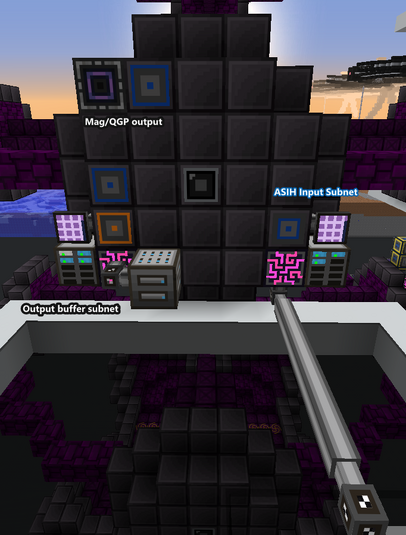
|
| STEP 2 - Physical OC arrangement | |
| On the Exoticizer controller, place an activity detector cover, set signal to strong with a soldering iron, and place a red alloy wire entering an OC Redstone I/O. Change the activity detector cover mode to "Machine Idle" + "Normal".
Place an OC Adapter adjacent to the output subnet ME controller and an OC Transposer (any tier) adjacent to the output subnet ME IO Port - this IO port is used to clear the output buffer subnet between cycles. Near the Exoticizer and other OC components, place a Computer Case (Tier 3), Screen (Tier 3), Keyboard, and Neutronium Energy Cell, and insert the following components. Lower tier versions may be used but there is no reason not to use the best components.
Connect the Computer Case to the Redstone I/O, Adapter, and Transposer via OC Cables. |
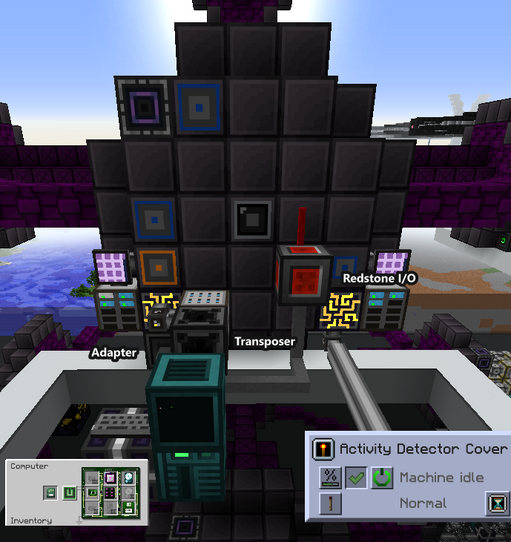
|
| STEP 3 - Magmatter/QGP SSR Arrangement | |
| Two different transposer/SSR arrangements are required depending on whether you're automating Quark Gluon Plasma or Magmatter. Follow the relevant subsection below. The SSRs must be connect to some form of AE2 storage that contains all relevant plasmas. This may be main-net, but it is recommended to use a dedicated subnet/plasma fabricator for producing these plasmas.
The required fluids for each mode can be found in the Exoticizer controller's All Possible Inputs information panel, under Click to display expected inputs. By default, the OC script verifies the SSR contents before starting operation, identifying any missing, unexpected or duplicate fluids. The 80 plasmas required for QGP must be distributed across all SSRs, with each fluid occupying one slot. The same applies for Magmatter, except it requires 14 plasmas + Spatially Enlarged Fluid + Tachyon Rich Temporal Fluid, for a total of 16 fluids. | |
| STEP 3.1 - Quark Gluon Plasma | |
| Place a full-block ME Dual Interface connected to the Input subnet, with three OC Transposers placed adjacent to it. Each Transposer requires three adjacent Super Stock Replenishers, for a total of nine SSRs.
Connect all three Transposers to the Computer Case using OC Cables. Additional ME Dual Interfaces may be used if required for space; they are only used for receiving fluids. |
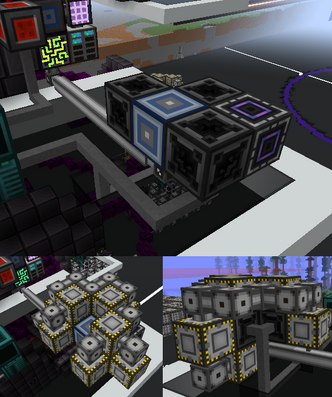
|
| STEP 3.2 - Magmatter | |
| Place a full-block ME Dual Interface connected to the Input subnet, with one OC Transposer and two adjacent Super Stock Replenishers. Connect the Transposer to the Computer Case using an OC Cable. | 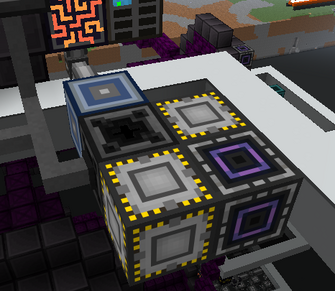
|
| STEP 3.3 - SSR Configuration | |
For both configurations, stock each SSR with at least 1 ML of every required fluid. Higher quantities are recommended.
The order of fluids within the SSRs does not matter, provided every required fluid is present. |

|
| STEP 4 - Script Installation and Configuration | |
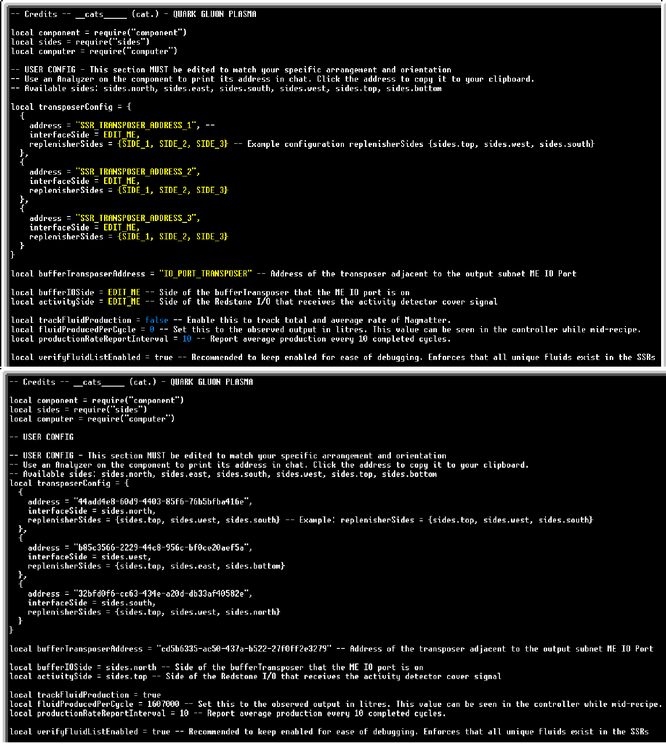
Download the appropriate QGP or Magmatter controller script and copy it onto the OpenComputers computer. The script and its accompanying expected_fluid_list.txt verification file must both be present in the same working directory. The following commands will download the relevant script/verification file. The attached image includes the expected default script and a fully configured, functional version.
QGP: Magmatter: Open the script in an editor and locate the Required configuration:For each plasma replenisher transposer, configure the following:
Available side values are Optional settings - these may be left at their defaults
Once configuration is complete, save the script (CTRL+S), exit the editor, (CTRL+W) and run it from the OpenComputers terminal. The script will automatically discover and verify the connected hardware, scan the SSRs and start a processing cycle if the output subnet already contains ingredients and otherwise wait for them if it's empty. |
|