GT New Horizons · Ultimate Voltage (UV)
Large Hadron Collider
The Large Hadron Collider (LHC) is a UV tier multiblock for accelerating particles to high energies and then colliding them to generate new particles. The LHC receives a particle beam from a Source Chamber or any other machine with a beam output and immediately enters particle accelerator mode which first increases the beam energy until the target beam energy is reached, and then increases the beam rate exclusively until the maximum number of cycles is reached. Beam energy determines which particles are discoverable and beam rate determines the amount of particles produced. The LHC then immediately enters collider mode which randomly generates new particle beams in each of the installed modules based on the pool of available options and their weighted probabilities.
These new output particle beams are then captured by a Beam Crafter to process recipes, or any other machine with a beam input such as the Synchrotron or Target Chamber. The Beam Mirror, Beam Splitter, and Beam Stabilizer are optional but they can help redirect or optimize the particle beams as necessary. At no point can the particles be physically held or stored as an item, but up to 2B of each type of particle can be buffered inside the Beam Crafter for future use.
Spreadsheet: GTNH LHC Calculator 2.9
Construction
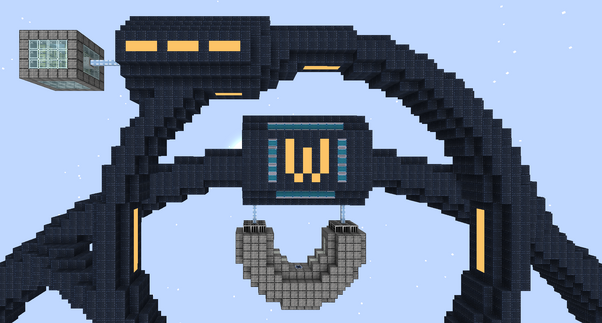
The LHC consists of two rings. The smaller ring is the particle accelerator which increases the energy and rate of the particle beam. The larger ring is the particle collider which produces new particles from the collision energy of the beam. The LHC has four modules available and each one is built on a specific side of the structure. The only functional difference between them is the type of particle beams that they produce. Multi-amp and laser energy hatches are supported for serious particle acceleration. The neonite blocks can be any color. Use the Multiblock Structure Hologram Projector to visualize/build the structure where the projector stack size determines the number of modules to build.
The filtered beam output hatch is nearly identical to the beam output hatch except it has a configurable blacklist to ignore certain particles. Blacklisting does NOT remove them from the pool of options or reduce the overall weight--it only prevents those particles from being outputted.
Base Structure
Total
|
CMS Module (Electromagnetism)
ATLAS Module (Weak)
ALICE Module (Strong)
LHCb Module (Gravity)
|
Wallsharing
LHCs may wallshare the entire large ring as long as the modules do not conflict with one another. That means four LHCs can share the CMS module, or two LHCs can share both the CMS and ATLAS modules. However, only one LHC is really needed for Beam Crafter recipes anyway.
Full Setup
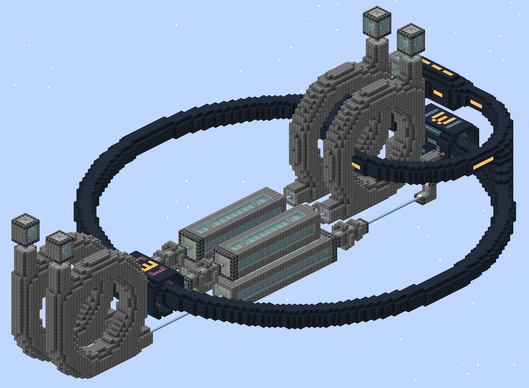
The LHC is one part in a series of three or more multiblocks chained together with beam pipes and beam input/output hatches, as seen in the following image. At a minimum, a Source Chamber is needed to generate an input particle beam for the LHC and a Beam Crafter is needed to capture one or more of the output particle beams for recipes. A Linear Accelerator, Beam Mirror, Beam Splitter, and/or Beam Stabilizer could be included, but they are not required. The beam pipes cannot bend and do not need to be colored. The space between the multiblocks has no effect on the operation of the machine--build them as far apart or close together as preferred. For more specific construction requirements such as tiered components and material lists, visit the individual pages for each of the multiblocks.
Usage
The ultimate goal of the LHC is to produce new subatomic particles for advanced crafts. For example, the LHC is the only multiblock capable of producing gravitons for stable boson containment units, or muons for unknown particles. Therefore, it is required for the Forge of the Gods and the Stargate. The following subsections go into great detail on each part of the LHC to help break everything down, and the calculator linked at the top helps with any planning or equations.
Source Chamber
See More: Source Chamber
The Source Chamber is the first step in the LHC and generates a concentrated beam of subatomic particles from very specific solid or liquid inputs, listed below in the following table. The input or source material is incredibly important because it determines the base stats of the particle beam including the particle type, energy, focus, and rate. Two of the rows are grayed out because neutrons have neutral charge and therefore cannot be accelerated--they are useless to the LHC.
- Particle Type - The subatomic particle that makes up the particle beam. Particles have a charge, rest mass, and their own max particle energy.
- Energy - The energy of the particle beam measured in electron volts (eV). Determines which particles are discoverable in collider mode.
- Focus - The width of the particle beam. No effect in the LHC, ignore.
- Rate - The throughput/density of the particle beam. Determines how many particles are produced in collider mode.
| Source Material | Consumption | Min Power | Max Material Energy | Energy Ratio | Particle | Max Particle Energy | Focus | Rate | |
| Uranium-238 Dust | 1/s | 480 EU/t | 4.27 MeV | 999 | Alpha | 8.00 MeV | 90 | 1 | |
| Californium Dust | 1/s | 1,920 EU/t | 9.00 MeV | 999 | Neutron | 15.0 MeV | 95 | 10 | |
| Long Beryllium Rod | 1/s | 30,720 EU/t | 15.0 MeV | 999 | Neutron | 15.0 MeV | 95 | 10 | |
| Tungsten Rod | 1/s | 7,680 EU/t | 1.00 MeV | 0.1 | Electron | 5.00 MeV | 98 | 20 | |
| Long LaB6 Rod | 1/s | 7,680 EU/t | 5.00 MeV | 0.3 | Electron | 5.00 MeV | 99 | 60 | |
| Hydrogen Gas | 1,000 L/s | 491,520 EU/t | 1,000 MeV | 0.3 | Proton | 1,000 MeV | 99 | 40 | |
| Unstable Dust | 1/s | 1,966,080 EU/t | 1,700 MeV | 0.3 | Omega | 1,700 MeV | 99 | 60 |
The only other input to the Source Chamber is power and it determines the output beam energy. Multi-amp and laser energy hatches are not supported and there can only be one regular energy hatch, but the power requirements are very low anyway. For example, an LuV energy hatch is all that is needed to max out the beam energy for long LaB6 rods and upgrading it has no effect on the operation of the machine.
| Input | Beam Energy vs. Energy Hatch | ||||
| IV | LuV | ZPM | UV | UHV+ | |
| Uranium-238 Dust | 4.27 MeV | 4.27 MeV | 4.27 MeV | 4.27 MeV | 4.27 MeV |
| Californium Dust | 9.00 MeV | 9.00 MeV | 9.00 MeV | 9.00 MeV | 9.00 MeV |
| Long Beryllium Rod | ---- | 15.0 MeV | 15.0 MeV | 15.0 MeV | 15.0 MeV |
| Tungsten Rod | 0.05 MeV | 0.919 MeV | 1.00 MeV | 1.00 MeV | 1.00 MeV |
| Long LaB6 Rod | 0.712 MeV | 4.997 MeV | 5.00 MeV | 5.00 MeV | 5.00 MeV |
| Hydrogen Gas | ---- | ---- | ---- | 999.946 MeV | 1,000 MeV |
| Unstable Dust | ---- | ---- | ---- | ---- | 1,700 MeV |
Particle Accelerator
The LHC begins in accelerator mode which repeatedly accelerates the input particle beam on a 1 second cycle. This first increases the beam energy until the target beam energy is reached, and then it starts to increase the beam rate exclusively until the maximum number of cycles is reached. The beam energy and the beam rate never increase together in the same cycle; they are separate and sequential phases. The power cost of the LHC scales linearly with the current beam rate and quadratically with the total number of completed cycles () in accelerator mode, as seen in the following equation. Notice that nothing depends on the voltage or throughput of the energy hatch so it can potentially be overwhelmed and powerfail.
Set both the target beam energy (up to 2TeV) and the maximum number of cycles in the GUI of the controller. The beam energy determines which particles are discoverable and the beam rate determines how many particles are produced per cycle. The latter directly impacts the Beam Crafter's processing speed so increase that as much as possible if there is enough power to support it. Use the calculator in the GUI of the controller or the spreadsheet linked at the top to predict the power cost and other stats before enabling the machine.
| Beam Energy (MeV) vs. Phase 1 Cycles | |||||||||||||||||
| 0 | 1 | 2 | 3 | 4 | 5 | 6 | 7 | 8 | 9 | 10 | 11 | 12 | 13 | 14 | 15 | 16 | .... |
| 1.00 | 2.05 | 6.24 | 15.7 | 32.5 | 58.7 | 96.4 | 148 | 215 | 300 | 405 | 532 | 683 | 860 | 1,065 | 1,301 | 1,570 | .... |
| 4.27 | 5.32 | 9.51 | 19.0 | 35.7 | 61.9 | 99.7 | 151 | 218 | 303 | 408 | 535 | 686 | 863 | 1,069 | 1,305 | 1,573 | .... |
| 5.00 | 6.05 | 10.2 | 19.7 | 36.5 | 62.7 | 100 | 152 | 219 | 304 | 409 | 536 | 687 | 864 | 1,069 | 1,305 | 1,574 | .... |
| 1,000 | 1,001 | 1,005 | 1,015 | 1,031 | 1,058 | 1,095 | 1,147 | 1,214 | 1,299 | 1,404 | 1,531 | 1,682 | 1,859 | 2,064 | 2,300 | 2,569 | .... |
| 1,700 | 1,701 | 1,705 | 1,715 | 1,731 | 1,758 | 1,795 | 1,847 | 1,914 | 1,999 | 2,104 | 2,231 | 2,382 | 2,559 | 2,764 | 3,000 | 3,269 | .... |
The beam rate per cycle depends on whether or not the current beam rate is above the 15,000 soft cap and whether or not there is booster fluid present, as seen in the following equations. The only booster fluids are degenerate quark gluon plasma (QGP) and magmatter which are both made in the Forge of the Gods' heliofusion exoticizer module and both consumed at a rate (L/s) equivalent to the current beam rate. The former is unlocked in UIV and the latter is unlocked in UXV. Select the current booster fluid in the GUI of the controller and do not run out or else the LHC immediately shuts down. Both booster fluids also permanently set the beam energy to 1TeV which is more than enough for every single particle from every module.
| Beam Rate vs. Phase 2 Cycles | |||||||||||||||||||||
| 0 | 1 | 2 | 3 | 4 | 5 | 6 | 7 | 8 | 9 | 10 | 11 | 12 | 13 | 14 | 15 | 16 | 17 | 18 | 19 | 20 | .... |
| 1 | 2 | 3 | 4 | 6 | 8 | 11 | 15 | 20 | 26 | 34 | 45 | 59 | 77 | 101 | 132 | 172 | 224 | 292 | 380 | 494 | .... |
| 20 | 26 | 34 | 45 | 59 | 77 | 101 | 132 | 172 | 224 | 292 | 380 | 494 | 643 | 836 | 1,087 | 1,414 | 1,839 | 2,391 | 3,109 | 4,042 | .... |
| 40 | 52 | 68 | 89 | 116 | 151 | 197 | 257 | 335 | 436 | 567 | 738 | 960 | 1,248 | 1,623 | 2,110 | 2,743 | 3,566 | 4,636 | 6,027 | 7,836 | .... |
| 60 | 78 | 102 | 133 | 173 | 225 | 293 | 381 | 496 | 645 | 839 | 1,091 | 1,419 | 1,845 | 2,399 | 3,119 | 4,055 | 5,272 | 6,854 | 8,911 | 11,585 | .... |
The LHC automatically switches to collider mode as soon as the maximum number of cycles is reached. At that point the beam energy, beam rate, and power consumption are locked until the LHC is disabled, manually switched back to accelerator mode, or powerfails. If switching from collider mode back to accelerator mode, the beam energy and beam rate start from the current stats instead of completely resetting. Running out of source material or losing the input particle beam does NOT reset it, but changing the source material will. Therefore, accelerator mode determines the final stats of the particle beam and never needs to be used again unless changing stats or restarting the machine. Think of accelerator mode as the setup mode and collider mode as the operating mode.
Particle Collider
In collider mode, the input particle beam is split into two beams that travel in opposite directions around the larger ring, which then collide to randomly generate new particles in each of the installed modules. The collision energy is always twice the beam energy and must be greater than or equal to the rest mass of an output particle for it to even have a chance of appearing. Not every output particle is discoverable by each module either, as seen in the following tables.
In practice, this just means that the beam energy determines which particles are discoverable, and the filtered beam output hatches re-roll their particle type every second. The output hatches are completely independent from one another and must always select exactly one particle type each cycle, unless the beam energy is not high enough to produce anything. The selection is random based on a weighted system, which means particles with a higher weight are more likely to be selected than those with a lower weight. Blacklisting particles in an output hatch does NOT remove them from the pool of options or reduce the overall weight--it only prevents those particles from being outputted.
|
| ||||||||||||||||||||||||||||||||||||||||||||||||||||||||||||||||||||||||||||||||||||||||||||||||||||||||||||||||||||||||||||||||||||||||||||||||||||||||||||||||||||||||||||||||||||||||||||||||||||||||
Consider the CMS module, for example. There are seven potential particles and each one has its own unique rest mass. The highest probability of obtaining any one in particular occurs when the collision energy is between the target particle's rest mass and the next one up. That not only minimizes the number of discoverable particles but it also keeps the total weight as low as possible. Photons are guaranteed at 0.250 MeV beam energy because there is a 1,000 / 1,000 chance of producing them but increasing the beam energy to above 0.256 MeV reduces that chance to 1,000 / 1,800 since it would have to share with electrons. The probability of each particle at various beam energies (NOT collision) is listed below in the following tables for reference.
| Module | Beam Energy | Total Weight | Particle Probabilities | ||||||
| Photon | Electron | Muon | Proton | Omega | Tau | W Boson | |||
| CMS
(E) |
0.250 MeV | 1,000 | 100.00% | 0% | 0% | 0% | 0% | 0% | 0% |
| 0.256 MeV | 1,800 | 55.56% | 44.44% | 0% | 0% | 0% | 0% | 0% | |
| 52.830 MeV | 2,100 | 47.62% | 38.10% | 14.29% | 0% | 0% | 0% | 0% | |
| 469.14 MeV | 2,700 | 37.04% | 29.63% | 11.11% | 22.22% | 0% | 0% | 0% | |
| 836.23 MeV | 2,760 | 36.23% | 28.99% | 10.87% | 21.74% | 2.17% | 0% | 0% | |
| 888.45 MeV | 2,860 | 34.97% | 27.97% | 10.49% | 20.98% | 2.10% | 3.50% | 0% | |
| 40,185 MeV | 2,880 | 33.67% | 26.94% | 10.10% | 20.20% | 2.02% | 3.37% | 3.70% | |
| Module | Beam Energy | Total Weight | Particle Probabilities | |||||||||||||||
| Electron Neutrino | Muon Neutrino | Tau Neutrino | Electron | Muon | Eta | Proton | Neutron | Lambda | Omega | Tau | J/Psi | Upsilon | W Boson | Z Boson | Higgs Boson | |||
| ATLAS
(W) |
0.250 MeV | 600 | 41.67% | 33.33% | 25.00% | 0% | 0% | 0% | 0% | 0% | 0% | 0% | 0% | 0% | 0% | 0% | 0% | 0% |
| 0.256 MeV | 1,400 | 17.86% | 14.29% | 10.71% | 57.14% | 0% | 0% | 0% | 0% | 0% | 0% | 0% | 0% | 0% | 0% | 0% | 0% | |
| 52.830 MeV | 1,700 | 14.71% | 11.76% | 8.82% | 47.06% | 17.65% | 0% | 0% | 0% | 0% | 0% | 0% | 0% | 0% | 0% | 0% | 0% | |
| 273.93 MeV | 2,100 | 11.90% | 9.52% | 7.14% | 38.10% | 14.29% | 19.05% | 0% | 0% | 0% | 0% | 0% | 0% | 0% | 0% | 0% | 0% | |
| 469.14 MeV | 2,700 | 9.26% | 7.41% | 5.56% | 29.63% | 11.11% | 14.81% | 22.22% | 0% | 0% | 0% | 0% | 0% | 0% | 0% | 0% | 0% | |
| 469.79 MeV | 3,200 | 7.81% | 6.25% | 4.69% | 25.00% | 9.38% | 12.50% | 18.75% | 15.63% | 0% | 0% | 0% | 0% | 0% | 0% | 0% | 0% | |
| 557.84 MeV | 3,280 | 7.62% | 6.10% | 4.57% | 24.39% | 9.15% | 12.20% | 18.29% | 15.24% | 2.44% | 0% | 0% | 0% | 0% | 0% | 0% | 0% | |
| 836.23 MeV | 3,340 | 7.49% | 5.99% | 4.49% | 23.95% | 8.98% | 11.98% | 17.96% | 14.97% | 2.40% | 1.80% | 0% | 0% | 0% | 0% | 0% | 0% | |
| 888.45 MeV | 3,440 | 7.27% | 5.81% | 4.36% | 23.26% | 8.72% | 11.63% | 17.44% | 14.53% | 2.33% | 1.74% | 2.91% | 0% | 0% | 0% | 0% | 0% | |
| 1,548.5 MeV | 3,490 | 7.16% | 5.73% | 4.30% | 22.92% | 8.60% | 11.46% | 17.19% | 14.33% | 2.29% | 1.72% | 2.87% | 1.43% | 0% | 0% | 0% | 0% | |
| 4,730.2 MeV | 3,530 | 7.08% | 5.67% | 4.25% | 22.66% | 8.50% | 11.33% | 17.00% | 14.16% | 2.27% | 1.70% | 2.83% | 1.42% | 1.13% | 0% | 0% | 0% | |
| 40,185 MeV | 3,640 | 6.87% | 5.49% | 4.12% | 21.98% | 8.24% | 10.99% | 16.48% | 13.74% | 2.20% | 1.65% | 2.75% | 1.37% | 1.10% | 3.02% | 0% | 0% | |
| 45,594 MeV | 3,750 | 6.67% | 5.33% | 4.00% | 21.33% | 8.00% | 10.67% | 16.00% | 13.33% | 2.13% | 1.60% | 2.67% | 1.33% | 1.07% | 2.93% | 2.93% | 0% | |
| 62,555 MeV | 3,765 | 6.64% | 5.31% | 3.98% | 21.25% | 7.97% | 10.62% | 15.94% | 13.28% | 2.12% | 1.59% | 2.66% | 1.33% | 1.06% | 2.92% | 2.92% | 0.40% | |
| Module | Beam Energy | Total Weight | Particle Probabilities | ||||||
| Eta | Proton | Neutron | Lambda | Omega | J/Psi | Upsilon | |||
| ALICE
(S) |
273.93 MeV | 400 | 100.00% | 0% | 0% | 0% | 0% | 0% | 0% |
| 469.14 MeV | 1,000 | 40.00% | 60.00% | 0% | 0% | 0% | 0% | 0% | |
| 469.79 MeV | 1,500 | 26.67% | 40.00% | 33.33% | 0% | 0% | 0% | 0% | |
| 557.84 MeV | 1,580 | 25.32% | 37.97% | 31.65% | 5.06% | 0% | 0% | 0% | |
| 836.23 MeV | 1,640 | 24.39% | 36.59% | 30.49% | 4.88% | 3.66% | 0% | 0% | |
| 1,548.5 MeV | 1,690 | 23.67% | 35.50% | 29.59% | 4.73% | 3.55% | 2.96% | 0% | |
| 4,730.2 MeV | 1,730 | 23.12% | 34.68% | 28.90% | 4.62% | 3.47% | 2.89% | 2.31% | |
| Module | Beam Energy | Total Weight | Particle Probabilities | |
| Graviton | Higgs Boson | |||
| LHCb
(G) |
0.250 MeV | 400 | 100.00% | 0% |
| 62,555 MeV | 1,000 | 76.92% | 23.08% | |
The amount of particles produced is always equivalent to the beam rate. For example, if the beam rate is 50 then a filtered beam output hatch could produce 50 photons, 50 electrons, 50 more photons, and 50 muons across four cycles. More particles means faster crafts in the Beam Crafter.
Beam Crafter
See More: Beam Crafter
The Beam Crafter is the final step in the LHC and captures one or more of the output particle beams for recipes. More specifically, it permanently buffers up to 2B of each particle type and only ever consumes them when a recipe requires them. There is no passive decay and it does not matter which beam input hatch the particles enter through.
Beam Crafter recipes start immediately upon receiving any valid inputs and only finish when the machine receives enough of the required particles, similar to the Research Station and computation. Therefore, the duration of recipes is strictly determined by the rate at which particles are consumed. It could be instantaneous if there are enough particles stored in the buffer, or last forever if the collision energy of the LHC is not high enough to produce the required particles. All available recipes are listed below in the following table along with their requirements and the module(s) that can produce both particles on their own. The "none" column refers to using only a Source Chamber to produce the required particles--no LHC necessary.
| Recipe | Min Voltage | Particle 1 | Particle 2 | Modules | ||||||
| Type | Amount | Type | Amount | None | CMS | ATLAS | ALICE | LHCb | ||
| Neptunium-238 Dust | EV | Neutron | 250 | Neutron | 250 | ✓ | ✗ | ✓ | ✓ | ✗ |
| Unknown Particle (1) | LuV | Proton | 120 | Electron | 720 | ✓ | ✓ | ✓ | ✗ | ✗ |
| Unknown Particle (64) | LuV | Proton | 5 | Muon | 3 | ✗ | ✓ | ✓ | ✗ | ✗ |
| Stable Baryon Containment Unit | LuV | Proton | 20 | Neutron | 20 | ✓ | ✗ | ✓ | ✓ | ✗ |
| Unstable Ingot | ZPM | Z Boson | 5 | W Boson | 5 | ✗ | ✗ | ✓ | ✗ | ✗ |
| Plutonium Based Liquid Fuel (Ex) | ZPM | Eta | 2 | Upsilon | 2 | ✗ | ✗ | ✓ | ✓ | ✗ |
| Stable Lepton Containment Unit | ZPM | Electron | 20 | Electron | 20 | ✓ | ✓ | ✓ | ✗ | ✗ |
| Radioactive Mineral Mix Dust | ZPM | Neutron | 250 | Neutron | 250 | ✓ | ✗ | ✓ | ✓ | ✗ |
| Quantum Anomaly | UV | Neutron | 250 | Neutron | 250 | ✓ | ✗ | ✓ | ✓ | ✗ |
| CMS Casing | UV | Electron | 3,000 | Electron | 3,000 | ✓ | ✓ | ✓ | ✗ | ✗ |
| Stable Meson Containment Unit | UV | Eta | 20 | J/Psi | 20 | ✗ | ✗ | ✓ | ✓ | ✗ |
| ATLAS Casing | UHV | Tau | 900 | Tau | 900 | ✗ | ✓ | ✓ | ✗ | ✗ |
| Xenoxene Petri Dish | UHV | Tau | 300 | Tau Neutrino | 200 | ✗ | ✗ | ✓ | ✗ | ✗ |
| Stable Boson Containment Unit | UHV | Graviton | 20 | Graviton | 20 | ✗ | ✗ | ✗ | ✗ | ✓ |
| ALICE Casing | UEV | Muon Neutrino | 450 | Muon Neutrino | 450 | ✗ | ✗ | ✓ | ✗ | ✗ |
| LHCb Casing | UIV | Upsilon | 750 | Omega | 750 | ✗ | ✗ | ✓ | ✓ | ✗ |
| Energised Tesseract | UIV | Electron Neutrino | 50 | Tau Neutrino | 30 | ✗ | ✗ | ✓ | ✗ | ✗ |
| ZPIC Wafer | UIV | Graviton | 20 | Graviton | 20 | ✗ | ✗ | ✗ | ✗ | ✓ |
| Up-Quark Releasing Catalyst | UMV | Proton | 1,000 | Lambda | 1,000 | ✗ | ✗ | ✓ | ✓ | ✗ |
| Down-Quark Releasing Catalyst | UMV | Neutron | 1,000 | Lambda | 1,000 | ✗ | ✗ | ✓ | ✓ | ✗ |
| Charm-Quark Releasing Catalyst | UMV | J/Psi | 1,000 | J/Psi | 1,000 | ✗ | ✗ | ✓ | ✓ | ✗ |
| Strange-Quark Releasing Catalyst | UMV | Eta | 1,000 | Eta | 1,000 | ✗ | ✗ | ✓ | ✓ | ✗ |
| Bottom-Quark Releasing Catalyst | UMV | Upsilon | 200 | Upsilon | 200 | ✗ | ✗ | ✓ | ✓ | ✗ |
| Top-Quark Releasing Catalyst | UMV | Higgs Boson | 25 | Higgs Boson | 25 | ✗ | ✗ | ✓ | ✗ | ✓ |
| Boundless Cosmic Solder | UMV | Graviton | 50 | Higgs Boson | 5 | ✗ | ✗ | ✗ | ✗ | ✓ |
The CMS module only supports a few basic recipes such as the two for unknown particles. The ATLAS module supports nearly every recipe because it has such a large pool of particles but that also makes it difficult to obtain any one in particular. The ALICE module is also quite flexible but its pool is much smaller for more concentrated crafts. The LHCb module supports the most advanced recipes like the ZPIC wafer and stable boson containment unit, and is significantly better for the two rarest particles.
Summary
Particle beams have four unique characteristics: particle type, energy, focus, and rate. Particle type only matters when it's a neutron because having a neutral charge makes it incompatible with the LHC. Energy determines which particles are discoverable. Focus is unused and can be safely ignored. Rate determines the amount of particles per cycle and therefore the overall processing speed of Beam Crafter recipes.
1. The Source Chamber sets the initial stats of the particle beam based on the input or source material and the voltage of the machine. Running out of source material or losing the input particle beam does NOT reset the LHC, but changing the source material will.
2. The LHC begins in accelerator mode which repeatedly accelerates the input particle beam on a 1 second cycle. This first increases the beam energy until the target beam energy is reached, and then it starts to increase the beam rate exclusively until the maximum number of cycles is reached. Set both the target beam energy (up to 2TeV) and the maximum number of cycles in the GUI of the controller.
3. The LHC automatically switches to collider mode once the maximum number of cycles is reached. At that point, the input particle beam is split into two beams that travel in opposite directions around the larger ring, which then collide to randomly generate new particles in each of the installed modules. In practice, this just means that the beam energy determines which particles are discoverable, and the filtered beam output hatches re-roll their particle type every second.
4. The Beam Crafter captures one or more of the output particle beams from the LHC and permanently stores up to 2B of each type of particle until a recipe requires them. The crafting speed depends exclusively on the available particles, not the provided power.
Beam Line Integration
See More: Beam Line
The LHC already uses the Source Chamber as input but it is also fully compatible with the Linear Accelerator (LINAC), Synchrotron, and Target Chamber since particle beams are universal regardless of where they originate or which machine(s) they pass through. The LHC is simply another tool for increasing the beam energy and rate to meet specific recipe requirements, and it happens to be surprisingly effective at engraving wafers. The main reason is that a single input beam produces multiple output beams all with the same energy, focus, and rate. Power can be concentrated into a single LHC rather than multiple Synchrotrons, which makes it approximately 15x more EU efficient than not using the LHC at all, at least until it reaches the 15,000 beam rate soft cap.
Proof of Concept
All Target Chamber recipes require a specific amount of photons within a specific energy range and above a minimum focus. The LHC can produce photons directly from the CMS module but the output beam energy is always way too high for even group 5 recipes, so that option is immediately discarded. In fact, the minimum output beam energy for any particle from any module is 1.42 MeV so it must be reduced by the Synchrotron and/or the LINAC prior to entering the Target Chamber. And if it must pass through those multiblocks, then the charge of the particle cannot be neutral which leaves the following options. Technically the focus also needs to be greater than 25 to enter the Synchrotron but that is never an issue since the LHC does not reduce focus at all.
| Particle | Charge | Rest Mass | Min Beam Energy | Weight | Modules |
| Electron | -1 | 0.511 MeV | 0.256 MeV | 800 | CMS, ATLAS |
| Muon | -1 | 105.66 MeV | 52.830 MeV | 300 | CMS, ATLAS |
| Proton | +1 | 938.27 MeV | 469.14 MeV | 600 | CMS, ATLAS, ALICE |
| Omega | -1 | 1,672.5 MeV | 836.23 MeV | 60 | CMS, ATLAS, ALICE |
| Tau | -1 | 1,776.9 MeV | 888.45 MeV | 100 | CMS, ATLAS |
| W Boson | +1 | 80,369 MeV | 40,185 MeV | 110 | CMS, ATLAS |
The obvious choice from these options is the electron because it requires significantly less energy than the rest. A single accelerator cycle with a target beam energy of 1 eV is all that is needed and then the remaining power/cycles can be used to increase the output beam rate, similar to how the Beam Line dumps power into the Synchrotron. Both the CMS and ATLAS modules are capable of producing electrons but the latter is better early on because electrons have a greater percentage of the total weight there--44% versus 57%. If using a booster fluid, then the percentages of obtaining any charged particle is 66% in CMS and 52% in ATLAS which makes the former a better option in the late game. Either way, neither module can perfectly isolate electrons so the other particles need to be blacklisted in the filtered beam output hatches or removed with a Beam Splitter.
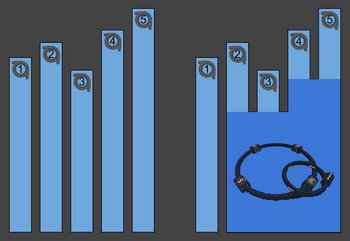
Finally, use a Beam Stabilizer to create a more continuous particle stream at the average beam rate and pass it through the LINAC, Synchrotron, and Target Chamber exactly like in a normal Beam Line. The LINAC is not technically necessary but it is much more precise than LHC acceleration cycles. Beam Crafters could be incorporated into the LHC Beam Line but that is not recommended because the extremely high energy levels required for Beam Crafter recipes is incompatible with the extremely low energy levels required for Beam Line recipes. This should be its own LHC.
 |
 |
Recommended Setups
The wide range of beam energy, focus, and rate requirements mean that a single Beam Line is not enough for all possible recipes. At a minimum, there must be five Beam Lines with varying LINAC lengths, energy hatches, and coolant. The following groupings are the wafers for each Beam Line and the table is the recommended setups for those groupings. The P values in parentheses are the number of Multiblock Structure Hologram Projectors to build the LINAC with that particular length. Use the LHC calculator linked at the top for more details and/or custom setups.
The problem with needing five Beam Lines is that electrons are only ever produced in the CMS and ATLAS modules which together have four filtered beam output hatches. That means a Beam Splitter is required to divide one of the outputs into two separate particle beams, or one of the groups must be processed separately. The recommendation is to build a single regular Beam Line or multiple Hyper-Intensity Laser Engravers for group 1 because it can only use T1 antenna casings in the LHC Beam Line and those recipes are very cheap and quick anyway.
Group 1 (2-4 eV)
|
Group 2 (8-10 eV)
|
Group 3 (190-200 eV)
|
Group 4 (2,000-3,000 eV)
|
Group 5 (6,000-9,000 eV)
|
Increase the number of LHC acceleration cycles to scale the throughput of all Beam Lines simultaneously, or upgrade the energy hatches on the Synchrotrons to increase the throughput of one Beam Line in particular. The LHC module is also not a hard requirement and can be switched without any changes to the rest of the setup. The voltage of the Target Chamber is simply a minimum requirement and has no effect on the operation of the machine. The coolant used for group 1 may be swapped for Super Coolant. However, to use the numbers from the following table, the source material must be unstable dust, as different source materials have different energies.
| Group | Source Chamber | Large Hadron Collider | Linear Accelerator | Synchrotron | Target Chamber | |||||||||||||||
| Input | Voltage | Target Energy | Cycles | Module | Particle | Length | Coolant | Voltage | Antennas | Coolant | Hatches | Energy | Focus | Rate | Voltage | |||||
| Group 1 | LaB6 | LuV | 1 eV | 8+ | CMS | Electron | 23 | Coolant+ | EV | T1 | Coolant+ | 4x LuV+ | 2.03 eV | 57.6 | 18+ | EV+ | ||||
| Group 2 | LaB6 | LuV | 1 eV | 8+ | CMS | Electron | 31 | S. Coolant | LuV | T1 | S. Coolant | 4x ZPM+ | 8.18 eV | 72.3 | 37+ | EV+ | ||||
| Group 3 | LaB6 | LuV | 1 eV | 7+ | CMS | Electron | 31 | S. Coolant | EV | T2 | S. Coolant | 4x ZPM+ | 192.8 eV | 72.3 | 72+ | EV+ | ||||
| Group 4 | LaB6 | LuV | 1 eV | 6+ | ATLAS | Electron | 37 | S. Coolant | ZPM | T2 | S. Coolant | 4x ZPM+ | 2,151 eV | 79.2 | 71+ | LuV | ||||
| Group 5 | LaB6 | LuV | 1 eV | 5+ | ATLAS | Electron | 29 | S. Coolant | UHV | T2 | S. Coolant | 4x ZPM+ | 6,052 eV | 72.7 | 54+ | LuV | ||||
| Construction Requirements | ||
Group 1
|
Group 2
|
Group 3
|
Group 4
|
Group 5
|
Total (Groups 2-5)
|
Trivia
- The only particle that the LHC cannot produce is the alpha particle, which is exclusive to the Source Chamber.
- The letters on top of the LHC modules are completely unrelated to the cardinal directions (east, west, south, gorth).
- The abbreviations of the four LHC modules all correspond to real-life LHC experiments at CERN.
- CMS = Compact Muon Solenoid
- ATLAS = A Toroidal LHC ApparatuS
- ALICE = A Large Ion Collider Experiment
- LHCb = Large Hadron Collider beauty