GT New Horizons · Ultimate Voltage (UV)
Ultimate Voltage (UV)
Ultimate Voltage (UV) is the eighth electric tier in GregTech: New Horizons. It is largely centered around the new Wetware circuit line, which introduces new multiblocks like the Quantum Computer and Research Station, as well a-s the new technologies that are unlocked with them, like the third tier of Fusion Reactor. It also introduces many multiblocks for improving infrastructure, including the Mega Alloy Blast Smelter, Component Assembly Line, and Space Elevator, as well as key automation tools like the Stocking Input Hatch.
Progression
Tier 7 Rocket
The Tier 7 Rocket is available as soon as the player is able to power their Assembly Line with two UV Energy Hatches to overclock it to UHV. It unlocks four new planets: Haumea, Makemake, Pluto, and the Kuiper Belt, which should only be mined using Void Miners at this point. The most useful planet to mine is Haumea, which has the earliest source of Nether Star Ore as well as a high chance for Infused Gold Ore, making it very useful for setting up the second tier of Naquadah Fuel. Other new ores are Borax, Red Garnet, Yellow Garnet, and Chrysotile. The available underground fluids are Hydrofluoric Acid on Makemake, and Oxygen, Nitrogen, Fluorine, and Liquid Air on Pluto.
The dungeons containing the next tier of schematic are found on Pluto, alongside the Draconic Core Schematic for the Draconic Evolution Fusion Crafter. It is highly recommended to place the Tier 8 Rocket Schematic in a singleblock Scanner (a Research Station in Scanner mode will not work) and duplicate it using a UV Circuit Assembler, because two Tier 8 Rocket Schematics will be needed: one for making the Tier 8 Rocket, and one to be researched for the Shuttle Schematic for the Mothership.
Wetware Circuits
Wetwares are the UV circuit line, spanning from LuV to UHV, which are required for advanced UV components and machines and will be used in UHV as an on-tier circuit. Wetwares are the first circuits that require the Assembly Line to produce, using it for the Neuro Processing Units that are required for the first circuit, the Wetwareprocessor. In addition, all UHV and above circuits, of which the Wetware Mainframe is the first, must be made in the Assembly Line and do not have Circuit Assembly Line recipes. The Advanced Assembly Line is highly recommended in order to produce these circuits faster. The Wetware Mainframe is also the first recipe to require the Research Station in order to obtain its Data Stick instead of the Scanner.
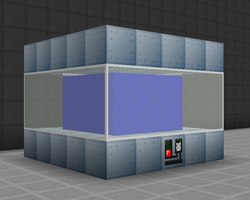
They are also the first required use of the Bacterial Vat, in order to make the Raw Growth Catalyst Medium for many different components of the circuits. This multiblock has a unique mechanic where the Output Hatch must be kept half full in order to maximize production speed and minimize item inputs. It also requires the use of the singleblock Bio Lab to produce cultures, which must be inserted into the controller for each Bacterial Vat. Note that many Bio Lab recipes require the items to be placed in the exact slot shown on NEI, unlike other singleblock machines. The necessary cultures for Raw Growth Catalyst Medium are easy to produce in sufficient quantities, but later cultures will be much more complex.
There are three different recipes for Raw Growth Catalyst Medium. The Mutagen recipe is the best for any players with sufficient bee breeding progress to access the Mutagen Producer, which can and should be accelerated with a World Accelerator, since it is the cheapest on item inputs and using it cuts out previous Bacterial Vat or Big Barrel Brewery steps. Otherwise, the three recipes are equally fast when accounting for their different voltages, and the decision of which to use is largely determined by which input fluid is easiest to obtain.
Because Wetwares rely on slower machines such as the Bacterial Vat and Assembly Line, in addition to having slower recipes in the Circuit Assembly Line, most players opt to continue using Crystals for LuV through UV circuits, and relegate Wetwares to only being used for UHV circuits.
PCB Factory
The PCB Factory is unlocked with Wetware Circuit Boards, and can be immediately upgraded with the Biochamber to be able to make said boards. With the upgrades available in UV, it is unable to overclock or parallel at all, even imperfectly. This makes it extremely slow, but it is still far cheaper than the standard Large Chemical Reactor recipes, making it a valuable upgrade for the expensive Wetware boards.
Research Station
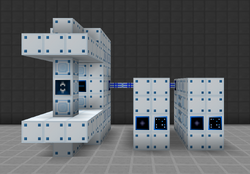
The Research Station is a new multiblock that replaces the Scanner for most Assembly Line recipe scans from UV onwards. Each Research Station recipe has a minimum computation rate in order to run at all, in addition to a total computation requirement to complete the research; most relevant recipes will have low computation rate requirements for a while, but building more computation than strictly necessary will make researching much faster. Each recipe also consumes varying amounts of EU/t, so more computation will save power by not having to draw that power for as long. The Research Station can also be used for Scanner recipes, and is much faster, usually completing them in less than a second.
Quantum Computer
The Quantum Computer is used to produce a new resource called computation, which is required to run the Research Station as well as other future multiblocks such as the Space Elevator. It has a variable length of between 5 and 16, corresponding to between 2 and 24 Computer Racks, each of which can be filled with circuits to generate computation and cooling devices to prevent overheating.
Optimal layouts for the Quantum Computer are shown on its page. The best layout available in UV before Wetware Mainframes is 24 racks with two Cooling Cores and two Tier 3 APUs each, although cheaper ones using Crystalprocessor Mainframes or less racks are also viable if less efficient. Layouts that produce more computation will speed up researches and therefore save on power, as well as allowing more recipes to be researched based on their minimum computation requirements.
Waterline
Like ZPM, UV brings two new steps to the Waterline, one of which is required in the tier and one of which is not required except as an ingredient to the next grade of water. The Extreme Temperature Fluctuation Purification Unit and its associated Grade 5 water are needed to process Americium-Doped Wafers, which are needed for QPIC Wafers for the Mk3 Fusion Reactor. The High Energy Laser Purification Unit and Grade 6 water are not required until UEV when Grade 7 water must be made, but since it is a significant improvement over Grade 5, and UHV will require large amounts of wafers, it's generally advisable to make it sooner than that. Grade 6 or above water is also required for the most advanced Beam Line masks.
Fusion Reactor Mk3
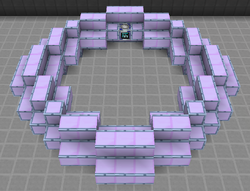
Like the previous two tiers, a new Fusion Reactor is the final goal of progression in UV, although it is not as central to said progression as the first two were. It also gets a 2/2 overclock on all Mk2 recipes, and an additional 2/2 overclock on Mk1 recipes as compared to the Fusion Reactor Mk2.
The most notable recipes unlocked by the Mk3 Fusion Reactor are:
- Americium Plasma from Plutonium 241 and Hydrogen, which is immensely faster than the existing Americium recipe: it takes only 3.2 seconds per ingot, compared to 43.2 seconds for the previous recipe in a Mk2 reactor or 21.6 seconds in a Mk3, a speedup of 13.5x or 6.75x; this immense speed increase means it should be the main Americium source as soon as the Mk3 reactor is unlocked, unless meteors or bees are used instead.
- Oganesson, a two-step recipe that first requires Californium from Beryllium and Plutonium 239, with Calcium then added to make Oganesson. It has many uses for recipes later in progression, but its primary uses in UV and UHV are as the best noble gas for Electric Blast Furnace recipes (albeit far too expensive in most cases), where it is 25% faster than Xenon on all recipes that can use it, and for the Void Miner, where it produces 4x as many ores as Xenon.
- Bismuth Plasma, from Tantalum and Zinc Plasma, is used for circuits and soldering starting in UHV, and is the second tier of plasma for the Space Elevator Mining Module.
Some other resources can be produced more easily as well:
- Neutronium can be fused from Americium and Naquadria at 12 seconds per ingot, providing a usable alternative to smelting it, especially if a Compact Fusion Reactor is used.
- Indium can be made from Silver and Lithium, taking 14.4 seconds per ingot.
The "plasma chain" of advanced fusion fuels is finished in the Fusion Reactor Mk3:
- Curium is part of the plasma chain, and is used in an alternate Californium recipe in the future.
- Xenon Plasma, Advanced Nitinol Plasma, and Celestial Tungsten Plasma are the final steps in the plasma chain, producing the best plasma fuel in the game as well as an alternate source of Celestial Tungsten and Advanced Nitinol as materials. Fusing Celestial Tungsten requires Tartarite, so it requires either a Tier 8 Rocket or the Space Elevator in order to reach Tier 8 planets.
Finally, there are a few new materials with no uses until later:
- Silver Plasma is used in UHV for a new plastic, Radox Polymer.
- Rubidium, Nickel Plasma, and Iron Plasma have no uses until UEV.
Compact Fusion
Compact Fusion Reactors are much larger fusion reactors that have roughly the production capacity of 64 standard reactors for the cost of 48. All five tiers of Fusion Reactor have Compact equivalents, but the Mk3 is the first one that is generally considered worth making. The Compact Fusion Reactor is fast enough to use for on-demand fusion recipes, in addition to being an immense upgrade for any passive fusion recipes with sufficiently high demand to justify it.
Cosmic Neutronium
Cosmic Neutronium is a material that plays a similar role in UHV as regular Neutronium does in UV, being used for almost every component as well as for the superconductor. However, unlike regular Neutronium, it cannot be mined directly from planets until the Mothership; it can be mined by the Space Elevator, but only with a Mk2 module, requiring significant progress in UHV first. The main way to produce it is instead by centrifuging Black Plutonium Dust. On average, 101 Black Plutonium is required per ingot of Cosmic Neutronium. Since both centrifuging and smelting is slow, it is highly recommended to make both steps passive, similar to Neutronium.
Meteors
Another option for players with enough magic progress is meteors, specifically the UV Crop Synthesizer meteor, which is unlocked with UHV circuits. If boosted with Orbis Terrae, this meteor contains around 2000 Cosmic Neutronium Ore when mined with Arcane Bores or manually, and triple that if an Ore Drilling Plant is used instead. By summoning them repeatedly, it's possible to amass very large quantities before getting access to the ore through the Space Elevator. The meteor also has other very useful ores, including a similar amount of Americium Ore, as well as Infinity Catalyst Ore, which can be used for earlier access to Infinity.
Infrastructure Improvements
Power
UV is the point at which power generation from the early game falls off: Nitrobenzene, Rocket Fuel, and Nuclear Reactors can last up to this point, but should be replaced by the start of the next tier. Plasma or Naquadah Fuel, both of which are viable in UV and able to scale for multiple more tiers, should be used instead. Plasma gains access to the Fusion Reactor Mk3, which provides both access to the best plasma chain fuels and an overclock on earlier fusion recipes to reduce the need for spam, and the Stocking Input Hatch helps parallelize on slower fusion steps. It also benefits from new better turbine materials, such as Cosmic Neutronium. Naquadah Fuel also benefits from these improvements for its slow fusion step, and gains access to Haumea Void Miners, the Space Elevator, and the Mega Apiary to help source its inputs.
Stocking Input Hatch
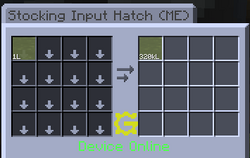
The Stocking Input Hatch is an extremely powerful tool for automation that is unlocked with Neuro Processing Units and UV Electric Pumps. It functions identically to the non-advanced Stocking Input Bus, except that it works with fluids instead of items. It can be used to parallelize passive machines using fluids, such as Fusion Reactors, or to move fluids into passive machines more quickly, but it also has many applications for on-demand crafting. It can be used in concert with Advanced Stocking Input Buses to automate large arrays of multiblocks with recipes that require fluids, using a subnet to allow them to all access the same inventory of fluid, at the cost of being limited to only 16 fluids that must be configured manually. Stocking Input Hatches also have the ability to send 2.1 GL per tick to a multiblock, helping to avoid recipe switching bottlenecks with extremely fast machines like the Mega Chemical Reactor when AE2 cannot push items into them fast enough.
Mega Alloy Blast Smelter
The Mega Alloy Blast Smelter (MABS) is a mega version of the Alloy Blast Smelter that can be made as soon as the player has UV Energy Hatches. Like other mega multiblocks, it has 256 parallels, support for multi-amp hatches, and support for laser hatches with UV-tier glass or better. It also has tiered coil and glass blocks, the former providing speed and energy bonuses, and the latter being used to determine the maximum recipe tier. The MABS should be a priority upgrade both for the immense speed increases it provides to ABS recipes, which are otherwise often very slow and near-impossible to speed up effectively, as well as for its ability to tierskip by using glass tier instead of energy hatch tier to determine its maximum recipe tier.
Component Assembly Line
The Component Assembly Line (CoAL) is a new multiblock for assembling components, such as Electric Motors, Robot Arms, and Sensors. It provides a 25% discount on both resources and time, as well as skipping the Assembly Line, two incredible advantages that mean it should be the only source of components whenever it can be used. The main cost of the CoAL is the 43 tiered Component Assembly Line Casings that determine the maximum available tier of components: a full CoAL takes 688 Electric Motors, 430 Electric Pistons, and 344 Robot Arms of its tier. In UV, both the UV and ZPM CoAL tiers are viable. The ZPM CoAL doesn't help with UV components, but it is much cheaper than the UV CoAL, and still useful for LuV and ZPM superconductors in particular, which are used for Fusion Reactor coils and Wetware Mainframes. The UV CoAL adds the ability to make UV components, but is very expensive, particularly on Americium, until late in the tier.
UU-Matter
UU-Matter begins to be used for crafting in UV, and will continue to be necessary for the rest of the game, particularly for circuits, nanites, and the Space Elevator. In order to obtain it in large quantities, the new Matter Fabrication CPU should be used once the player has a Quantum Anomaly to use to craft it. It has a free EU discount compared to its singleblock equivalent, access to parallels in addition to the existing perfect overclock all Mass Fabricators have, and the ability to use multiple Energy Hatches to scale better. It can also be used to produce Scrap and UU-Amplifier, but this is generally not as effective as overclocking more or placing more Matter Fabrication CPUs.
Elemental Duplicator
The Elemental Duplicator is the multiblock version of the Replicator, which can synthesize pure elements directly from UU-Matter. It is unlocked in UV, although it also requires a Quantum Anomaly in its recipe. It is most useful for certain rare elements, such as Oganesson, that are difficult to produce in sufficient quantities with other recipes.
Cheaper Crystal Circuits
The UV Energy Hatch unlocks a cheaper recipe for Crystalprocessors in the Circuit Assembly Line using Crystal SoCs. These SoCs can be made by engraving Crystal Processing Units, but it is far faster to make them from Ce:LuAG instead. There are two machines that can be used for Ce:LuAG: the Vacuum Furnace, which requires a loop, and the Industrial Autoclave, which requires Oganesson for the recipes without a chance of failure. Crystal SoCs will also be required in UHV for that tier's circuits.
Sidequests
Quality of Life
Auto-Taping Maintenance Hatch
The final maintenance upgrade in the game is the Auto-Taping Maintenance Hatch, which infinitely prevents all maintenance issues on multiblocks, without requiring any input at all. It also continuously fixes maintenance issues on connected multiblocks, meaning that it is no longer necessary to conduct maintenance on a multiblock before turning it on. Wallsharing can be useful in order to reduce the number of Auto-Taping Maintenance Hatches required for large arrays of multiblocks, and since there's never a need to access them, they can be placed in inaccessible locations in order to save on useful shared hatch space.
Laser Vacuum Mirror
The Laser Vacuum Mirror is an upgraded laser pipe that can be used to rotate lasers, although merging or splitting them still requires an Active Transformer. It requires UHV circuits as well as Chromatic Glass, the latter being made in a Hyper-Intensity Laser Engraver with a Quantum Anomaly as the lens.
Nano Forge and Nano Resin
The Nano Forge is a very large multiblock used to fabricate various tiers of nanites; it can be crafted in UV, but is not required until UHV. Crafting and running it requires 18 Carbon Nanites to be made using the much more expensive Assembly Line recipe: 1 to scan for the Data Stick, 16 to make the controller, and 1 to place inside the controller once it is built. The tier of the Nano Forge is determined by both the structure and the nanite placed inside the controller; it is possible to build the Tier 3 structure immediately, but actually upgrading to that tier is not possible until UEV. The Tier 2 is possible to build in UV with a Quantum Anomaly for the Neutronium Nanites, but provides no benefit other than perfect overclocks on Tier 1 recipes.
The main use for the Nano Forge in UV is for Nano Resin, a new way to produce desired lanthanides extremely easily from any lanthanide ore. A Nano Resin for a supported element can be made by combining one dust of that element with P-507 and Carbon Nanites. Each Nano Resin can be reused infinitely. In order to extract elements using it, the first step is to place a lanthanide crushed ore or ore concentrate dust in the Digester to get [Element] Chloride Concentrate. This first intermediate must be extracted using a Nano Resin matching the element of the ore, producing a Filled [Element] Extracting Nano Resin. By electrolyzing the filled Nano Resin, the Chlorine and original Nano Resin are recovered, and the lanthanide is obtained in molten form. In addition, extracting the element via Nano Resin leaves Chlorinated Rare Earth Concentrate, which can be processed by any Nano Resin, regardless of what the original ore was. This can be done for two more steps, for Chlorinated Rare Earth Enriched Solution and Chlorinated Rare Earth Diluted Solution, and it's possible to use the same Nano Resin for multiple steps, making Nano Resin a very strong source of lanthanide elements. The available elements from Nano Resin are:
- Cerium
- Dysprosium
- Erbium
- Europium
- Gadolinium
- Holmium
- Lanthanum
- Lutetium
- Neodymium
- Praseodymium
- Promethium
- Samarium
- Terbium
- Thulium
- Ytterbium
Space Elevator
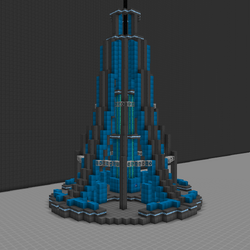
The Space Elevator is a modular multiblock that can be made late in UV, after obtaining UHV circuits. Although it supports many different modules with various abilities, the only one obtainable in UV is the first tier of Space Mining Module, which can produce hundreds or thousands of ores per second using a non-consumed tiered mining drone, computation from a Quantum Computer, rods and drill tips of varying materials depending on the mining drone, and Helium, Bismuth, or Radon Plasma. It can also be configured to change the available ores and modify the chances of each ore being produced. Using the Space Elevator effectively requires robust ore processing, including any processing lines like the Platline or Naqline whose inputs come from ores, and sufficient automatic production of plasma and rods/drill tips of the relevant material. Although it is available in UV, it is expensive enough and available late enough in the tier that many players do not build it until UHV.
The Space Elevator can also be used to travel to any planet up to Tier 8, although it cannot be used to return, so it's necessary to bring a rocket or other means of teleportation to get back. This mechanic can be used to reach Tier 8 planets without the Tier 8 Rocket, and thereby gain earlier access to materials like Awakened Draconium and Infinity Catalyst. An upgrade to Tier 3 motors unlocks travel to Tier 9 planets in UIV.
Mega Apiary
The Mega Apiary is the endgame solution to using bees for resource generation. It can fit thousands of bees, each with the equivalent of 64x acceleration and 8 production upgrades, and guarantees perfect conditions for all of them at once. There are also a few bees that can only produce anything when inside the Mega Apiary. The most notable of these bees in UV are the Americium Bee, the Xenon Bee, and the Drake Bee (which requires the Mega Apiary for Awakened Draconium, but not regular Draconium). It also makes it very easy to scale production, thanks to its Swarmer mode that produces duplicate princesses from a queen infinitely and the fact that it will never kill ignoble bees.
Neutronium Compressor
The Neutronium Compressor is a multiblock that is used to make Infinity Catalyst and Singularities. It has no uses until UHV for most players, but is available in UV, and can be used to get early Infinity for various quality of life upgrades and an improved PCB Factory for players using meteors or the Space Elevator for early Infinity Catalyst.
Kevlar
Kevlar is a fiber that can be made in UV; it has an infamously complex production chain, of similar complexity to the entire Platline. It is not necessary until the Mothership in late UHV, but it can be used before that in the PCB Factory for better speed and resource efficiency compared to PBI. Many players instead opt to use the Kevlar Bee, which produces Kevlar Nuggets in the Mega Apiary, for the small amount of Kevlar that is required until the line can be skipped with the tier 4 Quantum Force Transformer.