GT New Horizons · Insane Voltage (IV)
High Temperature Gas-Cooled Reactor
The High Temperature Gas-Cooled Reactor (HTGR) is an IV tier multiblock that decays TRISO balls through nuclear fission for their valuable byproducts. The HTGR must be primed with at least 100 TRISO balls and 51,200L of helium to start processing, but having any less than the maximum 10,000 TRISO balls and 512,000L of helium reduces efficiency and increases power consumption. Optionally, supply coolant and/or distilled water to drastically accelerate the decay process and reduce the maximum duration from 4,000 seconds to only 10 seconds. The HTGR consumes up to 0.14% of the TRISO balls and 0.05% of the helium at the very beginning of each cycle, but then uses as little as 1,536 EU/t to produce up to 11,783 L/t of hot coolant and 377,062 L/t of steam for the next 10 seconds. Burned out TRISO balls can be recycled in an Industrial Centrifuge for some of the original resources back and a few other valuable byproducts such as sunnarium, indium, lutetium, and lanthanum. The peak fuel throughput is 20,736 TRISO balls per hour.
The hot coolant is used by the Thermal Boiler, Large Heat Exchanger, or Whakawhiti Wera XL to produce superheated steam, or the Extreme Heat Exchanger to produce supercritical steam. The steam is then used to generate power in a series of Large Steam Turbines. Expect upwards of 395A of LuV power per HTGR at maximum efficiency. The HTGR is very similar to the Thorium High Temperature Reactor (THTR). The difference is that the THTR runs for significantly longer and produces hardly any byproducts. In other words, use the HTGR for resources and the THTR for power.
Spreadsheet: GTNH Power Planner 2.9
Construction
The HTGR consists of four individual structures. The exact locations of these structures are fixed in reference to the controller and all four are necessary for the structure to form. The large purple sphere is the reactor which has an input bus on top for TRISO balls and and output bus on bottom for burned out TRISO balls. The tall vertical structure in the middle is the primary coolant tower which has an input hatch on the side for coolant and an output hatch on the top for hot coolant. The smaller vertical structure on the edge is the secondary coolant tower which has an input hatch near the top for distilled water and an output hatch near the bottom for steam. The helium input hatch, energy hatch, and maintenance hatch are all limited to the top three casings above the pump at the center of the structure. Multi-amp and laser energy hatches are not supported and there cannot be more than one regular energy hatch. Use the Multiblock Structure Hologram Projector to visualize/build the structure.
Structure
- Controller: Front center, 2nd layer
- 273 Beryllium Integrated Reactor Casing
- 272 Pressure Containment Casing
- 164 Tungsten Frame Box
- 162 Graphite Moderator Casing
- 45 Tungstensteel Pipe Casing
- 41 Insulated Fluid Pipe Casing
- 30 Titanium Pipe Casing
- 24 Cable Casing
- 23 IV Machine Casing
- 20 Refined Graphite Block
- 17 Steel Pipe Casing
- 3 Pump Machine Casing
- 2 Motor Machine Casing
- 1 Processor Machine Casing
- 1 Energy Hatch: Any top pump casing
- 1 Maintenance Hatch: Any top pump casing
- 1 Input Bus: Top of reactor (TRISO Balls)
- 3 Input Hatch: Any top pump casing (helium), bottom of tall tower (coolant), top of short tower (distilled water)
- 1 Output Bus: Bottom of reactor (Burned Out TRISO Balls)
- 2 Output Hatch: Top of tall tower (hot coolant), bottom of short tower (steam)
Wallsharing
HTGRs cannot wallshare any significant part of their structure due to the restrictions on the location of the buses/hatches and the inability to rotate or flip the controller. Not even the reactor portion can be shared because it is not perfectly symmetrical.
Usage
The HTGR uses helium gas to stabilize the fission decay of TRISO balls inside the reactor. The end result is burned out TRISO balls which can be recycled in an Industrial Centrifuge for some of the original resources back, and a few other valuable byproducts. Each of the nine different types of TRISO balls have their own unique outputs and properties. Optionally, supply the HTGR with coolant and/or distilled water to drastically accelerate the decay process and burn through fuel much quicker while also generating a significant amount of hot coolant and steam for power generation.
The HTGR has two operating modes, listed below. Switch modes by right-clicking the controller with a screwdriver while the machine is idle. Do not enable the machine until all TRISO balls and helium have entered the reactor to maximize efficiency. View their current amounts as well as the consumption rates of coolant and water in the GUI of the controller.
- Normal - Stores TRISO balls and helium internally, and starts processing when the minimum conditions are met.
- Emptying - Returns all stored TRISO balls to the output bus.
Each cycle or operation consumes up to 0.14% of the total TRISO balls and 0.05% of the total helium at the start and runs for the next 214 to 4,000 seconds depending on the fuel used and the efficiency of the machine or how many TRISO balls were present at the start. The only mandatory input during that time is power which ranges from 1,536 - 61,440 EU/t depending on how much helium was present at the start. The two optional inputs, coolant and distilled water, together reduce the duration of the cycle down to only 10 seconds.
Fuel
The HTGR consumes TRISO balls (NOT pellets) for fuel. There are nine different types in total each with their own unique outputs and properties, but they can all be used in the same machine at the same time if necessary. The minimum amount of fuel to begin processing is 100 TRISO balls, but having any less than the maximum 10,000 TRISO balls reduces the efficiency of the machine, as seen in the following equation and graph. The efficiency cannot be increased while the machine is active and cannot exceed 100%. Maintenance issues reduce the maximum efficiency by 20% each.
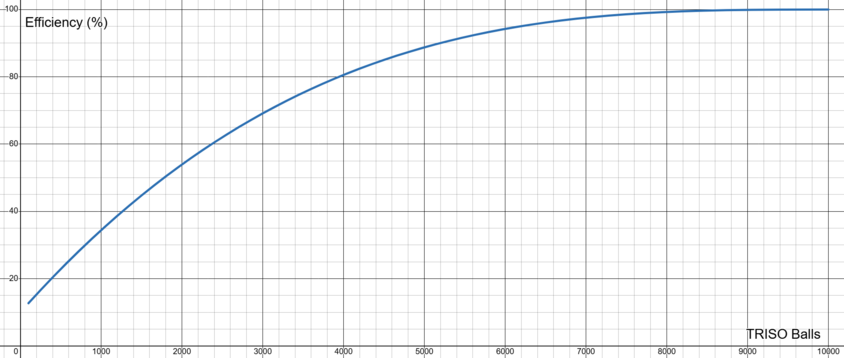
The efficiency of the HTGR is directly proportional to the duration of each cycle, as seen in the following equation. The first term depends on the properties of the TRISO ball used. The minimum duration is 177 seconds and the maximum duration is 4,000 seconds, although that can be significantly reduced with coolant and/or distilled water.
The efficiency of the HTGR is also directly proportional to the amount of TRISO balls consumed/burned per cycle, as seen in the following equation. The maximum is 14.15 TRISO balls per cycle, but the rate (without coolant or distilled water) is fixed at per hour regardless of the duration since both variables scale linearly with efficiency.
The HTGR outputs the same number of burned out TRISO balls once the cycle is complete. Centrifuge the burned out TRISO balls for some of the original resources back, and a few other valuable byproducts, as seen in the following tables. Most notably, glowstone TRISO balls produce sunnarium, silver TRISO balls produce indium, thorium TRISO balls produce lutetium, and caesium TRISO balls produce lanthanum.
|
|
| ||||||||||||||||||||||||||||||||||||||||||||||||||||||||||
|
|
| ||||||||||||||||||||||||||||||||||||||||||||||||||||||||||
|
|
| ||||||||||||||||||||||||||||||||||||||||||||||||||||||||||
Coolant
Helium is the only mandatory coolant in the HTGR. The minimum amount to begin processing is 51,200L but having any less than the maximum 512,000L increases the power consumption of the machine, as seen in the following equation. The HTGR consumes 0.05% of the current helium at the start of each cycle so it needs to be slowly refilled with over time. The maximum power consumption is 61,440 EU/t and the minimum power consumption is 1,536 EU/t. The maximum helium throughput is 25.6 L/s when using both coolant and distilled water.
Coolant and distilled water are optional but drastically accelerate the decay process of the TRISO balls. Coolant skips 7% of the total duration per second, distilled water skips 3% of the total duration per second, and together they skip 10% of the total duration per second. That means a full 4,000 second cycle can finish in under 10 seconds and still consumes the same amount of TRISO balls. Although terribly inefficient for power generation, this is extremely useful for breeding and harvesting byproducts. The base TRISO balls per hour increases up to TRISO balls per hour.
The amount of coolant and distilled water consumed by the HTGR depends on the current amount of TRISO balls and helium, as seen in the following table. The coolant is converted into hot coolant at a perfect 1:1 ratio while the distilled water is converted into steam at a 1:160 ratio.
| Input | Output | Consumption (L/t) | Skip |
| Distilled Water | Steam | +3% / s | |
| Coolant | Hot Coolant | +7% / s |
Multipliers
The properties of each TRISO Fuel are listed below in the following table. The average value of these properties ultimately determine the total cycle duration as well as the maximum throughput of coolant and distilled water, as seen in the following equations. The numerators have a summation because the HTGR can process multiple different types of TRISO balls simultaneously. The denominator is the total amount of TRISO balls for the base and 10,000 for the multiplier and exponent, which means the latter are significantly less effective with any less than the maximum. For example, if there are only 100 glowstone and 100 silver TRISO balls then the base would perfectly average to 0.375 but the resulting multiplier and exponent would only be 1.00 and 1.0002, respectively. The and values assume that all 10,000 TRISO balls are the same type.
| TRISO Fuel | Base | Mult | Exp | Max Input | Max Output | |||||
| Distilled Water | Coolant | Steam | Hot Coolant | |||||||
| Glowstone | 0.65 | 1.20 | 1.10 | x0.826 | x0.794 | 794 L/t | 3,972 L/t | 127,096 L/t | 3,972 L/t | |
| Silver | 0.10 | 0.80 | 1.10 | x0.826 | x0.078 | 78 L/t | 391 L/t | 12,518 L/t | 391 L/t | |
| Tungsten | 0.05 | 0.80 | 0.50 | x4.000 | x0.045 | 45 L/t | 224 L/t | 7,155 L/t | 224 L/t | |
| Thorium | 0.25 | 0.80 | 1.10 | x0.826 | x0.196 | 196 L/t | 978 L/t | 31,294 L/t | 978 L/t | |
| Uranium-235 | 1.10 | 1.10 | 1.10 | x0.826 | x1.222 | 1,222 L/t | 6,108 L/t | 195,454 L/t | 6,108 L/t | |
| Plutonium-239 | 2.00 | 1.20 | 0.90 | x1.235 | x2.357 | 2,357 L/t | 11,783 L/t | 377,062 L/t | 11,783 L/t | |
| Caesium | 0.50 | 0.90 | 0.90 | x1.235 | x0.455 | 455 L/t | 2,274 L/t | 72,763 L/t | 2,274 L/t | |
| Lanthanum | 0.50 | 0.80 | 0.90 | x1.235 | x0.409 | 409 L/t | 2,045 L/t | 65,444 L/t | 2,045 L/t | |
| Praseodymium | 0.75 | 1.20 | 0.70 | x2.041 | x0.852 | 852 L/t | 4,260 L/t | 136,335 L/t | 4,260 L/t | |
Power
Despite relatively high costs, the HTGR outputs up to 11,783 L/t of hot coolant and 377,052 L/t of steam for 10 seconds per cycle. The throughput of the coolant alone is 171x greater than the output of a Fluid Reactor, 61x greater than the output of a Deep Earth Heating Pump, and 2.45x greater than the output of the Thorium High Temperature Reactor. It is also more than enough to generate supercritical (SC) steam in an Extreme Heat Exchanger and superheated (SH) steam in a Thermal Boiler, Large Heat Exchanger, or Whakawhiti Wera XL. The only problem is that so much hot coolant requires a lot of heat exchangers and a massive supply of distilled water, as seen in the following table. The EHE is recommended over the WWXL because the supercritical steam yields more power overall.
Conversion Ratios
- 1 L/t Hot Coolant = 200 L/t SC Steam (EHE) or 200 L/t SH Steam (Thermal Boiler, LHE, WWXL)
- 160 L/t SC Steam = 160 L/t SH Steam = 160 L/t Steam = 1 L/t Distilled Water
| Hot Coolant | Heat Exchanger | Amount | Total Input | Total Output | |
| 3,972 L/t | Thermal Boiler | 158.9 | 4,965 L/t Water | 794,352 L/t SH Steam | |
| 3,972 L/t | Large Heat Exchanger | 49.7 | 4,965 L/t Distilled Water | 794,352 L/t SH Steam | |
| 3,972 L/t | Whakawhiti Wera XL | 1.55 | 4,965 L/t Distilled Water | 794,352 L/t SH Steam | |
| 3,972 L/t | Extreme Heat Exchanger | 0.62 | 4,964 L/t Distilled Water | 794,240 L/t SC Steam |
| Hot Coolant | Heat Exchanger | Amount | Total Input | Total Output | |
| 6,108 L/t | Thermal Boiler | 244.3 | 7,635 L/t Water | 1,221,588 L/t SH Steam | |
| 6,108 L/t | Large Heat Exchanger | 76.4 | 7,635 L/t Distilled Water | 1,221,588 L/t SH Steam | |
| 6,108 L/t | Whakawhiti Wera XL | 2.39 | 7,635 L/t Distilled Water | 1,221,588 L/t SH Steam | |
| 6,108 L/t | Extreme Heat Exchanger | 0.95 | 7,634 L/t Distilled Water | 1,221,440 L/t SC Steam |
| Hot Coolant | Heat Exchanger | Amount | Total Input | Total Output | |
| 11,783 L/t | Thermal Boiler | 471.3 | 14,729 L/t Water | 2,356,639 L/t SH Steam | |
| 11,783 L/t | Large Heat Exchanger | 147.3 | 14,729 L/t Distilled Water | 2,356,639 L/t SH Steam | |
| 11,783 L/t | Whakawhiti Wera XL | 4.60 | 14,729 L/t Distilled Water | 2,356,639 L/t SH Steam | |
| 11,783 L/t | Extreme Heat Exchanger | 1.84 | 14,728 L/t Distilled Water | 2,356,480 L/t SC Steam |
The natural order of XL Turbo Steam Turbines is listed below. All three types of steam have the same conversion ratio so the output of one can feed directly into the input of the next. At maximum efficiency, 100% of the steam is recycled back into distilled water--forming a sustainable closed loop system. Both SC steam and SH steam generate 2x more EU than regular steam at the same optimal flow rate.
- The XL Turbo SC Steam Turbine generates power from SC steam and converts it to SH steam at a 1:1 ratio.
- The XL Turbo HP Steam Turbine generates power from SH steam and converts it to regular steam at a 1:1 ratio.
- The XL Turbo Steam Turbine generates power from regular steam and converts it to distilled water at a 160:1 ratio.
If the steam throughput is too high for steam valves or fluid pipes, use fluid P2P tunnels instead. They have no transfer limit and evenly distribute all fluids between all output connections.
Example Setups
The following are some example setups for various turbine materials. The first table is for glowstone TRISO fuel, the second table is for Uranium-235 TRISO fuel, and the last table is for Plutonium-239 TRISO Fuel. All three assume the maximum hot coolant production which means 10,000 TRISO balls and 512,000L of helium. Use the planner linked at the top for a complete list of turbine materials and full setup breakdowns.
| HTGR | EHE | XLSTs | Power | |||||||||||||
| Amount | Fuel | Coolant | Amount | Distilled Water | SC Steam | Tier | Amount | Size | Material | Fitting | Flow Rate (per) | Net (total) | Amps | |||
| 1 | Glowstone | 3,972 L/t | 1 | 4,964 L/t | 794,240 L/t | IV | 1 ea | Large | Oriharukon | Loose | 794,240 L/t | 1,650,161 EU/t | 201A IV | |||
| 1 | Glowstone | 3,972 L/t | 1 | 4,964 L/t | 794,240 L/t | IV | 1 ea | Large | Shadow Metal | Loose | 794,240 L/t | 1,836,421 EU/t | 224A IV | |||
| 1 | Glowstone | 3,972 L/t | 1 | 4,964 L/t | 794,240 L/t | IV | 2 ea | Large | Ichorium | Tight | 397,120 L/t | 3,848,664 EU/t | 470A IV | |||
| 1 | U-235 | 6,108 L/t | 1 | 7,634 L/t | 1,221,440 L/t | LuV | 4 ea | Large | Trinium | Tight | 305,360 L/t | 5,613,784 EU/t | 171A LuV | |||
| 1 | U-235 | 6,108 L/t | 1 | 7,634 L/t | 1,221,440 L/t | LuV | 3 ea | Large | Ichorium | Tight | 407,147 L/t | 6,069,090 EU/t | 185A LuV | |||
| 1 | U-235 | 6,108 L/t | 1 | 7,634 L/t | 1,221,440 L/t | LuV | 16 ea | Large | Gaia Spirit | Tight | 76,340 L/t | 6,827,904 EU/t | 208A LuV | |||
| 1 | Pu-239 | 11,783 L/t | 2 | 14,728 L/t | 2,356,480 L/t | LuV | 8 ea | Large | Trinium | Tight | 294,560 L/t | 10,448,744 EU/t | 319A LuV | |||
| 1 | Pu-239 | 11,783 L/t | 2 | 14,728 L/t | 2,356,480 L/t | LuV | 32 ea | Large | Gaia Spirit | Tight | 73,640 L/t | 12,708,224 EU/t | 388A LuV | |||
| 1 | Pu-239 | 11,783 L/t | 2 | 14,728 L/t | 2,356,480 L/t | LuV | 5 ea | Large | Ichorium | Tight | 471,296 L/t | 12,951,739 EU/t | 395A LuV | |||