GT New Horizons · Extremely Ultimate Voltage (UEV)
Dimensionally Transcendent Plasma Forge
The Dimensionally Transcendent Plasma Forge (DTPF) is a UEV tier multiblock that breaches dimensional boundaries to forge some of the most exotic materials in GTNH through five different tiers of excited dimensionally transcendent catalysts. This machine is mandatory for progression to UIV as it is the only machine capable of crafting raw tesseracts for transcendent metal. The DTPF is also very useful for crafting quantum anomalies, superconductor bases, bedrockium, chromatic glass, neutronium, cosmic neutronium, infinity, hypogen, spacetime, and shirabon. Running the DTPF for up to 8 hours straight reduces catalyst consumption by 50% and potentially grants perfect overclocks if there is a transdimensional alignment matrix in the controller.
Expect to build many Compact Fusion Reactors and Industrial Mixing Machines for the catalysts because they require a lot of plasma and have very long recipe times. The Transcendent Plasma Mixer is gated behind UIV components and wireless EU, but can craft the excited catalysts directly and with unlimited parallels so it is highly recommended to build one as soon as possible.
Spreadsheet: DTPF Convergence Calculator
Construction
The DTPF has one tiered component. The heating coils must be at least Awakened Draconium and determine the overall heat capacity of the machine and therefore the available recipes. Buses/hatches may replace any injection casing anywhere on the structure as long as they do not exceed the maximum for each type. Multi-amp and laser energy hatches are supported for serious overclocking. Use the Multiblock Structure Hologram Projector to visualize/build the structure with subchannel "coil" to specify the tier of the heating coils.
Structure
- Controller: Middle of the structure, 3rd layer
- 2121 Dimensionally Transcendent Casing
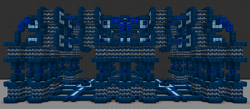
Wallshared DTPFs - 2112 Heating Coil (Tiered)
- 1250-1270 Dimensional Injection Casing
- 120 Dimensional Bridge
- 1-2 Energy Hatch: Any injection casing
- 1+ Input Bus/Hatch: Any injection casing
- 1+ Output Bus/Hatch: Any injection casing
Wallsharing
DTPFs may wallshare the outermost 3x3x3 coil segments on each of their sides or the entire bottom layer of the structure to save on heating coils, casings, and buses/hatches. This is highly recommended because the heating coils are by far the most expensive part of the structure. Sharing DTPFs side-by-side saves 288 heating coils in total and sharing the top layer saves 384 heating coils in total.
- Sharing 1 Side - 1,824 Heating Coil
- Sharing 2 Sides - 1,584 Heating Coil
- Sharing Top - 1,728 Heating Coil
- Sharing Top and 1 Side - 1,488 Heating Coil
- Sharing Top and 2 Sides - 1,296 Heating Coil
Usage
The following are the recipes that are unlocked with each new heating coil tier. This list is NOT all-inclusive and does not include any of the more efficient versions of recipes that are gated behind higher tier coils/catalysts. Although the DTPF can start with awakened draconium coils, raw tesseracts require at least infinity coils so it may be worth it to skip those.
Awakened Draconium Coils
|
Infinity Coils
Hypogen Coils
|
Eternal Coils
|
Dimensional Convergence
The DTPF is designed to run for as long as possible. Not only does it grow increasingly proficient at breaching dimensional boundaries but after 8 hours of continuous operation, it is able to perfectly align and synchronize multidimensional spaces to achieve Dimensional Convergence if there is a transdimensional alignment matrix in the controller.
(0-8 hours) The DTPF reduces catalyst consumption by up to 50%, scaling linearly with run time. The recipe does NOT need to be the same throughout and the savings do NOT apply to any of the other input ingredients, such as dimensionally transcendent residue. The current discount and run time can be seen by using a Portable Scanner on the controller or through an industrial information panel. While idle, the run time decays 100 times faster than it builds up--just 4.8 minutes of inactivity can undo a full 8 hours of continuous operation. There is no cap to the run time, however, which means a DTPF running for longer than 8 hours has a buffer that prevents it from immediately losing the 50% fuel discount or dimensional convergence.
(8+ hours) The DTPF additionally performs perfect overclocks if and only if there is a transdimensional alignment matrix in the controller and any type of catalyst present. The matrix is gated behind UMV components and therefore cannot be crafted right away. The perfect overclocks are not free and increase the amount of catalyst needed depending on the density (EU/L) of the catalyst as well as the difference between the total EU of the original recipe (without overclocks) and the total EU of the recipe with the same number of imperfect overclocks. Use the following equation to calculate the total additional catalyst for a recipe.
| Tier | Catalyst | Density (EU/L) | Residue (% of Catalyst) |
| 1 | Crude | 14,514,983 | 12.5% |
| 2 | Prosaic | 66,768,460 | 25% |
| 3 | Resplendent | 269,326,451 | 50% |
| 4 | Exotic | 1,073,007,393 | 100% |
| 5 | Stellar | 4,276,767,521 | 200% |
Recipes that do not take any catalyst (ie. spacetime or shirabon) do not converge until a catalyst is provided, which is actually extremely useful because a DTPF can be prepared to converge at any moment without needing to consume the extra catalyst at all times. That means a DTPF passively running one of these recipes is much cheaper to sustain and can still switch to a converged state for any active or on-demand recipes as necessary.
Select which catalyst to add by right-clicking the convergence button in the GUI of the controller (1=Crude up to 5=Stellar). The DTPF only uses the configured type of catalyst when the recipe does not take any, and consumes extra catalyst matching the recipe's type in all other cases. Output residue amounts still scale proportionally to the tier/amount of catalyst and the 50% discount is still applied to the added catalyst, hence the 2 in the bottom of the equation.
Example Calculations
The following graph shows how much catalyst is needed for crafting molten neutronium for varying amounts of perfect overclocks. Although this graph is continuous, the number of perfect overclocks is discrete. Stellar catalyst is not included because there is no recipe for molten neutronium that uses that catalyst (or any recipe that uses all 5 for that matter).
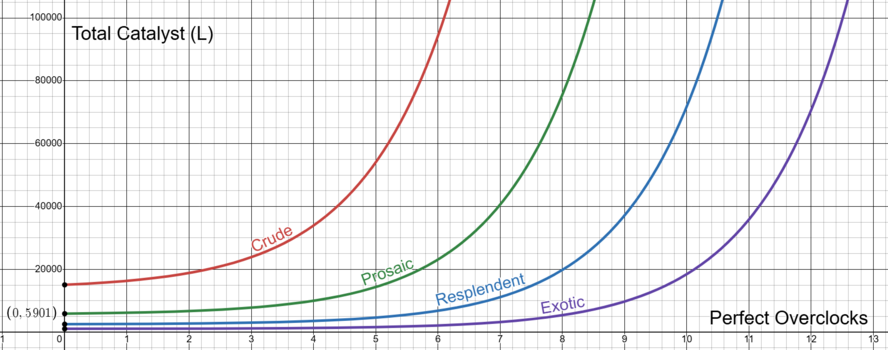
Consider the molten neutronium recipe with prosaic catalyst running at 64A of UMV power (8,589,934,592 EU/t). The original recipe takes 11,802L of prosaic catalyst and 29,186,457,200 total EU, but the 50% discount drops the required prosaic catalyst down to 5,901L and the recipe is perfectly overclocked three times. The theoretical total energy of the recipe given three imperfect overclocks is as follows:
This equates to an additional 1,530L of prosaic catalyst per recipe of molten neutronium which is only 26% more catalyst than the original recipe after the discount. The perfect overclocks are absolutely worth the cost, especially for how negligible it is for exotic and stellar catalyst.
Methodology
There are three different strategies to balancing passive and active recipes in the DTPF. The only differences are their flexibility in switching recipes and how the recipes are patterned. All three still prioritize running the DTPF for as long as possible for the maximum 50% fuel discount and perfect overclocks from dimensional convergence.
1) Separate Machines. Avoid sharing passive and active recipes by having a set of DTPFs exclusively for passive recipes (ie. infinity, hypogen, and spacetime) and another set of DTPFs for everything else. The latter is not intended to reach dimensional convergence so there is inconsistent fuel discounts. Furthermore, patterns must always specify 100% of the original catalyst amount and the crafting input buffers need to be manually emptied every so often.
2) Hatch Prioritization w/ Proxies. Use the same DTPF(s) for ALL recipes. Let a stocking input hatch and stocking input bus keep the machine running continuously for something like infinity, hypogen, or spacetime to maximize the fuel discount and reach dimensional convergence. Include a crafting input buffer/proxy somewhere in the structure to hold any active or on-demand recipes. When the player manually submits a crafting request, it temporarily takes priority over the passive recipe without shutting off the machine. Pattern recipes with a little more than 50% of the original catalyst to cover the cost of the perfect overclocks after the maximum fuel discount is applied, or simply use 100% of the original catalyst to be extra safe. The downsides of this strategy are that the crafting input buffers need to be manually emptied every so often and it is difficult to know exactly how much additional catalyst is needed for each recipe.
3) Hatch Prioritization w/ Colored Hatches. Use the same DTPF(s) for ALL recipes. Let a colored stocking input bus/hatch keep the machine running continuously for something like infinity, hypogen, or spacetime to maximize the fuel discount and reach dimensional convergence. Active or on-demand recipes are sent to a subnet with a different set of colored hatches to temporarily take priority over the passive recipe. Patterns do NOT contain any catalyst so the player never has to make any convergence calculations. There is also no crafting input buffers that routinely need to be emptied--everything is fully automatic. There are no significant downsides to this strategy and is highly recommended over the other two. See the automation section below for more details.
Automation
The challenge in using the DTPF effectively is allowing for active recipes to temporarily take priority over passive recipes. That way it can maximize the catalyst discount while also being available for miscellaneous crafts. Patterning recipes is also challenging because the amount of catalyst required changes a lot with respect to the current discount and the number of overclocks in convergence.
Method 1: Colored Hatches
The core mechanic behind this approach is using colored hatches to automatically switch priority from a passive recipe to an active or on-demand one. The stocking input bus/hatch with the passive recipe simply needs to be painted with a lower priority color than the stocking input bus/hatch with the active recipes. Catalyst and non-consumables are left in an uncolored bus/hatch to remain available to both. This approach is compact, simple, and scales well. There are no significant downsides.
| STEP 1 | |
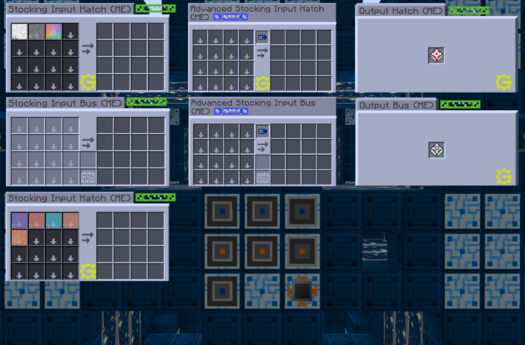
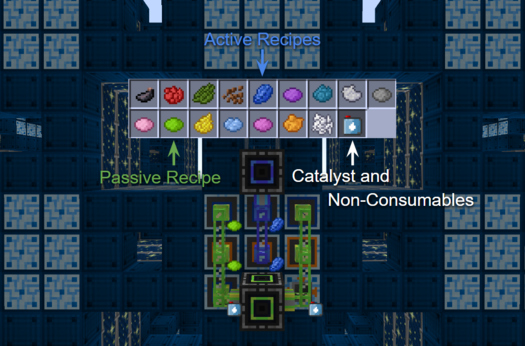
| Start by placing buses/hatches as shown in the image to the right, preferably in the wallshared portion of four DTPFs.
LEFT: A stocking input bus/hatch on the main network (lime) for a passive recipe. There is also a stocking input hatch exclusively for catalyst. Keeping them separate makes the catalyst available for the active recipe too, after they're painted in the next step. CENTER: An advanced stocking input bus/hatch on the DTPF subnetwork (blue). Set these to auto-pull to automatically retrieve any items/fluids stored on the blue network. RIGHT: An output bus/hatch and a regular input bus for any non-consumables. |
|
| STEP 2 | |
| Next, paint the buses/hatches as shown in the image to the right.
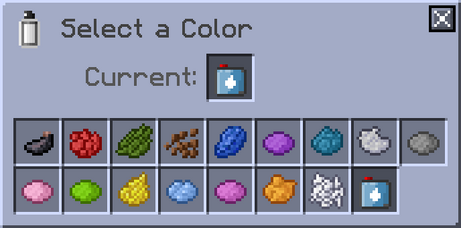
The stocking input bus/hatch with the passive recipe is lime, the advanced stocking input bus/hatch for active recipes is blue, the catalyst hatch is uncolored, and the regular input bus is uncolored. Blue has a higher priority than lime which allows it to temporarily take over the passive recipe. Colors may vary as long as they follow the same priority logic. Uncolored buses/hatches not follow the same input separation rules and is available to both the lime and blue hatches. |
|
| STEP 3 | |
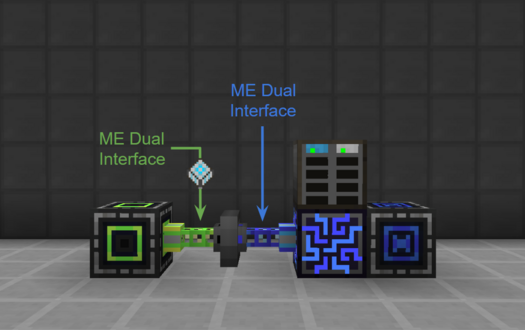
| Build the DTPF subnetwork (blue) with a neutronium infused ME controller, ME drive, and wireless connector hub.
The storage cells just need to be large enough to hold one or more active recipes. The wireless connector hub should link with the blue wireless connector from the previous step. Place a pair of ME dual interfaces between the main network (lime) and the DTPF subnetwork (blue). Place any patterns on the main network side, but DO NOT INCLUDE ANY CATALYST since that is already provided by the uncolored stocking input hatch. |
|
Trivia
- Unchunkloading a DTPF prevents it from gaining or LOSING runtime, which could help maintain its fuel discount when resources are low.