GT New Horizons · Medium Voltage (MV)
Pyrolyse Oven
The Pyrolyse Oven is an MV tier multiblock for burning logs into charcoal with the option of one fluid byproduct (ie. coal gas, wood gas, wood vinegar, wood tar, charcoal byproducts). The Pyrolyse Oven is a direct upgrade from the basic Coke Oven because it runs on electricity and can overclock with enough power. It also gains a speed bonus that scales linearly with the tier of the heating coils. The fluid byproducts are useful for producing organic compounds such as ethylene, benzene, and toluene. Although slower initially, the Pyrolyse Oven is generally recommended over the Advanced Coke Oven because it scales better and the fluid byproducts are crucial for progression. Both are superseded by the Industrial Coke Oven in EV.
Construction
The Pyrolyse Oven has one tiered component. The heating coils determine the heat capacity of the machine and must all be the same tier for the structure to form. The energy hatch, maintenance hatch, and output bus/hatch may replace any pyrolyse oven casing on the bottom layer of the structure. The muffler hatch and input bus/hatch may replace any pyrolyse oven casing on the top layer of the structure. Multi-amp and laser energy hatches are not supported, but there can be multiple regular energy hatches for overclocking--similar to the EBF and nearly every GregTech multiblock. Use the Multiblock Structure Hologram Projector to visualize/build the structure with subchannel "coil" to specify the tier of the heating coils.
Structure
- Controller: Front center, 2nd layer
- 60-68 Pyrolyse Oven Casing
- 12 Heating Coil (Tiered)
- 8 Steel Pipe Casing
- 4 Steel Firebox Casing
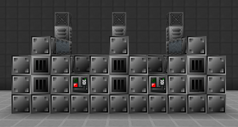
Wallshared Pyrolyse Ovens - 2 Steel Frame Box
- 1+ Energy Hatch: Any bottom casing
- 1 Maintenance Hatch: Any bottom casing
- 1 Muffler Hatch: Any top casing
- 1+ Input Bus/Hatch: Any top casing
- 1+ Output Bus/Hatch: Any bottom casing
Wallsharing
Pyrolyse Ovens may wallshare each of their sides to save on casings, frame boxes, and buses/hatches. That includes up to half the heating coils as seen in the image above. This is highly recommended because the heating coils are the most expensive part of the structure.
Usage
The Pyrolyse Oven gains a speed bonus that scales linearly with the tier of its heating coils. More specifically, the processing speed starts at 50% with cupronickel coils and increases by 50% with every heating coil tier above that, as seen in the following table. The length of a recipe with a base processing time of 16 seconds and no overclocks is provided as reference. The speed bonus does NOT increase the power consumption of the Pyrolyse Oven since the EU/t remains the same. Instead, it actually reduces the total EU consumed because it runs for a shorter amount of time.
| Heating Coil | Speed | Example | Total EU |
| Cupronickel | 50% | 32.00 s | 200% |
| Kanthal | 100% | 16.00 s | 100% |
| Nichrome | 150% | 10.67 s | 66.7% |
| TPV-Alloy | 200% | 8.00 s | 50.0% |
| HSS-G | 250% | 6.40 s | 40.0% |
| HSS-S | 300% | 5.33 s | 33.3% |
| Naquadah | 350% | 4.57 s | 28.6% |
| Naquadah Alloy | 400% | 4.00 s | 25.0% |
| Trinium | 450% | 3.56 s | 22.2% |
| Electrum Flux | 500% | 3.20 s | 20.0% |
| Awakened Draconium | 550% | 2.91 s | 18.2% |
| Infinity | 600% | 2.67 s | 16.7% |
| Hypogen | 650% | 2.46 s | 15.4% |
| Eternal | 700% | 2.29 s | 14.3% |
The Pyrolyse Oven is primarily used to burn logs into charcoal with the option of ONE fluid byproduct--determined by the programmed circuit in the input bus or controller. The most common choice is charcoal byproducts because it breaks down into dimethylbenzene, wood gas, wood vinegar, and wood tar in a Distillation Tower. Another common choice is wood tar for making nitrobenzene more directly/efficiently. There is also the option to use 1,000L of nitrogen gas per 16 logs to double the processing speed of the machine, which is again determined by the programmed circuit in the input bus or controller. The following is a non-exhaustive list of the available recipes with their programmed circuit in brackets.
- [1] Creosote Oil
- [2] Creosote Oil (requires nitrogen)
- [3] Charcoal Byproducts
- [4] Charcoal Byproducts (requires nitrogen)
- [5] Wood Gas
- [6] Wood Gas (requires nitrogen)
- [7] Wood Vinegar
- [8] Wood Vinegar (requires nitrogen)
- [9] Wood Tar
- [10] Wood Tar (requires nitrogen)
- [11] Heavy Oil
- [20] Coal Gas (requires steam)
There are other Pyrolyse Oven recipes such as turning bio chaff into fermented biomass and coal into coal coke which may be useful depending on your available resources and goals. The machine is highly versatile and serves a variety of purposes beyond producing charcoal.
Charcoal Rate Comparison
The Advanced Coke Oven (ACO) is another option for burning logs into charcoal in the early game and operates at a fixed rate of one charcoal per second, but consumes 1 for every 16 produced as fuel. To help the player decide between the ACO and the Pyrolyse Oven, the following table compares their average charcoal per second for various recipes, heating coils, and overclocks. The cells highlighted green mean the Pyrolyse Oven is faster than the ACO and the cells highlighted in red mean the Pyrolyse Oven is slower. Note that it may be more practical to use the ACO even where it is slower because it does not consume any EU, albeit at the cost of no fluid byproducts.
| Overclocks | Pyrolyse Oven w/ No Input Fluid | Pyrolyse Oven w/ Nitrogen | ACO | |||||||
| Cupronickel | Kanthal | Nichrome | Cupronickel | Kanthal | Nichrome | |||||
| 0 (MV) | 0.313 /s | 0.625 /s | 0.939 /s | 0.625 /s | 1.250 /s | 1.887 /s | 0.938 /s | |||
| 1 (HV) | 0.625 /s | 1.250 /s | 1.887 /s | 1.250 /s | 2.500 /s | 3.774 /s | 0.938 /s | |||
| 2 (EV) | 1.250 /s | 2.500 /s | 3.774 /s | 2.500 /s | 5.000 /s | 7.692 /s | 0.938 /s | |||
Radox Rate Comparison
The Industrial Coke Oven (ICO) is another option for producing radox and seemingly the obvious choice after upgrading in EV. However, the ICO only outperforms the Pyrolyse Oven when it can take full advantage of its parallels. To help decide between a full-length ICO and the Pyrolyse Oven, the following table compares the average L/s of radox for various heating coils and overclocks. The cells highlighted green mean the Pyrolyse Oven is faster than the ICO and the cells highlighted red mean the Pyrolyse Oven is slower.
| Overclocks | Pyrolyse Oven | ICO | ||||||
| Elec. Flux | Aw. Drac. | Infinity | Hypogen | Eternal | ||||
| 0 (UV) | 27.8 L/s | 30.6 L/s | 33.3 L/s | 36.2 L/s | 38.9 L/s | 6.94 L/s | ||
| 1 (UHV) | 55.6 L/s | 61.2 L/s | 66.7 L/s | 72.5 L/s | 77.8 L/s | 27.8 L/s | ||
| 2 (UEV) | 111 L/s | 123 L/s | 133 L/s | 145 L/s | 156 L/s | 125 L/s | ||
| 3 (UIV) | 222 L/s | 247 L/s | 267 L/s | 290 L/s | 313 L/s | 521 L/s | ||
| 4 (UMV) | 444 L/s | 500 L/s | 541 L/s | 588 L/s | 625 L/s | 1,889 L/s | ||
From this information, it can be concluded that the Pyrolyse Oven is the superior option for 0-1 overclocks and the ICO is the superior option for either 2+ or 3+ overclocks depending on the heating coils.