GT New Horizons · High Voltage (HV)
Large Steam Turbine
The Large Steam Turbine (LST) is an HV tier multiblock for generating power from steam. The LST is a direct upgrade from the singleblock steam turbines because it outputs up to 4A of power with much higher efficiency. However, a turbine must be placed inside the controller for the machine to run, the input rate of steam must be carefully regulated, and it must be running for at least 50 seconds to fully warm-up. Turbines come in four different sizes and many different materials each with their own efficiency bonus and optimal flow rate (L/t). Power is extracted from a 4A dynamo hatch on the back of the structure as steam condensates into distilled water in the output hatch. Breaking the dynamo hatch while the machine is running causes it to explode. Save on fuel by automatically toggling the LST with an RS latch connected to a Lapotronic Supercapacitor.
The Large HP Steam Turbine (LST-HP) and Large SC Steam Turbine (LST-SC) are nearly identical to the LST except they exclusively process superheated steam and supercritical steam, respectively. They are also unlocked later in EV and LuV. Supercritical steam generates twice the EU as regular steam at the same optimal flow rate and is converted into superheated steam. Superheated steam generates twice the EU as regular steam at the same optimal flow rate and is converted into regular steam.
The LST is superseded by the XL Turbo Steam Turbine in IV which consumes as much steam and produces as much power as 16 LST, but only requires 12 turbines. It also supports multi-amp and laser dynamo hatches for serious power generation and comes in HP and SC variants.
Spreadsheet: GTNH Power Planner 2.9
Construction
The LST has no tiered components. The maintenance hatch, input hatch, and output hatch may replace any turbine casing on the back half of the structure. The dynamo hatch is limited to the center casing on the very back of the structure and cannot be greater than 4A. There is no muffler hatch so do not include one. Use the Multiblock Structure Hologram Projector to visualize/build the structure.
Unique to large turbines is the turbine housing which is effectively a ULV input bus for storing an extra turbine that automatically replaces the one inside the controller once it breaks. It is completely optional and gated to UV, but helps maximize runtime.
Structure
- Controller: Front center, 2nd layer
- 14 Frame Box[1]
- 8-14 Turbine Casing[1]
- 12 Pipe Casing[1]
- 0+ Turbine Housing: Any back turbine casing
- 1 Dynamo Hatch: Back center turbine casing
- 1 Maintenance Hatch: Any back turbine casing
- 1+ Input Hatch: Any back turbine casing
- 0+ Output Hatch: Any back turbine casing
- Mandatory Air: 3x3 area in front of controller
Wallsharing
LSTs may wallshare each of their sides to save on casings, frame boxes, and buses/hatches. However, do NOT share the input hatch because the fuel is not split evenly between the LSTs--one consumes everything and the other receives nothing. The restriction on the hatch locations make that difficult to accomplish anyway.
Usage
The LST has two operating modes, listed below, but see the planner linked at the top for the quantifiable differences between them. The former is better in the early to mid game when steam production is low and the latter is better in the late game when power output is more important than efficiency. Switch modes by using a screwdriver on the controller.
- Tight Fitting Mode - High efficiency, Low optimal flow rate (power).
- Loose Fitting Mode - Low efficiency, High optimal flow rate (power).
The speed of the LST increases linearly up to 100% while active and decreases back to 0% while inactive. Speed is directly proportional to the power output of the machine and takes 50 seconds to reach its maximum value regardless of the turbine size/material. Speed decays extremely fast when the LST is disabled, the turbine is removed, the structure is broken, or fuel runs out. View the current speed of the turbine by using a Portable Scanner on the controller or looking at the "efficiency" value in WAILA.
Optimal Flow Rate
The rate (L/t) at which steam enters the LST is extremely important. Too little steam and only a fraction of the potential power is generated; too much steam and a tremendous amount of fuel is wasted. Ideally, steam enters the LST at the optimal flow rate of the turbine, which changes significantly with size/material and the operating mode of the machine. Although visible in NEI, the optimal flow rate () in L/t can be calculated with the following equations where is an arbitrary multiplier associated with each material, speed is the Tinker's Construct mining speed of the material, size is a constant between 1=small and 4=huge, and is the base efficiency of the turbine.
The optimal flow rates of some turbines are incredibly high because steam has a very low fuel density of 0.5 EU/L, especially if the LST is in loose mode. The player may need to upgrade their fluid regulator or add a second input hatch to meet the increased demand. Eventually it becomes necessary to switch to AE2 fluid P2P tunnels which effectively have no transfer limit and no concern for temperature or heat capacity.
Power & Overflow
The power generated by the LST depends on the current flow rate (), the optimal flow rate (), and the efficiency of the turbine (). Exceeding the optimal flow rate generates additional power with diminishing returns based on the overflow tier () of the turbine. There are only three overflow tiers in total and depends strictly on the material of the turbine. A higher overflow tier also increases the maximum flow rate (). View the overflow tier of a turbine through NEI and the current power output of the machine through WAILA.
Power is extracted from a 4A dynamo hatch on the back of the structure. Do not break the dynamo hatch while the machine is running or else the LST will explode. Exceeding the maximum EU/t or the total EU in the dynamo's buffer is perfectly safe; the LST will not explode if an attached battery buffer or Lapotronic Supercapacitor (LSC) is full and there is nowhere for the EU to go. Any additional EU is simply voided. It is highly recommended to automatically toggle the LST with a redstone RS latch to avoid wasting fuel--see the LSC page for a guide on setting that up.
|
| ||||||
|
Example
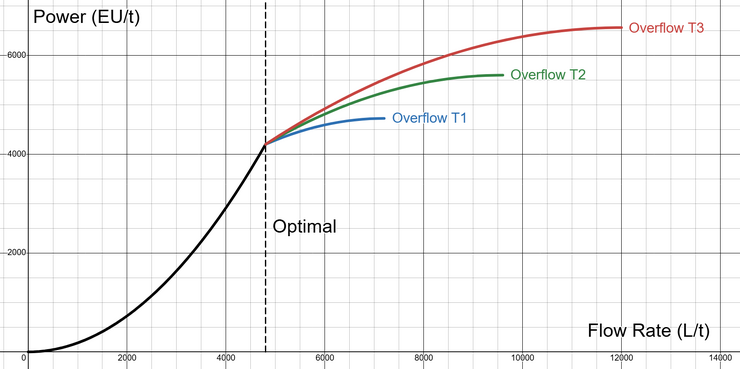
The following graph depicts the relationship between flow rate () of steam and the power generated by an LST with a large HSS-E turbine in tight fitting mode. The efficiency of the turbine is 175%, the optimal flow rate is 4,800 L/t, and the overflow tier is 3. This means the maximum flow rate is 4,800 L/t x 2.5 = 12,000 L/t and the LST follows the top line in red. The lower overflow efficiency tiers are only visible for comparison purposes. Notice how quickly the EU/t increases as the flow rate approaches the optimal value and then how quickly the turbine loses efficiency afterwards. Loose fitting mode and every other turbine follows a very similar pattern.
Turbines
A turbine must be placed inside the GUI of the controller for the machine to run. Turbines come in four different sizes and many different materials each with their own efficiency bonus and optimal flow rate. There are too many different permutations to list them all here, but the planner linked at the top has all the relevant information and even a calculator for determining the power output and lifespan of any turbine with any fuel.
- Small turbines are crafted with long magnalium rods (available as early as LV)
- Normal turbines are crafted with long titanium rods (available at the end of HV after traveling to the moon)
- Large turbines are crafted with long tungstensteel rods (available in IV after the tungsten processing line)
- Huge turbines are crafted with long americium rods (available in ZPM after building a Fusion Reactor Mk-II)
Durability
Turbines slowly lose durability proportional to the power generated. The total durability of a turbine depends on the material and instantly voids once it reaches 0%. Turbines cannot be inserted or extracted from the controller, but turbine housings check if the controller is empty once every 60 seconds to insert a new one. Use a screwdriver on the housing to decrease the interval, as necessary, and re-enable the LST with a machine controller cover.
The following equation calculates the lifespan of a turbine (in hours) from the current power output of an LST. Note that loose fitting mode provides a 25% durability boost to compensate for the reduced lifespan of a higher power output. Turbines generally have lifespans of several hundred hours (or more) so they do not need to be replaced very often.
Recommended Progression
The following are recommended turbines and flow rates based on the maximum EU/t of various 4A dynamo hatches. It is very common to skip a few of these because the cost of replacing healthy turbines may not be worth the slight boost in performance. Note that this list is slightly different from the other large turbines and even the XL Turbo Steam Turbine because different fuels have different energy values and the LST is very limited by the size of the dynamo hatch. Use the planner linked at the top for a complete list of turbine materials and full setup breakdowns.
| Tier | Size | Material | Efficiency | Mode | Fuel | Flow Rate | Power | Dynamo | Lifespan |
| HV | Small | Vibrant Alloy | 95% | Tight | Steam | 900 L/t | 427 EU/t | HV | 296.7 h |
| Small | Manyullyn | 104% | Tight | Steam | 1,250 L/t | 656 EU/t | HV (4A) | 116.1 h | |
| Small | Shadow Metal | 95% | Tight | Steam | 1,600 L/t | 760 EU/t | HV (4A) | 425.2 h | |
| EV | Normal | Shadow Metal | 120% | Tight | Steam | 3,200 L/t | 1,920 EU/t | HV (4A) | 487.7 h |
| Normal | Terrasteel | 130% | Tight | Steam | 3,200 L/t | 2,080 EU/t | HV (4A) | 488.9 h | |
| IV | Large | Shadow Metal | 145% | Tight | Steam | 4,800 L/t | 3,480 EU/t | EV (4A) | 512.0 h |
| Large | Oriharukon | 155% | Tight | Steam | 4,800 L/t | 3,720 EU/t | EV (4A) | 614.9 h | |
| Large | HSS-E | 175% | Tight | Steam | 4,800 L/t | 4,200 EU/t | EV (4A) | 571.7 h | |
| Large | HSS-S | 185% | Tight | Steam | 4,800 L/t | 4,440 EU/t | EV (4A) | 553.0 h | |
| Large | Oriharukon | 101% | Loose | Steam | 60,152 L/t | 30,316 EU/t | IV (4A) | 218.3 h | |
| Large | Ichorium | 225% | Tight | Steam | 28,800 L/t | 32,400 EU/t | IV (4A) | 13,928 h | |
| LuV | Large | MAR-Ce-M200 Steel | 145% | Tight | Steam | 22,500 L/t | 16,313 EU/t | IV (4A) | 5,065 h |
| Large | Duranium | 215% | Tight | Steam | 76,800 L/t | 82,560 EU/t | LuV (4A) | 382.9 h | |
| ZPM | Huge | Duranium | 240% | Tight | Steam | 102,400 L/t | 122,880 EU/t | LuV (4A) | 402.2 h |
| Huge | Adamantium | 158% | Loose | Steam | 335,029 L/t | 265,343 EU/t | ZPM (4A) | 63.4 h | |
| Huge | Gaia Spirit | 174% | Loose | Steam | 490,515 L/t | 426,013 EU/t | ZPM (4A) | 4,948 h | |