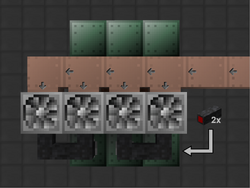
The Electric Blast Furnace (EBF) is an LV tier multiblock for smelting dusts into ingots at a higher heat than standard furnaces. The EBF is a direct upgrade from the Bricked Blast Furnace because it runs off electricity instead of burnable fuels and can process higher tier materials. The heating coils in the structure determine the heat capacity of the machine and the energy hatch(es) determine the voltage. Upgrade both to unlock new recipes and overclock the machine. The EBF follows standard multiblock behaviors such as releasing pollution from a muffler hatch, occasionally requiring maintenance, and voiding ingredients on power fail. Items and fluids are inserted/extracted through buses and hatches, respectively.
Construction
The EBF is built with heat proof machine casings on the top and bottom layers and heating coils in the middle two layers. The heating coils determine the heat capacity of the machine and must all be the same tier for the structure to form. Buses/hatches may replace any bottom casing, except for the muffler hatch which replaces the top center casing and the optional gas output hatch which replaces any top casing. The amount of gas recovered depends on the tier of the muffler hatch. The EBF runs at the voltage tier of the energy hatch, but can overclock to the next voltage tier with two of them, like nearly every multiblock. Multi-amp and laser energy hatches are not supported. Use the Multiblock Structure Hologram Projector to visualize/build the structure with subchannel "coil" to specify the tier of the heating coils.
Structure
Controller: Front bottom center
Wallshared EBFs16 Heating Coil (Tiered)
0-12 Heat Proof Machine Casing
1+ Energy Hatch: Any bottom casing
1 Maintenance Hatch: Any bottom casing
1 Muffler Hatch: Top center casing
1+ Input Bus/Hatch: Any bottom casing
1+ Output Bus/Hatch: Any bottom casing for items, any top/bottom casing for liquids
Mandatory Air: Interior of the structure
Wallsharing
EBFs may wallshare each of their sides to save on casings, heating coils, and buses/hatches. Overlapping EBFs side-by-side is the most effective and highly recommended because it saves a significant amount of heating coils and reduces the cost of additional EBFs. For example, a quad-shared EBF requires only 42 heating coils to build instead of the full 64. The only downside is the difficulty in upgrading heating coils because they must all be the same tier for the structure(s) to form. Sharing a maintenance hatch, output bus, and input hatch is also quite useful, but do NOT share energy hatches because the EBF frequently needs to be overclocked to a higher voltage tier which uses the maximum 4A from two energy hatches. Splitting that between two machines is simply not possible and causes one to power fail.
Caution:
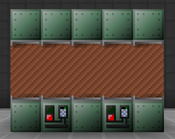
There are a few potential hazards for GregTech multiblocks that could cause them to power fail or even explode. Do not expose the EBF to the rain. Do not block the muffler hatch with any sort of block, cable, or pipe. Do not exceed the voltage tier of the energy hatches. Provide consistent power during the entire recipe. Ensure there is space for any outputs if void protection is enabled.
Usage
The EBF is finally ready for use once the structure is formed and all maintenance issues are repaired. However, there are no LV recipes despite the player only having access to LV energy hatches; steel and aluminium are both MV recipes that require at least 120 EU/t to run. The solution is building two energy hatches into the structure to overclock the machine to the next voltage tier. Energy hatches typically only pull 1A of power, but they are capable of pulling up to 2A when there are two or more energy hatches on the same machine. The combined 4A of power is equivalent to 1A of the next voltage tier, which means an EBF with LV energy hatches can process up to MV recipes. This behavior is nearly universal for all multiblocks in GTNH.
Supplying a continuous 4A of power requires at least four singleblock steam turbines nearby. The 120 EU/t to process steel or aluminium is slightly less than a full MV amp so there can be some cable loss but not very much. The following are the three methods for meeting these power requirements. The first two assume that the player is using tin cables which lose 1 EU per meter per amp, and the last one assumes that the player is using superconductor cables which have zero loss regardless of distance or amps.
Method 1: Minimize the Cable Loss
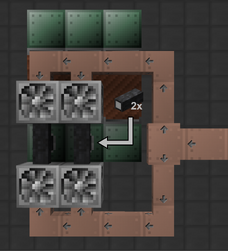
Place four steam turbines close to the energy hatches to keep losses at a minimum.
Requires only four steam turbines.
Uses smaller cables (Tin 2x).
Lower cable loss.
Cannot power other machines.
Method 1 (Option 1)
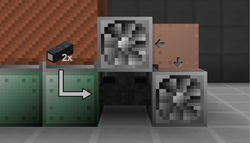
Method 1 (Option 2)
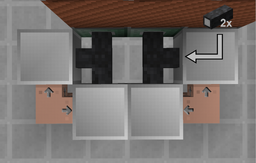
Method 1 (Option 3)
Method 2: Buffer the Cable Loss
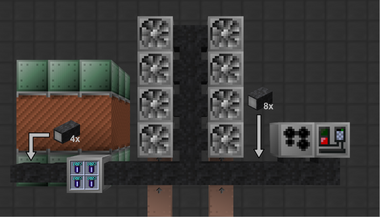
Place a battery buffer (4+ slots) near the energy hatches to cover any loss with extra turbines.
Requires five or more steam turbines.
Requires four or more batteries and a battery buffer.
Uses larger cables (Tin 4x / 8x).
Higher cable loss.
Can power other machines.
Method 2 (Option 1)
Method 3: Superconductor
Use LV superconductors to carry power without any loss.
Requires only four steam turbines.
Uses smaller cables (redstone alloy 2x).
Zero cable loss.
The steam turbines do not need to be next to the EBF and can carry up to 16 amps from a centralized location.
Redstone alloy dust is smelted in an EBF and therefore requires another method first.
Redstone alloy is much more expensive than tin and MV+ superconductors are not worth crafting at all in the early game.
Method 3 (Option 1)
Heat Capacity
The heating coils built into the structure determine the heat capacity of the EBF and therefore which recipes it can run. Use a Portable Scanner on the controller to see its current heat capacity, and NEI to see a recipe's minimum heat capacity. For example, a cupronickel EBF has a heat capacity of 1,801K which is more than enough to smelt steel (1,000K) and aluminium (1,300K), but NOT silicon solar grade (2,273K). There is also a +100K heat bonus for every voltage tier above MV, as seen in the following table.
LV
MV
HV
EV
IV
LuV
ZPM
UV
UHV
UEV
UIV
UMV
UXV
MAX
MAX+
Heat Bonus
----
----
+100K
+200K
+300K
+400K
+500K
+600K
+700K
+800K
+900K
+1,000K
+1,100K
+1,200K
+1,300K
Exceeding the minimum heat capacity of a recipe grants two separate bonuses. The first is a 5% energy discount (multiplicative) for every 900K above. The second is a perfect overclock for every 1,800K above. The latter is particularly strong because the EBF normally runs imperfect overclocks which are half as effective for the same amount of power.
Imperfect Overclock - 2x speed for 4x power (2/4).
Perfect Overclock - 4x speed for 4x power (4/4).
For example, consider smelting raw aluminium (1,300K) with HV power and nichrome coils. The base recipe with nitrogen consumes 144,000 EU over 60 seconds at a rate of 120 EU/t. The heat capacity of the EBF is 3,701K or precisely 2,401K above the minimum heat capacity of the recipe. This means there are two 5% energy discounts and one perfect overclock. The result is a recipe that only consumes 130,200 EU over 15 seconds at a rate of 120 EU/t x 0.95 x 0.95 x 4 = 434 EU/t.
Troubleshooting
1) Structure Incomplete. Check that it meets all the minimum requirements (number of casings, one maintenance hatch, one muffler hatch, and one or more energy hatches). If the EBF has everything, try forcing a structure check inside the GUI of the controller. Also check that nothing is inside the EBF, such as an invisible lighting block.
2) Does not start. Check that the recipe is correct (items, fluids, and programmed circuit). Also check that the muffler hatch is not blocked by a block, cable, or pipe. This problem could even occur if the EBF is not receiving any power at all. Check that cables are connected and that any steam turbines are pointed in the correct direction.
3) Runs for a second before turning off and voiding ingredients. Check that the EBF is receiving enough power. There is probably too much cable loss, not enough steam turbines, or the pipes carrying the steam are not big enough to support the required throughput (6,208 L/s for four LV steam turbines).
4) Not enough output space. Check that the output bus/hatch is not filled. The recipe may also be trying to output a gas which requires an output hatch on the top layer of the structure, as opposed to fluid outputs which require an output hatch on the bottom layer of the structure. If one of the outputs is not particularly important, then enable void mode for items, fluids, or both.
Tips
There can be more than one input bus/hatch which may be useful for holding the various fluid inputs (ie. hydrogen, oxygen, nitrogen, helium). A quadruple input hatch also works very well once they are unlocked in EV.
It is highly recommended to build additional EBFs as their demand increases. Recipe times are intentionally long in GTNH to force the player into expanding their infrastructure.
There is often more than one recipe for the same material so periodically scroll through NEI to find the best one for you. For example, most ingots have a recipe with each of the noble gases to lower their smelting times, and steel can be made from cast/wrought iron dust instead of iron dust for a significant time and energy discount.
One MV EBF smelting cast/wrought iron dust is as fast as 48 Bricked Blast Furnaces for making steel, and it can overclock beyond that.
 Caution: