GT New Horizons · Extremely Ultimate Voltage (UEV)
Absolute Baryonic Perfection Purification Unit
The Absolute Baryonic Perfection Purification Unit (BPU) is a UEV tier multiblock used for the eighth and final step of the Water Line. It is unlocked in late UEV, after making the DTPF, and is required in order to make Dimensionally Shifted Superfluid, which replaces Lubricant in recipes in UIV and beyond, as well as being an upgrade over Grade 7 water anywhere it is used. It is also the only Waterline multiblock with a relevant output other than purified water: It also outputs Stabilised Baryonic Matter, which is partly used in its puzzle and partly used as an ingredient for Dimensionally Shifted Superfluid.
Construction
The BPU has no tiered components or energy hatches because it receives power directly from the Water Purification Plant once linked with a data stick, like the rest of the Water Line multiblocks. Stocking input buses are BLACKLISTED. Use the Multiblock Structure Hologram Projector to visualize/build the structure.
Structure
- Controller: Front center, 9th layer
- 300-339 Quark Exclusion Casing
- 240 Non-Photonic Matter Exclusion Glass
- 108 Bedrockium Frame Box
- 96 Femtometer-Calibrated Particle Beam Casing
- 37 Particle Beam Guidance Pipe Casing
- 1+ Input Bus: Any quark exclusion casing (no stocking bus)
- 1+ Input Hatch: Any quark exclusion casing
- 1+ Output Bus: Any quark exclusion casing
- 1+ Output Hatch: Any quark exclusion casing
Mechanics
See More: Waterline#Shared Mechanics
The goal of the BPU is to add the correct pair of quarks to the input water in order to complete the recipe. There are six flavors of quarks—up, down, charm, strange, top, and bottom—that can be inserted using Quark Releasing Catalysts, which are made in a DTPF using particles from a Cyclotron. At the start of its cycle, the BPU will select a random pair of quarks that must be inserted in order to complete the recipe successfully. Inserting any Quark Releasing Catalyst requires Molten Infinity in an Input Hatch: this cost begins at 144L (equal to 1 ingot), and doubles every time the same Quark Releasing Catalyst is inserted during the same cycle.
The BPU does not output any indication of the correct quark pair while running, so the only way to find it is to insert Quark Releasing Catalysts until the pair is identified. However, it does immediately output 2000L of Stabilised Baryonic Matter when the correct pair is inserted, which can be used to detect recipe completion and thereby avoid wasting Molten Infinity on inserting extra Quark Releasing Catalysts. Pairs are unordered: for example, if the BPU is requesting Strange and Charm, inserting Charm followed by Strange will also complete the recipe successfully.
At the end of a recipe cycle, if the correct pair of quarks was inserted into the BPU, it will output 500L of Stabilised Baryonic Matter per parallel, in addition to the 900L of Grade 8 water. It will also return all Quark Releasing Catalysts, whether or not the recipe succeeded; if it did succeed, the two Quark Releasing Catalysts in the correct pair will be output as Unaligned Quark Releasing Catalysts instead, and each must be re-aligned in a Hyper-Intensity Laser Engraver using 1000L of Stabilised Baryonic Matter to reuse.
Automation
There are many methods of automating the BPU, but only one is discussed in detail here.
Insertion Sequence
One important part of automating the BPU is determining a sequence to insert the Quark Releasing Catalysts that minimizes the amount of Catalysts needed as well as the Molten Infinity cost. The minimum possible length for such a sequence that covers all 15 possible pairs is 18, which requires at maximum 42 ingots worth of Molten Infinity to insert. This is because each Catalyst needs to appear next to all five other Catalysts, and each occurrence of a Catalyst can only appear next to two other Catalysts. As a result, each Catalyst must appear at least 3 times, for a total of 18. There are many possible sequences that include all pairs and have a length of 18. One such sequence, and the sequence used in the example below (with spaces for clarity), is 123456 241635 315264, where each digit uniquely corresponds to one flavor of Catalyst.
Method 1: Applied Energistics + ProjectRed
The main idea of this approach is to use AE2 Interface stocking with crafting cards to set the order of catalyst insertion and some redstone logic to control when the sequence is inserted.
| STEP 1 | |
|
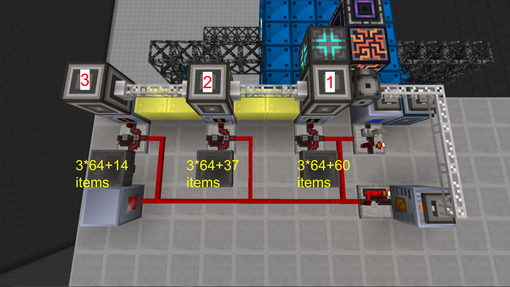
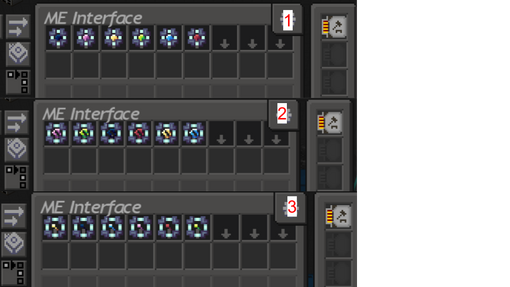
Build this setup near any face of Quark Exclusion Casings. The crafting storage unit shown is a 64k but any size is fine. (From right to left) each Hopper should contain 3 stacks + 60, 3 stacks + 37, and 3 stacks + 14 of any stackable item. Place a Wireless Redstone Receiver (External) cover on the machine hull and set a unique frequency. The three Comparators and the one Repeater can be vanilla or ProjectRed versions. In the corresponding numbered ME Interfaces, add one of each of the six flavors of catalyst to make three groups of six, with one group in each interface. Refer to the sequence above for a viable combination. Add a crafting card to each interface. For clarity, the sequences for each ME Interface is as follows (left to right): 1. Up, Down, Strange, Charm, Bottom, Top 2. Down, Charm, Up, Top, Strange, Bottom 3. Strange, Up, Bottom, Down, Top, Charm |
|
| STEP 2 | |
|
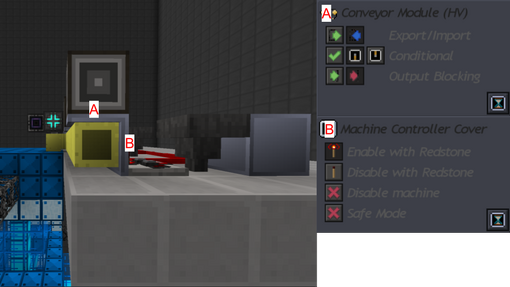
For the line of item pipes, any GregTech item pipe with at least 1 stack/sec is fine. For each pipe beneath the three ME Interfaces add a Machine Controller cover (facing the ProjectRed Comparator) and an HV Item Conveyor set to IMPORT on "Machine Processing State" (facing the interface). |
|
| STEP 3 | |
|
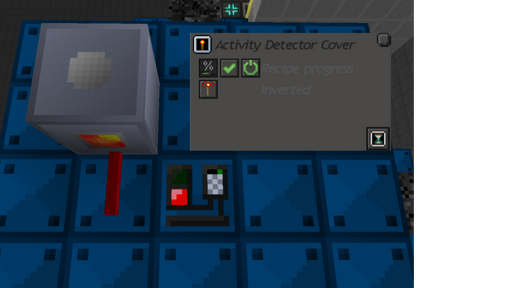
Add an Activity Detector cover to the side of the controller and set it to “Recipe Progress” and INVERTED. Use a soldering iron to set the signal on that side to STRONG and add red alloy wire as shown. Place a machine hull with a Wireless Redstone Transmitter (External) cover so that the wire connects to the cover and match the frequency to the wireless receiver in Step 1. (Optional: add a Fluid Detector cover on the input hatch for molten infinity to provide a signal to only enable the BPU when at least 42 ingots worth is present.) |
|
| STEP 4 | |
|
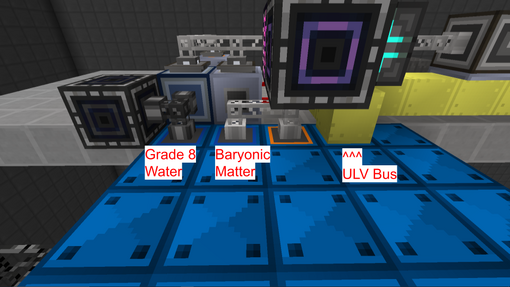
BLACK is the main net and WHITE is the sub net. Add two ME Fluid Output Hatches to the BPU and connect one to each network separately. Add a ME Output Bus and connect it to the sub net. The main net hatch should have a fluid storage cell partitioned to Grade 8 Water and the sub net hatch should have a cell partitioned to Stabilized Baryonic Matter. The item pipe shown previously should connect to a ULV Input Bus somewhere on the BPU. |
|
| STEP 5 | |
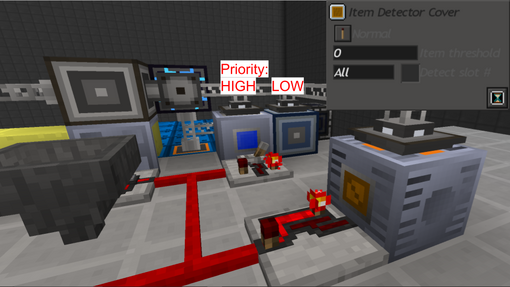
| On the HV Input Bus, add an Item Detector cover facing the repeater and set it to emit with 0 items. Be sure the input bus is facing the storage bus and that the storage bus is set to “bidirectional.”
On the tank (any GT tank ok), place a Fluid Detector cover facing the input of the ProjectRed toggle latch and set it to emit with 0 fluids. Ensure the toggle latch is NOT powering the red alloy wire initially. Also add a IV Pump on the tank facing the Dual Interface. For the fluid storage bus on the tank, filter to Stabilized Baryonic Matter and set a high priority. Repeat for the fluid storage bus on the Dual Interface but set a lower priority. |
|
| STEP 6 | |
|
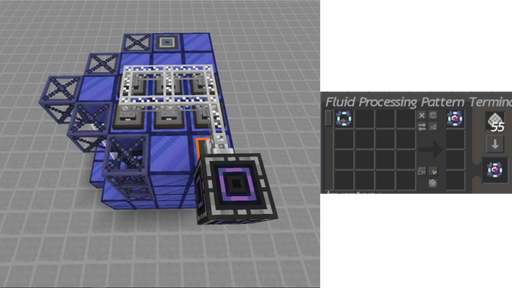
To realign the catalysts, build a UHV Hyper-Intensity Laser Engraver (HILE) with six input busses. Place an ME Interface on each bus and connect them to the WHITE sub net. Also, connect a ME Output Bus to the sub net and passively supply the HILE with Baryonic Matter. In each interface, add a pattern to craft one of the six flavors of catalyst (pay attention to the program circuit of the bus!). Omit the Baryonic Matter as it is already provided. |
|
Method 2: Level Maintainer
This method relies on using a level maintainer to cycle the Unaligned Quark Releasing Catalysts back into the missing Quark Releasing Catalysts, as well as a fake crafting recipe to insert the Catalysts in order.
| STEP 1 | |
|
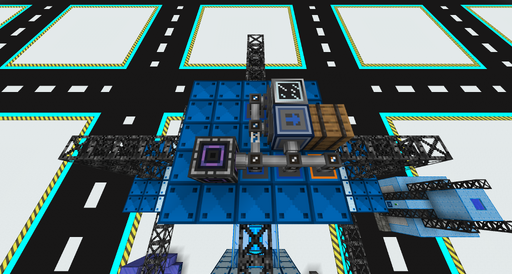
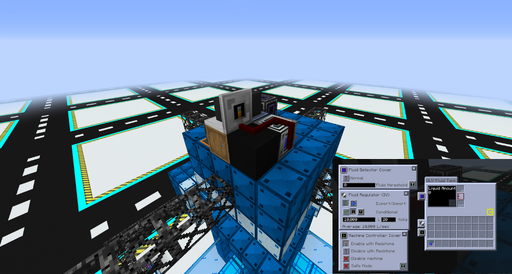
On the BPU, place a ULV Input Bus with an inventory on top of it large enough to hold 18 items. Place an ME Output bus, a Stocking Input Hatch filtered with Molten Infinity and Grade 7 water, and an ME Output Hatch filtered to Grade 8 water. Separate from this, place another ME Output Hatch filtered to Stabilized Baryonic Matter. Facing into the inventory above the Input Bus, place a block sized dual interface. Connect the interface, ME Output Bus, Stocking Input Hatch, and the Grade 8 water filtered hatch to the same network. If you don't care about returning excess catalysts on recipe success to save infinity, skip this part as well as Step 2. Add a ULV fluid tank next to the interface. On a subnet, place a Fluid Storage Bus on both the fluid tank and the dual interface from before. Filter both for Stabilized Baryonic Matter, and make the bus on the fluid tank higher priority. |
|
| STEP 2 | |
|
On the fluid tank, place a Fluid Detector cover, a Machine Controller cover, and a Fluid Regulator on the side touching the interface. Set the regulator to Export, with Use Machine Processing State enabled, and set it to 10,000L every 20 ticks. Place Red Alloy Wire to power everything with the signal from the Fluid Detector cover. Continue the Red Alloy Wire to the inventory holding the catalysts. Add a fast Conveyor Module (IV+) and a Machine Controller cover to some Item Pipes leading back into the interface. Set the conveyor to Import, and enable Use Machine Processing State. |
|
| STEP 3 | |
|
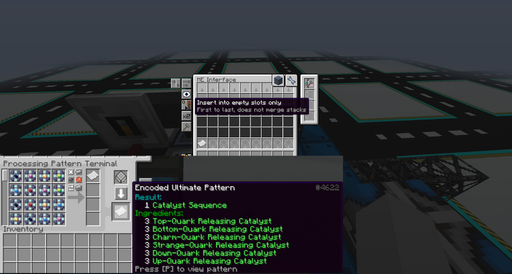
Create a pattern that has the catalysts in order of a correct insertion sequence, similar to an Assembly Line. You don't need to rename duplicates of each catalyst. Set the output to any item you like, as long as its something the subnet will never receive. Add the pattern to the interface facing into the inventory from before, and set insertion mode to 'Insert into empty slots only'. Add a fake crafting card. On the input bus, add a conveyor module capable of inserting ONLY one stack at a time (HV-IV), and set the speed to every 2 seconds. |
|
| STEP 4 | |
|
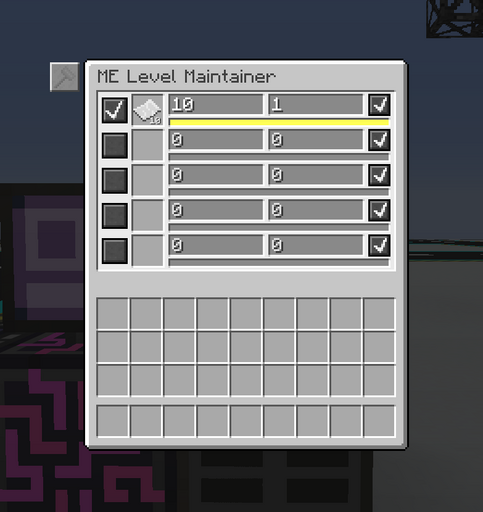
Place a Hyper-Intensity Laser Engraver and give it at least UHV power. Add a ULV Input Hatch with a storage bus filtered to Stabilized Baryonic Matter, and give it high priority. Create patterns to turn Unaligned Quark Releasing Catalysts into each Quark Releasing Catalysts, omitting the Stabilized Baryonic Matter. Take note of the required circuit number for each recipe. Add a Level Maintainer and Crafting CPU to the network. Add your target item from the recipe containing each catalyst from before, set it to maintain any amount greater than 1, and request 1 at a time. The requested recipe can only possibly run once the BPU has finished a cycle, and will automatically craft the required missing catalysts that were used in the previous cycle. |
|