GT New Horizons · Insanely Ultimate Voltage (UIV)
Bose-Einstein Condensate Line
The Bose-Einstein Condensate (BEC) Line is a series of four UIV tier multiblocks for assembling exotic machine parts from entangled condensate. The line begins with converting regular fluids into condensate at the cost of power in the Entanglement Apparatus. The condensate is automatically pushed to any Containment Fields on the network for storage whether or not there is enough space available. Optionally, a Maxwell Gate can be used to control condensate exposure/visibility and therefore the direction of flow. Items are supplied directly to one of the Teleportation Nodes (IO Nodes) which immediately begins processing the recipe regardless of current condensate levels. The Observation Array then transfers the requested condensate from the Containment Field(s) to the IO Node(s) while covering their power cost and holding the requested nanites for recipes. The nanites in the Observation Array must be rapidly swapped out to perfectly match the requested nanite at all times and maximize the processing speed of the IO Node(s).
BEC recipes appear as Assembly Line recipes in NEI but there is no strict item or condensate order to follow. Instead, they have a certain number of equal-length steps equivalent to their number of solid inputs. The steps are not exactly hard stops but each one requests a specific nanite tier or better to run. The nanite order is constant per recipe but varies between recipes so any automation method needs to be highly precise and flexible.
Construction
The BEC Line is a series of four UIV tier multiblocks linked together by BEC conduits and BEC hatches  , as seen in the following image. BEC conduits may bend and split freely, and do not need to be colored to connect. BEC conduit casings work exactly like normal BEC conduits except they are also explosion proof. Think of the conduits as connecting each multiblock to the same network rather than functioning as a fluid pipe or beam pipe. The space between the multiblocks has no effect on the operation of the machines--build them as far apart or close together as preferred. Not shown in the image is the Maxwell Gate which is completely optional and controls condensate exposure/visibility.
There is also the line-of-sight connector hatch for linking the Observation Array to up to 16 IO Node(s) around it. Each pair must face each other and form a perfectly straight line along one of the axes (no bends or diagonals), but there is no cabling in between and they can be up to 128 blocks apart if necessary. A valid line-of-sight connection creates a beacon-like animation between the hatches to signal that it is operational.
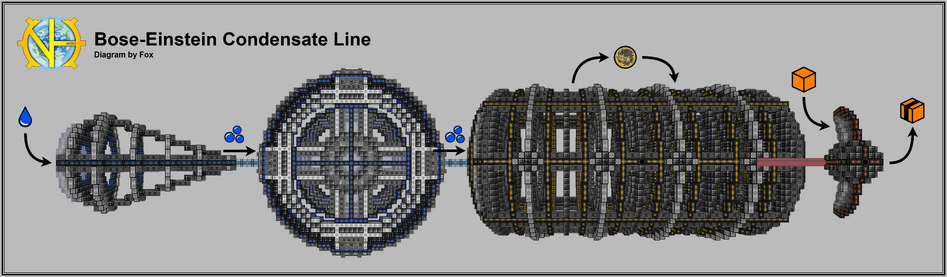
Optionally, use the following hatches to assist with the automation of the BEC Line. OpenComputers can also help gather information about the machines and dynamically change their variables and filters.
- The BEC Detector Hatch
 on the Containment Field emits a redstone signal if the set condition inside its GUI is true. There is a filter for specifying a particular type of condensate, a comparison operator, and a threshold value. Leave the filter blank to sum all stored condensates together.
- The Nanite Detector Hatch on the IO Node emits a redstone signal if the set condition inside its GUI is true. There is a comparison operator and a threshold value for the tier of the current requested nanite.
- The Teleportation Node Controller Hatch on the IO Node can pause the machine either immediately or upon transitioning to a new input step/nanite when it receives a redstone signal. Pausing the machine halts all recipe progress and prevents condensate from being inserted, but the IO Node can still read the nanite(s) in the Observation Array, still updates any nanite detector hatches, and still consumes power.
Usage
The BEC Line is effectively a large assembler for exotic machine parts. It is required for Eye of Harmony field generators, the T3 chassis for the Exo-Foundry, all Stargate components, and more. BEC recipes appear as Assembly Line recipes in NEI but there is no strict item or condensate order to follow. Instead, they have a certain number of equal-length steps equivalent to their number of solid inputs. The steps are not exactly hard stops but each one requests a specific nanite tier or better to run. The general workflow for processing BEC recipes is listed below and explained in much more intricate detail in the following subsections about each of the individual multiblocks.
| 1. Insert fluid into the Entanglement Apparatus to convert it into condensate at the cost of power. | |
| 2. The condensate is automatically pushed to any Containment Fields on the network for storage whether or not there is enough space available. | |
| 3. Optionally, a Maxwell Gate can control condensate exposure/visibility and therefore the direction of flow. | |
| 4. Items are supplied directly to one of the IO Nodes which immediately begins processing the recipe regardless of current condensate levels. | |
| 5. The Observation Array then transfers the requested condensate from the Containment Field(s) to the IO Node(s) while covering their power cost and holding the requested nanites for recipes. | |
| 6. The nanites in the Observation Array must be rapidly swapped out to perfectly match the requested nanite at all times and maximize the processing speed of the IO Node(s). |
There is also a few additional challenges that could potentially inflict penalties or void outputs if not careful. For example, if there ever more than three unrequested condensates in the network at once then any active recipes immediately fail and void. Again, these are covered in much more detail below.
Entanglement Apparatus
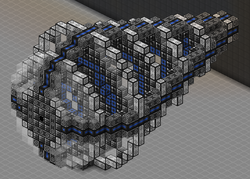
The Entanglement Apparatus or BEC Generator is the first step in the BEC Line and converts fluids into entangled condensate at the cost of power. The Entanglement Apparatus does not overclock but it has unlimited parallels to process as much as possible based on the amount of power provided. Multi-amp and laser energy hatches are supported for serious throughput.
Insert fluid through an input hatch  on the front of the structure. The Entanglement Apparatus can entangle different fluids simultaneously but the processing time is always going to be the max duration of the active recipes. If there is not enough power to entangle all the available fluids at once, then priority follows standard multiblock order with colored hatches, location, etc.
The entangled condensate is outputted through the BEC hatch on the back of the structure and stored in a Containment Field until the Observation Array pulls it into an IO Node for recipes. The challenge, however, is that the Entanglement Apparatus does not check if there is enough space available for the condensate before it begins processing. It could unintentionally overflow the Containment Field(s) and void the condensate if not careful. The solution is using a BEC detector hatch on the Containment Field to temporarily disable the Entanglement Apparatus if levels ever get too high, or dynamically adjusting the field strength of the Containment Field with OpenComputers.
Condensate Recipes
Every recipe consists of a single input fluid, an EU quota for entanglement, and a fixed duration. The EU quota is simply the required EU/t per parallel. For example, neutronium has a quota of 7,864,320 EU which means every 7,864,320 EU/t in throughput grants an additional parallel. The durations are very long to encourage passive condensate production, and then later filtering for the correct ones with a Maxwell Gate.
| Entangled Condensate | Duration | Per Parallel | ||
| Amount | Power Required | |||
| Neutronium | 30 s | 144 L | 7,864,320 EU/t | 1A UEV |
| Cosmic Neutronium | 30 s | 144 L | 7,864,320 EU/t | 1A UEV |
| Bedrockium | 30 s | 144 L | 7,864,320 EU/t | 1A UEV |
| Chromatic Glass | 30 s | 144 L | 31,457,280 EU/t | 1A UIV |
| Celestial Tungsten | 30 s | 144 L | 31,457,280 EU/t | 1A UIV |
| Infinity | 30 s | 144 L | 125,829,120 EU/t | 1A UMV |
| Dimensionally Shifted Superfluid | 60 s | 1,000 L | 125,829,120 EU/t | 1A UMV |
| Lossless Phonon Transfer Medium | 90 s | 1,000 L | 125,829,120 EU/t | 1A UMV |
| Degenerate Quark Gluon Plasma | 120 s | 1,000 L | 125,829,120 EU/t | 1A UMV |
| Hypogen | 60 s | 144 L | 503,316,480 EU/t | 1A UXV |
| Transcendent Metal | 60 s | 144 L | 503,316,480 EU/t | 1A UXV |
| Spacetime | 120 s | 144 L | 503,316,480 EU/t | 1A UXV |
| Tachyon Rich Temporal Fluid | 120 s | 144 L | 503,316,480 EU/t | 1A UXV |
| Spatially Enlarged Fluid | 120 s | 144 L | 503,316,480 EU/t | 1A UXV |
| Boundless Cosmic Solder | 120 s | 1,000 L | 503,316,480 EU/t | 1A UXV |
| MHDCSM | 180 s | 144 L | 2,013,265,920 EU/t | 1A MAX |
| Magmatter | 180 s | 144 L | 2,013,265,920 EU/t | 1A MAX |
| Universium | 180 s | 144 L | 2,013,265,920 EU/t | 1A MAX |
| Eternity | 180 s | 144 L | 2,013,265,920 EU/t | 1A MAX |
Containment Field
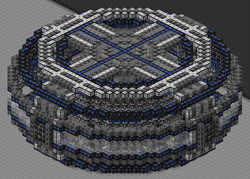
The Containment Field or BEC Storage is the second step in the BEC Line and stores entangled condensate until it is requested by an IO Node for a recipe. Condensate both enters and leaves the Containment Field through BEC hatches on the sides of the structure and is exposed to all Observation Arrays on the current network.
The field strength of the Containment Field is set manually in the GUI of the controller (or with OpenComputers) and determines both the maximum capacity and passive power consumption of the machine; every 1 unit of field strength increases the maximum capacity by 1L at the cost of 1 EU/t. It is not possible to filter or partition the storage based on condensate type.
The maximum capacity is only a soft cap since excess condensate can still enter the machine, but 11% of all condensate is voided each second until it falls back below the maximum capacity. This penalty applies evenly to all stored condensates and never prioritizes any one over the others. Avoid this penalty by setting the field strength really high, or by using an unfiltered BEC detector hatch to disable the Entanglement Apparatus with a machine controller cover when condensate levels get too high.
 Caution: | The Containment Field voids all of its contents if it ever powerfails or is manually disabled. Keep it running at all times while in use unless it is absolutely necessary to shut it down. |
Maxwell Gate
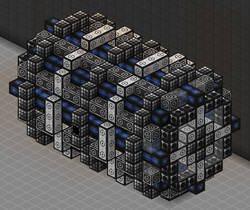
The Maxwell Gate or BEC Diode is an optional step in the BEC Line and controls condensate exposure/visibility, like an ME storage bus. The Maxwell Gate may be placed anywhere on a BEC network and effectively splits it into two separate subnetworks that connect to the BEC hatches on either side of the structure. Everything on the left network is exposed to the right network, but not the other way around. The Maxwell Gate does not push, pull, or buffer any condensate itself and consumes a fixed 1A UIV while active regardless of either network's status.
For the Entanglement Apparatus to push condensate to a Containment Field through a Maxwell Gate, the Entanglement Apparatus must be on the right network and the Containment Field must be on the left network. For the Observation Array to pull condensate from a Containment Field through a Maxwell Gate, the Observation Array must be on the right network and the Containment Field must be on the left network
The Maxwell Gate allows all condensate through by default but it can also filter for specific condensates. Set the filter manually in the GUI of the controller or by filling input hatches with the original fluid of the desired condensate. Filtering is particularly useful for passive condensate production and prevents contaminants from being exposed to the Observation Array. Without it, condensate would have to be requested on-demand which could take a very long time since the Entanglement Apparatus cannot be overclocked.
Observation Array
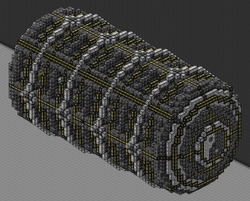
The Observation Array or BEC Assembler is the third step in the BEC Line and supplies power, condensate, and nanites to any connected IO Nodes. The Observation Array is really just a large router rather than an assembler because it does not process any recipes or hold condensate itself. It only ever stores nanites locally for IO Nodes to read from and transfers condensate from the Containment Field to IO Nodes upon request.
Up to 16 IO Nodes may connect to the same Observation Array via line-of-sight connector hatches , but it is not recommended to run different recipes at the same time because that could introduce penalties and potentially void outputs. IO Nodes do not have their own energy hatches so their individual power costs are summed together and covered by the Observation Array, which supports multi-amp and laser energy hatches for serious throughput.
Nanites are stored in one or more nanite containment buses  around the structure and are never actually consumed but they do need to be rapidly swapped out of the Observation Array to perfectly match the requested nanite at all times and maximize processing speed. The nanite containment bus can hold up to 2,147,483,647 nanites at once and the fastest way to move them all is by placing an ME storage bus on its face side and using an ME IO Port. The effect of nanites on recipes is discussed more in the following subsection.
IO Node
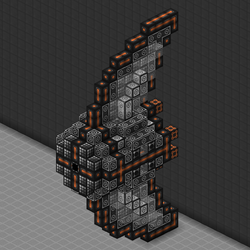
The IO Node is the fourth and final step in the BEC Line and inserts/extracts items in the BEC Line. However, in practice the items never actually leave the IO Node and recipes are processed locally instead of in the Observation Array; the IO Node is technically the assembler and the Observation Array is really just a large router for power, condensate, and nanites.
BEC recipes appear as Assembly Line recipes in NEI but there is no strict item or condensate order to follow. The items may all be inserted through the same input bus on the IO Node while the power, condensate, and nanites are pulled from the linked Observation Array. Condensate does not have to be present for a recipe to start processing but the recipe will fail and void if there is still some missing by the end.
Optionally, configure the number of parallels and speed divisor in the GUI of the controller. Parallels do not actually increase the total throughput of the machine because they are inversely proportional to the processing speed, but they can help process larger batches at once. The speed divisor manually slows down recipes if absolutely necessary for automation without reducing the overall EU/t.
Condensate
Condensate is produced in the Entanglement Apparatus and stored in the Containment Field. The Observation Array does not hold any condensate itself and only ever transfers it from the Containment Field to the IO Node upon request.
Any condensate in the network that is not requested by the current recipe is considered a contaminant or slowdown. Each contaminant significantly reduces the processing speed of the IO node and if there are ever more than three contaminants in the network at once then the recipe immediately fails and voids. Condensate supplied to an IO Node is no longer considered in the network and therefore does not affect other IO Nodes processing other recipes on the same Observation Array. However, it is still recommended to process only one recipe at a time to avoid these penalties altogether.
Nanites
|
Recipes are processed in sequential, equal-length steps equivalent to its number of solid inputs. For example, the primitive waveguide is processed in five steps that are each 1/5th of the total overall duration because it has five solid inputs in its recipe. The steps are not exactly hard stops but each one requests a specific nanite tier or better to run and exceeding the requested tier significantly reduces the IO Node's processing speed, as seen in the following equations. It is possible to skip steps or complete entire recipes in one tick if there are enough nanites available at once, but there is a hard cap of 30,720 nanites.
Nanites are never consumed and should be rapidly swapped out of the Observation Array to perfectly match the requested nanite at all times. Different types of nanites can be mixed, but their effective tier is always the lowest available. For example, Magmatter nanites (T10) could be interpreted as carbon nanites (T1) if both are present in the Observation Array at the same time. |
|
Recipes
The following tables list every BEC recipe by their voltage, duration, steps, requested nanites, and required condensates. The nanite order is constant per recipe but varies between recipes, even if they are the same number of steps. Nanite tiers highlighted BLUE are the maximum for that recipe. The IO Node has unlimited tier skips which means it can run any recipe regardless of voltage as long as there is enough power. However, the total duration may only be reduced by supplying more nanites to the Observation Array since the IO Node cannot overclock.
| Total Occurences | |
|
|
| UEV Recipes | Voltage | Duration | Steps | Requested Nanite Tiers by Step | Required Condensate | ||||||||||||||||||||
| Rough Wave Focus | UEV | 300 s | 4 | 4 | 1 | 2 | 1 | Chromatic Glass | Infinity | Transcendent Metal | |||||||||||||||
| Rough Resonance Chamber | UEV | 300 s | 4 | 4 | 1 | 2 | 1 | Chromatic Glass | Infinity | Transcendent Metal | |||||||||||||||
| Rough Sensor Array | UEV | 300 s | 4 | 4 | 1 | 2 | 1 | Chromatic Glass | Infinity | Transcendent Metal | |||||||||||||||
| Rough Field Manipulator | UEV | 300 s | 4 | 4 | 1 | 2 | 1 | Chromatic Glass | Infinity | Transcendent Metal | |||||||||||||||
| UIV Recipes | Voltage | Duration | Steps | Requested Nanite Tiers by Step | Required Condensate | ||||||||||||||||||||
| Condensate Guidance Coil | UIV | 150 s | 8 | 3 | 1 | 1 | 1 | 4 | 2 | 1 | 1 | Chromatic Glass | Infinity | Celestial Tungsten | |||||||||||
| Electromagnetic Waveguide | UIV | 240 s | 4 | 3 | 4 | 1 | 1 | Chromatic Glass | Infinity | Celestial Tungsten | |||||||||||||||
| Reinforced Wave Focus | UIV | 300 s | 4 | 5 | 2 | 3 | 2 | Chromatic Glass | Infinity | Cosmic Solder | |||||||||||||||
| Reinforced Resonance Chamber | UIV | 300 s | 4 | 5 | 2 | 3 | 2 | Chromatic Glass | Infinity | Cosmic Solder | |||||||||||||||
| Reinforced Sensor Array | UIV | 300 s | 4 | 5 | 2 | 3 | 2 | Chromatic Glass | Infinity | Cosmic Solder | |||||||||||||||
| Reinforced Field Manipulator | UIV | 300 s | 4 | 5 | 2 | 3 | 2 | Chromatic Glass | Infinity | Cosmic Solder | |||||||||||||||
| Primitive Shielding | UIV | 300 s | 5 | 4 | 1 | 1 | 3 | 1 | Chromatic Glass | Transcendent Metal | |||||||||||||||
| Primitive Waveguide | UIV | 300 s | 5 | 4 | 1 | 1 | 3 | 1 | Chromatic Glass | ||||||||||||||||
| Primitive Energy Conduit | UIV | 300 s | 5 | 4 | 1 | 1 | 3 | 1 | Chromatic Glass | ||||||||||||||||
| Primitive Electromagnetic Valve | UIV | 300 s | 5 | 4 | 1 | 1 | 3 | 1 | Chromatic Glass | Dimensionally Shifted Superfluid | |||||||||||||||
| Condensate Transformative Coil | UIV | 300 s | 7 | 2 | 1 | 2 | 1 | 3 | 3 | 4 | Chromatic Glass | Infinity | Celestial Tungsten | ||||||||||||
| Boundless Gravitationally Severed Structure Casing | UIV | 300 s | 8 | 1 | 1 | 1 | 1 | 2 | 2 | 4 | 3 | Hypogen | Neutronium | ||||||||||||
| Celestial Matter Guidance Casing | UIV | 300 s | 8 | 1 | 2 | 2 | 4 | 3 | 1 | 1 | 1 | Hypogen | Cosmic Neutronium | ||||||||||||
| Spatially Transcendent Gravitational Lens Block | UIV | 300 s | 13 | 3 | 3 | 2 | 4 | 1 | 1 | 1 | 1 | 1 | 1 | 1 | 1 | 2 | Chromatic Glass | ||||||||
| Remote Graviton Flow Modulator | UIV | 450 s | 10 | 1 | 2 | 1 | 1 | 1 | 1 | 3 | 4 | 2 | 3 | Chromatic Glass | Infinity | ||||||||||
| Fine-Structure Constant Manipulator | UIV | 600 s | 8 | 3 | 4 | 1 | 1 | 3 | 2 | 1 | 1 | Chromatic Glass | Infinity | Celestial Tungsten | |||||||||||
| Electromagnetically-Isolated Casing | UIV | 1,200 s | 8 | 4 | 1 | 1 | 1 | 3 | 2 | 1 | 1 | Chromatic Glass | Infinity | Celestial Tungsten | |||||||||||
| Coherence-Preserving Plasma Conduit | UIV | 1,200 s | 8 | 4 | 1 | 1 | 2 | 1 | 3 | 1 | 1 | Chromatic Glass | Infinity | Celestial Tungsten | |||||||||||
| Transcendentally Amplified Magnetic Confinement Casing | UIV | 1,800 s | 9 | 1 | 2 | 1 | 1 | 1 | 1 | 2 | 3 | 4 | Hypogen | Celestial Tungsten | |||||||||||
| UMV Recipes | Voltage | Duration | Steps | Requested Nanite Tiers by Step | Required Condensate | ||||||||||||||||||||
| Refined Wave Focus | UMV | 300 s | 4 | 6 | 3 | 4 | 3 | Chromatic Glass | Infinity | Cosmic Solder | |||||||||||||||
| Refined Resonance Chamber | UMV | 300 s | 4 | 6 | 3 | 4 | 3 | Chromatic Glass | Infinity | Cosmic Solder | |||||||||||||||
| Refined Sensor Array | UMV | 300 s | 4 | 6 | 3 | 4 | 3 | Chromatic Glass | Infinity | Cosmic Solder | |||||||||||||||
| Refined Field Manipulator | UMV | 300 s | 4 | 6 | 3 | 4 | 3 | Chromatic Glass | Infinity | Cosmic Solder | |||||||||||||||
| Pristine Shielding | UMV | 300 s | 5 | 6 | 3 | 3 | 5 | 3 | Chromatic Glass | Transcendent Metal | |||||||||||||||
| Pristine Waveguide | UMV | 300 s | 5 | 6 | 3 | 3 | 5 | 3 | Chromatic Glass | Transcendent Metal | |||||||||||||||
| Pristine Energy Conduit | UMV | 300 s | 5 | 6 | 3 | 3 | 5 | 3 | Chromatic Glass | Transcendent Metal | |||||||||||||||
| Pristine Electrogravitic Valve | UMV | 300 s | 5 | 6 | 3 | 3 | 5 | 3 | Chromatic Glass | Dimensionally Shifted Superfluid | |||||||||||||||
| Medial Graviton Flow Modulator | UMV | 300 s | 12 | 1 | 1 | 1 | 1 | 1 | 2 | 3 | 3 | 3 | 2 | 2 | 4 | Chromatic Glass | Infinity | Transcendent Metal | |||||||
| Singularity Reinforced Stellar Shielding Casing | UMV | 300 s | 16 | 1 | 2 | 1 | 1 | 2 | 4 | 3 | 1 | 1 | 3 | 4 | 2 | 1 | 1 | 2 | 1 | Hypogen | Infinity | Celestial Tungsten | Neutronium | ||
| Transdimensional Alignment Matrix | UMV | 600 s | 12 | 1 | 2 | 4 | 4 | 4 | 3 | 2 | 4 | 1 | 1 | 2 | 3 | Spacetime | Dimensionally Shifted Superfluid | Spatially Enlarged | |||||||
| Component Assembly Line Casing (UMV) | UMV | 600 s | 12 | 1 | 1 | 3 | 3 | 3 | 2 | 2 | 1 | 4 | 4 | 2 | 2 | Spatially Enlarged | Spacetime | Dimensionally Shifted Superfluid | |||||||
| Component Assembly Line Casing (UXV) | UMV | 600 s | 16 | 1 | 3 | 3 | 7 | 6 | 6 | 5 | 5 | 4 | 4 | 2 | 5 | 5 | 6 | 8 | 9 | Cosmic Solder | MHDCSM | Eternity | Dimensionally Shifted Superfluid | ||
| Reinforced Temporal Structure Casing | UMV | 40,000 s | 12 | 4 | 1 | 1 | 2 | 1 | 1 | 4 | 1 | 1 | 1 | 1 | 2 | Neutronium | Cosmic Neutronium | Bedrockium | Tachyon Rich | ||||||
| Reinforced Spatial Structure Casing | UMV | 40,000 s | 12 | 4 | 1 | 1 | 2 | 1 | 1 | 4 | 1 | 1 | 1 | 1 | 2 | Neutronium | Cosmic Neutronium | Bedrockium | Spatially Enlarged | ||||||
| Infinite Spacetime Energy Boundary Casing | UMV | 40,000 s | 16 | 4 | 1 | 2 | 1 | 1 | 3 | 4 | 3 | 1 | 1 | 1 | 1 | 1 | 1 | 1 | 1 | Neutronium | Cosmic Neutronium | Bedrockium | Spacetime | ||
| Crude Time Dilation Field Generator | UMV | 100,000 s | 16 | 2 | 2 | 2 | 2 | 2 | 1 | 1 | 1 | 3 | 4 | 3 | 3 | 4 | 1 | 1 | 1 | Transcendent Metal | Tachyon Rich | Spacetime | Cosmic Neutronium | ||
| Primitive Time Dilation Field Generator | UMV | 150,000 s | 16 | 3 | 3 | 3 | 3 | 3 | 2 | 2 | 2 | 4 | 5 | 4 | 4 | 5 | 2 | 2 | 2 | Cosmic Solder | Tachyon Rich | Spacetime | Cosmic Neutronium | ||
| Stable Time Dilation Field Generator | UMV | 200,000 s | 16 | 3 | 3 | 3 | 3 | 3 | 2 | 2 | 2 | 4 | 5 | 4 | 4 | 5 | 2 | 2 | 2 | Cosmic Solder | Tachyon Rich | Spacetime | Cosmic Neutronium | ||
| Advanced Time Dilation Field Generator | UMV | 250,000 s | 16 | 3 | 3 | 3 | 3 | 3 | 2 | 2 | 2 | 4 | 5 | 4 | 4 | 5 | 2 | 2 | 2 | Cosmic Solder | Tachyon Rich | Spacetime | Cosmic Neutronium | ||
| Superb Time Dilation Field Generator | UMV | 5,000 s | 16 | 4 | 4 | 4 | 4 | 4 | 3 | 3 | 3 | 5 | 6 | 5 | 5 | 6 | 3 | 3 | 3 | Cosmic Solder | Tachyon Rich | Spacetime | Cosmic Neutronium | ||
| Exotic Time Dilation Field Generator | UMV | 6,000 s | 16 | 4 | 4 | 4 | 4 | 4 | 3 | 3 | 3 | 5 | 6 | 5 | 5 | 6 | 3 | 3 | 3 | Cosmic Solder | Tachyon Rich | Spacetime | Cosmic Neutronium | ||
| Perfect Time Dilation Field Generator | UMV | 7,000 s | 16 | 4 | 4 | 4 | 4 | 4 | 3 | 3 | 3 | 5 | 6 | 5 | 5 | 6 | 3 | 3 | 3 | Cosmic Solder | Tachyon Rich | Spacetime | Cosmic Neutronium | ||
| Tipler Time Dilation Field Generator | UMV | 8,000 s | 16 | 5 | 5 | 5 | 5 | 5 | 4 | 4 | 4 | 6 | 7 | 6 | 6 | 7 | 4 | 4 | 4 | Cosmic Solder | Tachyon Rich | Spacetime | Cosmic Neutronium | ||
| Gallifreyan Time Dilation Field Generator | UMV | 9,000 s | 16 | 5 | 5 | 5 | 5 | 5 | 4 | 4 | 4 | 6 | 7 | 6 | 6 | 7 | 4 | 4 | 4 | Cosmic Solder | Tachyon Rich | Spacetime | Cosmic Neutronium | ||
| Crude Spacetime Compression Field Generator | UMV | 100,000 s | 16 | 3 | 3 | 2 | 4 | 2 | 2 | 4 | 3 | 2 | 2 | 1 | 1 | 1 | 1 | 1 | 1 | Transcendent Metal | Spatially Enlarged | Spacetime | Neutronium | ||
| Primitive Spacetime Compression Field Generator | UMV | 150,000 s | 16 | 4 | 4 | 3 | 5 | 3 | 3 | 5 | 4 | 3 | 3 | 2 | 2 | 2 | 2 | 2 | 2 | Cosmic Solder | Spatially Enlarged | Spacetime | Neutronium | ||
| Stable Spacetime Compression Field Generator | UMV | 200,000 s | 16 | 4 | 4 | 3 | 5 | 3 | 3 | 5 | 4 | 3 | 3 | 2 | 2 | 2 | 2 | 2 | 2 | Cosmic Solder | Spatially Enlarged | Spacetime | Neutronium | ||
| Advanced Spacetime Compression Field Generator | UMV | 250,000 s | 16 | 4 | 4 | 3 | 5 | 3 | 3 | 5 | 4 | 3 | 3 | 2 | 2 | 2 | 2 | 2 | 2 | Cosmic Solder | Spatially Enlarged | Spacetime | Neutronium | ||
| Superb Spacetime Compression Field Generator | UMV | 5,000 s | 16 | 5 | 5 | 4 | 6 | 4 | 4 | 6 | 5 | 4 | 4 | 3 | 3 | 3 | 3 | 3 | 3 | Cosmic Solder | Spatially Enlarged | Spacetime | Neutronium | ||
| Exotic Spacetime Compression Field Generator | UMV | 6,000 s | 16 | 5 | 5 | 4 | 6 | 4 | 4 | 6 | 5 | 4 | 4 | 3 | 3 | 3 | 3 | 3 | 3 | Cosmic Solder | Spatially Enlarged | Spacetime | Neutronium | ||
| Perfect Spacetime Compression Field Generator | UMV | 7,000 s | 16 | 5 | 5 | 4 | 6 | 4 | 4 | 6 | 5 | 4 | 4 | 3 | 3 | 3 | 3 | 3 | 3 | Cosmic Solder | Spatially Enlarged | Spacetime | Neutronium | ||
| Tipler Spacetime Compression Field Generator | UMV | 8,000 s | 16 | 6 | 6 | 5 | 7 | 5 | 5 | 7 | 6 | 5 | 5 | 4 | 4 | 4 | 4 | 4 | 4 | Cosmic Solder | Spatially Enlarged | Spacetime | Neutronium | ||
| Gallifreyan Spacetime Compression Field Generator | UMV | 9,000 s | 16 | 6 | 6 | 5 | 7 | 5 | 5 | 7 | 6 | 5 | 5 | 4 | 4 | 4 | 4 | 4 | 4 | Cosmic Solder | Spatially Enlarged | Spacetime | Neutronium | ||
| Crude Stabilisation Field Generator | UMV | 100,000 s | 16 | 3 | 3 | 3 | 2 | 1 | 1 | 1 | 1 | 2 | 2 | 2 | 2 | 4 | 4 | 1 | 1 | Transcendent Metal | Tachyon Rich | Spatially Enlarged | Spacetime | ||
| Primitive Stabilisation Field Generator | UMV | 150,000 s | 16 | 4 | 4 | 4 | 3 | 2 | 2 | 2 | 2 | 3 | 3 | 3 | 3 | 5 | 5 | 2 | 2 | Cosmic Solder | Tachyon Rich | Spatially Enlarged | Spacetime | ||
| Stable Stabilisation Field Generator | UMV | 200,000 s | 16 | 4 | 4 | 4 | 3 | 2 | 2 | 2 | 2 | 3 | 3 | 3 | 3 | 5 | 5 | 2 | 2 | Cosmic Solder | Tachyon Rich | Spatially Enlarged | Spacetime | ||
| Advanced Stabilisation Field Generator | UMV | 250,000 s | 16 | 4 | 4 | 4 | 3 | 2 | 2 | 2 | 2 | 3 | 3 | 3 | 3 | 5 | 5 | 2 | 2 | Cosmic Solder | Tachyon Rich | Spatially Enlarged | Spacetime | ||
| Superb Stabilisation Field Generator | UMV | 5,000 s | 16 | 5 | 5 | 5 | 4 | 3 | 3 | 3 | 3 | 4 | 4 | 4 | 4 | 6 | 6 | 3 | 3 | Cosmic Solder | Tachyon Rich | Spatially Enlarged | Spacetime | ||
| Exotic Stabilisation Field Generator | UMV | 6,000 s | 16 | 5 | 5 | 5 | 4 | 3 | 3 | 3 | 3 | 4 | 4 | 4 | 4 | 6 | 6 | 3 | 3 | Cosmic Solder | Tachyon Rich | Spatially Enlarged | Spacetime | ||
| Perfect Stabilisation Field Generator | UMV | 7,000 s | 16 | 5 | 5 | 5 | 4 | 3 | 3 | 3 | 3 | 4 | 4 | 4 | 4 | 6 | 6 | 3 | 3 | Cosmic Solder | Tachyon Rich | Spatially Enlarged | Spacetime | ||
| Tipler Stabilisation Field Generator | UMV | 8,000 s | 16 | 6 | 6 | 6 | 5 | 4 | 4 | 4 | 4 | 5 | 5 | 5 | 5 | 7 | 7 | 4 | 4 | Cosmic Solder | Tachyon Rich | Spatially Enlarged | Spacetime | ||
| Gallifreyan Stabilisation Field Generator | UMV | 9,000 s | 16 | 6 | 6 | 6 | 5 | 4 | 4 | 4 | 4 | 5 | 5 | 5 | 5 | 7 | 7 | 4 | 4 | Cosmic Solder | Tachyon Rich | Spatially Enlarged | Spacetime | ||
| UXV Recipes | Voltage | Duration | Steps | Requested Nanite Tiers by Step | Required Condensate | ||||||||||||||||||||
| Resplendent Wave Focus | UXV | 300 s | 4 | 7 | 4 | 5 | 4 | Chromatic Glass | Infinity | Cosmic Solder | |||||||||||||||
| Resplendent Resonance Chamber | UXV | 300 s | 4 | 7 | 4 | 5 | 4 | Chromatic Glass | Infinity | Cosmic Solder | |||||||||||||||
| Resplendent Sensor Array | UXV | 300 s | 4 | 7 | 4 | 5 | 4 | Chromatic Glass | Infinity | Cosmic Solder | |||||||||||||||
| Resplendent Field Manipulator | UXV | 300 s | 4 | 7 | 4 | 5 | 4 | Chromatic Glass | Infinity | Cosmic Solder | |||||||||||||||
| Perfected Shielding | UXV | 300 s | 5 | 8 | 5 | 5 | 7 | 5 | Chromatic Glass | Transcendent Metal | |||||||||||||||
| Perfected Waveguide | UXV | 300 s | 5 | 8 | 5 | 5 | 7 | 5 | Chromatic Glass | Transcendent Metal | |||||||||||||||
| Perfected Energy Conduit | UXV | 300 s | 5 | 8 | 5 | 5 | 7 | 5 | Chromatic Glass | Transcendent Metal | |||||||||||||||
| Perfected Electrogravitic Valve | UXV | 300 s | 5 | 8 | 5 | 5 | 7 | 5 | Chromatic Glass | Dimensionally Shifted Superfluid | |||||||||||||||
| Harmonic Phonon Transmission Conduit | UXV | 300 s | 8 | 1 | 1 | 2 | 3 | 4 | 3 | 2 | 1 | Hypogen | Lossless Phonon Transfer Medium | Celestial Tungsten | |||||||||||
| Central Graviton Flow Modulator | UXV | 300 s | 16 | 1 | 3 | 2 | 2 | 4 | 2 | 1 | 7 | 8 | 6 | 6 | 9 | 2 | 3 | 5 | 8 | Chromatic Glass | Infinity | Cosmic Solder | Eternity | ||
| Celestial Magnetic Chassis | UXV | 600 s | 16 | 4 | 2 | 3 | 5 | 9 | 8 | 10 | 6 | 2 | 2 | 3 | 3 | 4 | 4 | 5 | 5 | Cosmic Solder | Degenerate Quark Gluon Plasma | Dimensionally Shifted Superfluid | Eternity | ||
| Astral Array Fabricator | UXV | 7,200 s | 16 | 6 | 6 | 6 | 8 | 6 | 6 | 6 | 3 | 1 | 1 | 2 | 9 | 10 | 4 | 5 | 7 | Cosmic Solder | Spatially Enlarged | Spacetime | Eternity | ||
| Empty Spatially Compressed Circuit Array | UXV | 10,000 s | 16 | 2 | 2 | 4 | 10 | 1 | 3 | 4 | 3 | 6 | 6 | 7 | 7 | 5 | 5 | 8 | 9 | Dimensionally Shifted Superfluid | Lossless Phonon Transfer Medium | Universium | MHDCSM | ||
| Spatially Compressed Circuit Array (ULV) | UXV | 50,000 s | 16 | 10 | 5 | 9 | 1 | 4 | 8 | 8 | 4 | 4 | 8 | 8 | 4 | 2 | 6 | 7 | 3 | Cosmic Solder | Spatially Enlarged | Tachyon Rich | Spacetime | ||
| Spatially Compressed Circuit Array (LV) | UXV | 50,000 s | 16 | 10 | 5 | 9 | 1 | 4 | 8 | 8 | 4 | 4 | 8 | 8 | 4 | 2 | 6 | 7 | 3 | Cosmic Solder | Spatially Enlarged | Tachyon Rich | Spacetime | ||
| Spatially Compressed Circuit Array (MV) | UXV | 50,000 s | 16 | 10 | 5 | 9 | 1 | 4 | 8 | 8 | 4 | 4 | 8 | 8 | 4 | 2 | 6 | 7 | 3 | Cosmic Solder | Spatially Enlarged | Tachyon Rich | Spacetime | ||
| Spatially Compressed Circuit Array (HV) | UXV | 50,000 s | 16 | 10 | 5 | 9 | 1 | 4 | 8 | 8 | 4 | 4 | 8 | 8 | 4 | 2 | 6 | 7 | 3 | Cosmic Solder | Spatially Enlarged | Tachyon Rich | Spacetime | ||
| Spatially Compressed Circuit Array (EV) | UXV | 50,000 s | 16 | 10 | 5 | 9 | 1 | 4 | 8 | 8 | 4 | 4 | 8 | 8 | 4 | 2 | 6 | 7 | 3 | Cosmic Solder | Spatially Enlarged | Tachyon Rich | Spacetime | ||
| Spatially Compressed Circuit Array (IV) | UXV | 50,000 s | 16 | 10 | 5 | 9 | 1 | 4 | 8 | 8 | 4 | 4 | 8 | 8 | 4 | 2 | 6 | 7 | 3 | Cosmic Solder | Spatially Enlarged | Tachyon Rich | Spacetime | ||
| Spatially Compressed Circuit Array (LuV) | UXV | 50,000 s | 16 | 10 | 5 | 9 | 1 | 4 | 8 | 8 | 4 | 4 | 8 | 8 | 4 | 2 | 6 | 7 | 3 | Cosmic Solder | Spatially Enlarged | Tachyon Rich | Spacetime | ||
| Spatially Compressed Circuit Array (ZPM) | UXV | 50,000 s | 16 | 10 | 5 | 9 | 1 | 4 | 8 | 8 | 4 | 4 | 8 | 8 | 4 | 2 | 6 | 7 | 3 | Cosmic Solder | Spatially Enlarged | Tachyon Rich | Spacetime | ||
| Spatially Compressed Circuit Array (UV) | UXV | 50,000 s | 16 | 10 | 5 | 9 | 1 | 4 | 8 | 8 | 4 | 4 | 8 | 8 | 4 | 2 | 6 | 7 | 3 | Cosmic Solder | Spatially Enlarged | Tachyon Rich | Spacetime | ||
| Spatially Compressed Circuit Array (UHV) | UXV | 50,000 s | 16 | 10 | 5 | 9 | 1 | 4 | 8 | 8 | 4 | 4 | 8 | 8 | 4 | 2 | 6 | 7 | 3 | Cosmic Solder | Spatially Enlarged | Tachyon Rich | Spacetime | ||
| Spatially Compressed Circuit Array (UEV) | UXV | 50,000 s | 16 | 10 | 5 | 9 | 1 | 4 | 8 | 8 | 4 | 4 | 8 | 8 | 4 | 2 | 6 | 7 | 3 | Cosmic Solder | Spatially Enlarged | Tachyon Rich | Spacetime | ||
| Spatially Compressed Circuit Array (UIV) | UXV | 50,000 s | 16 | 10 | 5 | 9 | 1 | 4 | 8 | 8 | 4 | 4 | 8 | 8 | 4 | 2 | 6 | 7 | 3 | Cosmic Solder | Spatially Enlarged | Tachyon Rich | Spacetime | ||
| Spatially Compressed Circuit Array (UMV) | UXV | 50,000 s | 16 | 10 | 5 | 9 | 1 | 4 | 8 | 8 | 4 | 4 | 8 | 8 | 4 | 2 | 6 | 7 | 3 | Cosmic Solder | Spatially Enlarged | Tachyon Rich | Spacetime | ||
| Spatially Compressed Circuit Array (UXV) | UXV | 50,000 s | 16 | 10 | 5 | 9 | 1 | 4 | 8 | 8 | 4 | 4 | 8 | 8 | 4 | 2 | 6 | 7 | 3 | Cosmic Solder | Spatially Enlarged | Tachyon Rich | Spacetime | ||
| Spatially Compressed Circuit Array (MAX) | UXV | 50,000 s | 16 | 10 | 5 | 9 | 1 | 4 | 8 | 8 | 4 | 4 | 8 | 8 | 4 | 2 | 6 | 7 | 3 | Cosmic Solder | Spatially Enlarged | Tachyon Rich | Spacetime | ||
| Stargate Material Mesh | UXV | 1,000,000 s | 16 | 1 | 2 | 2 | 3 | 3 | 4 | 4 | 5 | 5 | 6 | 6 | 7 | 7 | 8 | 9 | 10 | Degenerate Quark Gluon Plasma | Lossless Phonon Transfer Medium | Magmatter | Universium | ||
| Stargate Frame Part | UXV | 4,000,000 s | 16 | 3 | 7 | 7 | 2 | 5 | 1 | 8 | 6 | 5 | 9 | 10 | 6 | 2 | 4 | 4 | 3 | Degenerate Quark Gluon Plasma | Lossless Phonon Transfer Medium | Magmatter | Eternity | ||
| Stargate Radiation Containment Plate | UXV | 8,000,000 s | 16 | 7 | 6 | 5 | 5 | 3 | 3 | 2 | 2 | 9 | 4 | 4 | 1 | 6 | 7 | 8 | 10 | Degenerate Quark Gluon Plasma | Lossless Phonon Transfer Medium | Magmatter | MHDCSM | ||
| Stargate Chevron | UXV | 8,000,000 s | 16 | 2 | 10 | 2 | 4 | 1 | 3 | 4 | 3 | 6 | 6 | 7 | 7 | 5 | 5 | 8 | 9 | Degenerate Quark Gluon Plasma | Lossless Phonon Transfer Medium | Magmatter | Cosmic Solder | ||
| Ultra Low Computation Singularity | UXV | 32,000,000 s | 16 | 10 | 5 | 9 | 1 | 4 | 8 | 8 | 4 | 4 | 8 | 8 | 4 | 2 | 6 | 7 | 3 | Chromatic Glass | Neutronium | Cosmic Neutronium | Bedrockium | ||
| Low Computation Singularity | UXV | 32,000,000 s | 16 | 10 | 5 | 9 | 1 | 4 | 8 | 8 | 4 | 4 | 8 | 8 | 4 | 2 | 6 | 7 | 3 | Chromatic Glass | Neutronium | Cosmic Neutronium | Bedrockium | ||
| Medium Computation Singularity | UXV | 32,000,000 s | 16 | 10 | 5 | 9 | 1 | 4 | 8 | 8 | 4 | 4 | 8 | 8 | 4 | 2 | 6 | 7 | 3 | Chromatic Glass | Neutronium | Cosmic Neutronium | Bedrockium | ||
| High Computation Singularity | UXV | 32,000,000 s | 16 | 10 | 5 | 9 | 1 | 4 | 8 | 8 | 4 | 4 | 8 | 8 | 4 | 2 | 6 | 7 | 3 | Chromatic Glass | Neutronium | Cosmic Neutronium | Bedrockium | ||
| Extreme Computation Singularity | UXV | 32,000,000 s | 16 | 10 | 5 | 9 | 1 | 4 | 8 | 8 | 4 | 4 | 8 | 8 | 4 | 2 | 6 | 7 | 3 | Chromatic Glass | Neutronium | Cosmic Neutronium | Bedrockium | ||
| Insane Computation Singularity | UXV | 32,000,000 s | 16 | 10 | 5 | 9 | 1 | 4 | 8 | 8 | 4 | 4 | 8 | 8 | 4 | 2 | 6 | 7 | 3 | Chromatic Glass | Neutronium | Cosmic Neutronium | Bedrockium | ||
| Ludicrous Computation Singularity | UXV | 32,000,000 s | 16 | 10 | 5 | 9 | 1 | 4 | 8 | 8 | 4 | 4 | 8 | 8 | 4 | 2 | 6 | 7 | 3 | Chromatic Glass | Neutronium | Cosmic Neutronium | Bedrockium | ||
| ZPM Computation Singularity | UXV | 32,000,000 s | 16 | 10 | 5 | 9 | 1 | 4 | 8 | 8 | 4 | 4 | 8 | 8 | 4 | 2 | 6 | 7 | 3 | Chromatic Glass | Neutronium | Cosmic Neutronium | Bedrockium | ||
| Ultimate Computation Singularity | UXV | 32,000,000 s | 16 | 10 | 5 | 9 | 1 | 4 | 8 | 8 | 4 | 4 | 8 | 8 | 4 | 2 | 6 | 7 | 3 | Chromatic Glass | Neutronium | Cosmic Neutronium | Bedrockium | ||
| Highly Ultimate Computation Singularity | UXV | 32,000,000 s | 16 | 10 | 5 | 9 | 1 | 4 | 8 | 8 | 4 | 4 | 8 | 8 | 4 | 2 | 6 | 7 | 3 | Chromatic Glass | Neutronium | Cosmic Neutronium | Bedrockium | ||
| Extremely Ultimate Computation Singularity | UXV | 32,000,000 s | 16 | 10 | 5 | 9 | 1 | 4 | 8 | 8 | 4 | 4 | 8 | 8 | 4 | 2 | 6 | 7 | 3 | Chromatic Glass | Neutronium | Cosmic Neutronium | Bedrockium | ||
| Insanely Ultimate Computation Singularity | UXV | 32,000,000 s | 16 | 10 | 5 | 9 | 1 | 4 | 8 | 8 | 4 | 4 | 8 | 8 | 4 | 2 | 6 | 7 | 3 | Chromatic Glass | Neutronium | Cosmic Neutronium | Bedrockium | ||
| Mega Ultimate Computation Singularity | UXV | 32,000,000 s | 16 | 10 | 5 | 9 | 1 | 4 | 8 | 8 | 4 | 4 | 8 | 8 | 4 | 2 | 6 | 7 | 3 | Chromatic Glass | Neutronium | Cosmic Neutronium | Bedrockium | ||
| Extended Mega Ultimate Computation Singularity | UXV | 32,000,000 s | 16 | 10 | 5 | 9 | 1 | 4 | 8 | 8 | 4 | 4 | 8 | 8 | 4 | 2 | 6 | 7 | 3 | Chromatic Glass | Neutronium | Cosmic Neutronium | Bedrockium | ||
| Maximum Computation Singularity | UXV | 32,000,000 s | 16 | 10 | 5 | 9 | 1 | 4 | 8 | 8 | 4 | 4 | 8 | 8 | 4 | 2 | 6 | 7 | 3 | Chromatic Glass | Neutronium | Cosmic Neutronium | Bedrockium | ||
Automation
The challenge in using the BEC Line effectively is rapidly swapping out nanites to perfectly match the requested nanite at all times while simultaneously following all the other limitations such as not overflowing the Containment Field or having too many contaminants in the network at once. All IO Nodes connected to the same Observation Array also need to be synced to avoid slowdowns.
Method 1: GregTech
The core mechanic behind this approach is designating one IO Node to be the master and the rest as proxies. The master always receives its items first and is the only one that requires nanite detector hatches to signal the requested nanite tier. The nanites themselves are swapped out using ME IO Ports but only if all the condensate is ready and there are no remaining items in the BEC subnetwork (blue). However, patterns must include a single dummy item such as cobblestone to block subsequent recipes from entering the BEC subnetwork until the current recipe has finished processing. This approach is robust, flexible, and scalable, but it does take some time to setup and makes pattern handling slightly more difficult.
| Caution: | This was designed before the condensate recipes were heavily nerfed. It is very slow on newer daily builds and 2.9 stable. |
| STEP 1 | |
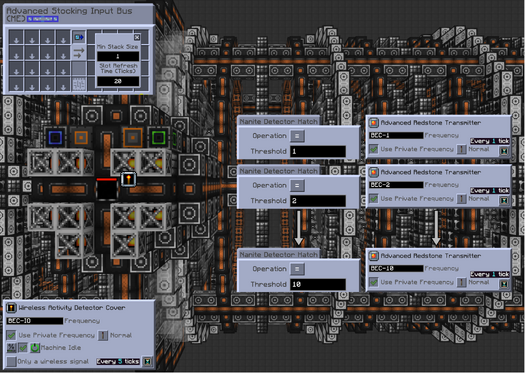
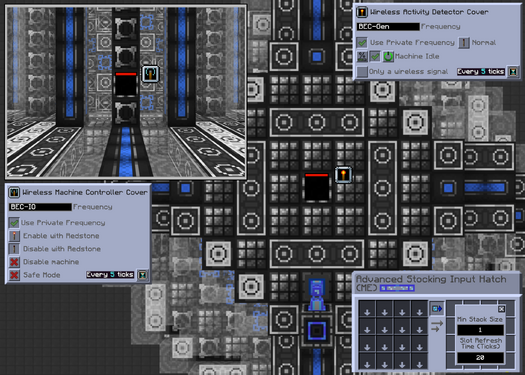
| Start by building the master IO Node. Place a wireless activity detector cover set to MACHINE IDLE on the controller and configure the advanced stocking input bus to AUTO-PULL on a 20 tick interval. Keep both the parallel and speed divisor settings at 1.
Place 10 nanite detector hatches facing into 10 advanced redstone transmitters. Configure them to detect each specific nanite tier and transmit out their own unique frequency. Set their tick refresh rate to 1t to match the update speed of the nanite detector hatches. The BEC subnetwork (blue) holds the inputs and the main network (green) receives the outputs. Connect an ME output bus to the latter. |
|
| STEP 2 | |
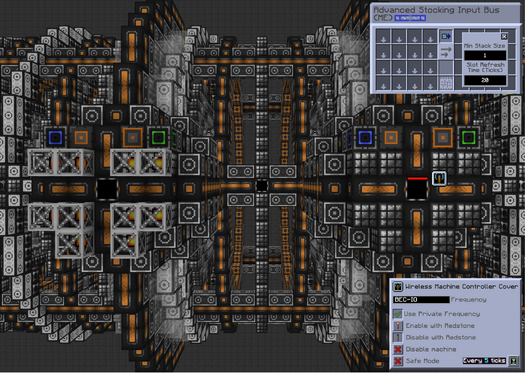
| Optionally, build up to 15 proxy IO Nodes for increasing the overall throughput of the BEC since parallels do not.
Place a wireless machine controller cover set to DISABLE WITH REDSTONE on the proxy's controller and configure the advanced stocking input bus to AUTO-PULL on a 20 tick interval. Keep both the parallel and speed divisor settings at 1. The proxy IO Nodes are only enabled after the master IO Node is active to guarantee that the master is always running regardless of batch size. Nanite swapping is disabled until the BEC subnetwork (blue) is empty to keep all the IO Nodes perfectly in sync. Again, the BEC subnetwork (blue) holds the inputs and the main network (green) receives the outputs. Connect an ME output bus to the latter. |
|
| STEP 3 | |
| Place a wireless machine controller cover on the Containment Field to disable it when the BEC Line is not in use.
Place a wireless activity detector cover set to MACHINE IDLE on the Entanglement Apparatus to signal that not all the condensate is ready yet. This prevents recipes from starting (and finishing) without it. Configure the frequency to something unique. Also place an advanced stocking input hatch set to AUTO-PULL on the Entanglement Apparatus and connect it to the BEC subnetwork (blue). |
|
| STEP 4 | |
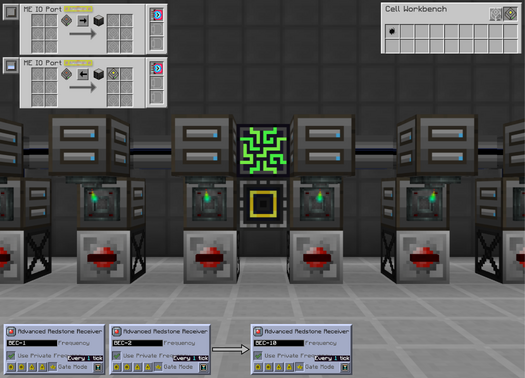
| Build out the nanite subnetwork (yellow) with up to 10 pairs of ME IO Ports, a pair of item translocators between them, and an advanced redstone receiver below. Each of these is for a specific nanite tier, but not all 10 are required at first.
Configure the ME IO Ports, item translocators, and advanced redstone receivers as shown. Right-click both translocators with redstone to make them respond to redstone signals and then right-click only the lower one with an empty hand to set the default direction as down. The frequencies of the receivers should match those used earlier for the nanite detector hatches and their signals toggle the direction of the item translocators. Each pair of ME IO Ports holds a filtered 4k storage cell with up to 30,720 nanites inside. The tier of the nanites should match their receiver frequency. |
|
| STEP 5 | |
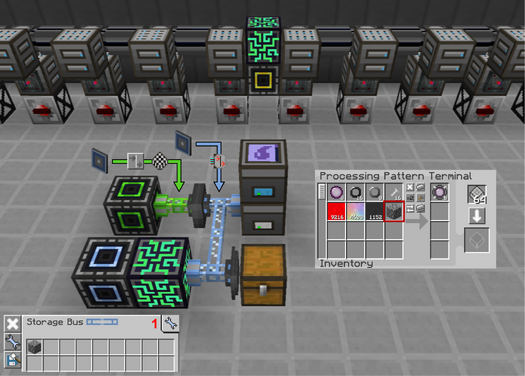
| Build out the buffer subnetwork (light blue) with an ME dual interface, two ME chests, and a storage bus facing into a regular chest. Enable blocking mode and insert an advanced blocking card as shown.
Inputs from the main network (green) enter through the ME dual interface and are buffered in the ME chests until consumed by the IO Nodes and Entanglement Apparatus. The regular chest is for a dummy item (cobblestone) which is added to each of the patterns to block subsequent recipes from entering the subnetwork until the current recipe has finished processing. Increase the priority of the storage bus to 1 to force the item there. Patterns should not exceed 16 parallels and there must always be exactly one cobblestone regardless of the number of parallels. |
|
| STEP 6 | |
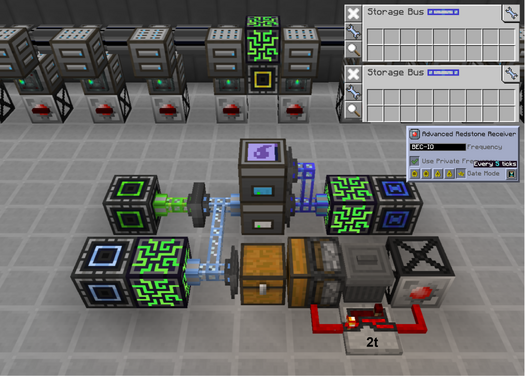
| Build out the BEC subnetwork (blue). Place a storage bus on the ME chest with items and a fluid storage bus on the ME chest with fluids. Connect the wireless hub to the IO Nodes and Entanglement Apparatus.
Place an item importer facing into a trash can next to the regular chest. When activated by the advanced redstone receiver, this voids the single cobblestone that is part of each recipe and allows the next set of inputs to enter the subnetworks. The repeater guarantees that all the machines are properly reset before restarting again. The delay may need to increase if there is a lot of lag in the world. |
|
| STEP 7 | |
| Build the remaining part of the nanite subnetwork (yellow) with a bi-directional storage bus on a singularity nanite containment bus.
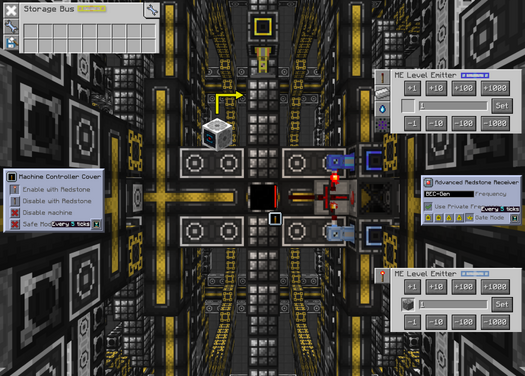
Place a machine controller cover on the side of the Observation Array to toggle nanite swapping based on the signals from the level emitters and advanced redstone receiver. The level emitter on the BEC subnetwork (blue) guarantees that all inputs are consumed by the IO Node(s) and Entanglement Apparatus. The advanced redstone receiver that all condensate is ready. And the level emitter on the buffer subnetwork (light blue) guarantees that a recipe is waiting to craft. Scale this approach by adding more IO Nodes, not by increasing the number of parallels. |
|
Method 2: OpenComputers
GTNH BEC Controller contains a guide showing how to setup the BEC Multiblocks using an OpenComputers script in addition to some simple AE2 automation.