GT New Horizons · Ludicrous Voltage (LuV)
Ludicrous Voltage (LuV)
Ludicrous Voltage (LuV) is the sixth electric tier in GregTech: New Horizons. This tier is largely centered around building the infrastructure necessary to construct the first tier of Fusion Reactor, as well as the new items and machines gated by fusion. This is the first tier where the Assembly Line is used to craft on-tier components as well as highly advanced machines. In addition, the costs and crafting trees for machines are even larger than in previous tiers, making fully automated on-demand crafting with AE2 absolutely necessary. The massive demand for robust infrastructure continues for the rest of the game; arrays of Volcanus consuming on-tier voltage are highly suggested.
Progression
LuV is a much smaller tier compared to IV in terms of different milestones. The capstone of this tier is the Mk I. Fusion Reactor; it enables crafting Europium, which in turn gates T5 rockets, europium-doped wafers, the Crystal circuit line, and more.
LuV Components
Unlike all previous tiers, LuV components must be crafted in a multiblock dedicated to complex crafts: the Assembly Line. The Assembly Line requires data sticks corresponding to crafts in order to craft anything. The data sticks for LuV components are created by scanning their IV counterparts inside a Scanner singleblock.
Naquadah Processing
The LuV energy hatch recipe requires 4 ingots worth of molten Naquadah. Naquadah is obtained from Naquadah Oxide Mixture-- a dust obtained from Naquadah Ore veins on T4 planets. Prior to LuV, the only way to obtain Naquadah was through an IV EBF recipe which produces one nugget from two NOM dust and is miserably slow.
In LuV, a naquadah processing line becomes possible to set up, which greatly increases the efficiency of NOM to Naquadah conversion. Most of the central steps do not require LuV voltage, but one of the central machines is strictly gated to LuV: the Neutron Activator.
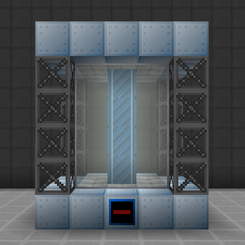
There are also two related materials that are also obtained from Naquadah Ore: Enriched Naquadah and Naquadria. These materials have similar processing steps, but are processed separately from different dusts. Their lines are possible to construct although optional in LuV. They may be attractive due to the byproducts of indium, barium, and trinium. However, they must be built to progress in ZPM.
Neutron Activator
The Neutron Activator is a multiblock that is central to the processing of naquadah, enriched naquadah, and naquadria. It requires the Precise Assembler to craft. On top of this, the Precise Assembler needs to have Mk I. casings in order to be able to craft the Neutron Activator and its required components. The Neutron Activator has a unique mechanic not seen in previous multiblocks-- the height of the Neutron Activator is used to determine the speed of recipes, not the input voltage.
Fusion Reactor
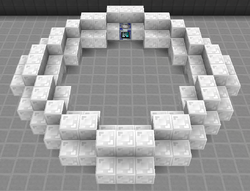
The capstone of LuV is the construction of a Fusion Reactor. Once Europium is obtained, it becomes possible to craft ZPM components. The Fusion Reactor is expensive--a single Mk I. requires over 4,000 LuV superconductors. Despite this expense, additional fusion reactors become attractive immediately, both for other materials and potentially to generate power.
Fusion Reactors have a unique mechanic in that they require a large amount of EU to begin processing a single type of recipe, typically in the hundreds of millions of EU. This is largely intended to penalize recipe switching or letting a recipe stop running, meaning that passive production of materials via fusion is the most attractive way to use Fusion Reactors. Fusion Reactors also have a very limited rate of power intake; it can take several minutes before a new recipe can run. As a result, resources that are crafted on demand should use a large batch size.
The available recipes in the Mk1 fusion reactor, in rough order of importance, are as follows:
- Europium is the most important recipe by far, since it's needed in large quantities for all ZPM components. It should be passively produced in a dedicated reactor due to its slow rate of production, taking nearly 6 minutes to produce for a single ZPM motor.
- Helium Plasma is not strictly necessary in LuV, but will be required in ZPM to smelt Neutronium and in UV for the Waterline. In LuV, it can also be used for power in a singleblock plasma generator or Large Plasma Turbine, or in further fusion recipes for Sunnarium and Boron Plasma.
- Duranium is not necessary yet either, but is an extremely powerful material for steam and gas turbine rotors. It is needed for Quantum Anomalies in the Cyclotron, and is used in ZPM to make Tritanium, which is needed for Void Miners and the Tier 6 Rocket.
- Calcium Plasma, Boron Plasma, Neon Plasma, and Force Plasma are part of the "plasma chain" of fusion recipes, which extends through the first three tiers of fusion reactors, and produces plasmas with much better stats than simple Helium Plasma for power generation.
- Sunnarium can be produced using Helium Plasma, providing an alternative to methods like bees, breeder reactors, or the Molecular Transformer.
- Osmium can be fused from Tungsten, although it is extremely slow at nearly 2 minutes per ingot, and therefore needs to be passive to be usable at all.
- There are fusion recipes for Iron, Chrome, and Platinum, but those materials are cheap enough that they're never worth using.
For information on additional plasma options to generate power and to make additional materials, see this spreadsheet.
Power
Storage and Distribution
The next tier of Lapotronic Supercapacitor capacitor is unlocked; it provides a massive boost to the total energy storage capacity. Vanadium-gallium cables are still recommended in this tier as a backbone due to their relatively low loss and amperage.
Generation
Like the previous tier IV, power generation capacity should follow the trend of exponential increase in order to accommodate the increasing number of energy-intensive processes. Several new multiblocks are now possible to construct which keeps some older power generation methods viable:
Despite the upgrade to the UCFE, power generation from oil processing begins to fall off after this tier. Nitrobenzene gains a massive buff from the XLGT largely due to scalability, since turbines no longer need to be manually replaced, and only one multi-amp / laser dynamo is needed for a multiblock that generates 16x the power of a single LGT. Like oil, this is the last tier where benzene gains a direct upgrade. Lastly, Vacuum Reactors gain a massive buff in "The Core". "The Core" is the final fuel rod upgrade for vacuum reactors; it is extremely dangerous due to its heat generation, but produces a massive amount of energy.
In addition, a new method of power generation becomes available: plasma. Plasma produced by a fusion reactor can generate power in two different ways: placed into an Extreme Heat Exchanger in order to produce supercritical steam, or placed into a Large Plasma Turbine which directly generates power. Both methods will transform the plasma into its liquid / gas state, which can be potentially useful. Building a compact fusion reactor for power generation is the strongest source of energy available in LuV, albeit by far the most expensive.
Infrastructure
Resource Shortages
Aside from the new materials, all of the Platline materials will be needed in massive amounts. Ruridit as well as rhodium-plated palladium are used in huge quantities for even the most basic components and machines. Yttrium, Samarium, Neodymium, and many other rare earths will be needed in large amounts as well. However, mining many of the rare earths directly is not yet possible, so alternative production methods must be explored, such as Rare Earth dehydration, bees, and blood magic meteors. Radon will also be needed in large amounts, so the radon loop should be built if one has not done so.
Waterline
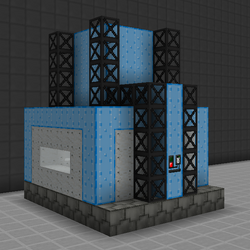
LuV introduces the Waterline, a collection of multiblocks which produce increasingly pure water. The first two tiers of water, Filtered and Ozonated, speed up the cutting and engraving of wafers. The first grade of water is necessary for LuV progression as it is needed for the Netherite line. The second grade is optional at LuV, but it improves the yield and speed of the Nefarious Oil step, so it is recommended to invest in it. They will also be needed later on as the Waterline is even more relevant at higher tiers where high tier water is necessary for the production of chips.
Circuits
After the completion of the fusion reactor, it becomes possible to manufacture Crystal circuits. These circuits have a unique automation challenge due to how their "CPU" component is crafted; it requires a loop of autoclaving and forge hammering. In addition, the standard method of creating the CPUs requires molten europium. The Crystalprocessor Mainframe is the first UV circuit available.
Other Multiblocks
- Circuit Assembly Line: Creates a large amount of circuits faster and often with a reduced cost than a regular circuit assembler. Pre-fusion, a Circuit Assembly Line only provides a speed improvement and so is optional. Post-fusion they are necessary to create the new circuit line, Crystalprocessors, and all circuit lines after.
- Cyclotron: This multiblock is shaped similar to a fusion reactor, and generates particles. A notable use for the cyclotron is to generate quantum anomalies to make Advanced Nitinol. Advanced Nitinol is needed for the Matter Fabrication CPU as well as other ZPM and higher multiblocks. Note that in 2.9, this multiblock has been depreciated and replaced by the Large Hadron Collider.
- Industrial Autoclave: A multi-block autoclave, it is a massive upgrade to the single-block autoclave with reduced power consumption, as well as increased speed and parallels. It is highly recommended to create the large amount of crystal chips needed for crystal processors, as well as for processing Naquadah at far faster rates.
- Industrial Arc Furnace: A multi-block arc furnace. Although unlocked in LuV, it has few uses, and requires a unique automation challenge with managing electrodes, making its usefulness at this stage questionable, outside of making netherite materials faster.