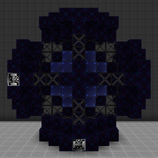
The Large Naquadah Reactor (LNR) is a ZPM tier multiblock for generating power from naquadah based liquid fuels. The LNR converts the fuel into EU directly, does not have a warm-up period, and does not use turbines. The only challenge is meeting the input requirements: There can only be ONE type of fuel in the input hatches at any given time and the LNR must be supplied with 2,400 L/s of liquid air to output power. Optionally, supply a coolant to increase the efficiency of the machine and/or an excited liquid to increase the overall throughput of the machine. A single LNR can generate up to 665B EU/t (with the highest tier liquids) which means it scales very well into the higher voltage tiers. The LNR is superseded by the Dyson Swarm Ground Unit or Semi-Stable Antimatter Stabilization Sequencer (SSASS).
The first two tiers of naquadah based liquid fuel (naq fuel) are crafted in the Fusion Reactor and Large Chemical Reactor, respectively. The remaining four tiers are all crafted in the Naquadah Fuel Refinery which uses advanced field restriction coils to unlock new recipes. The Mk-V fuel is also used to craft star fuel and the depleted Mk-V and Mk-VI fuels are used by the SSASS for activation stabilization. The Neutron Activator can significantly accelerate the decay of naq fuel, but does not generate any power.
The LNR has no tiered components. Buses/hatches may replace any naquadah reactor casing anywhere on the structure. A stocking input hatch is highly recommended to hold the four different input fluids. Multi-amp and laser dynamo hatches are supported for serious power generation, but there cannot be more than one. The LNR shuts down if the dynamo hatch cannot support 100% of the current power output so it is practically mandatory to use a high-amp laser source hatch. Use the Multiblock Structure Hologram Projector to visualize/build the structure.
Structure
Ballshared LNRsController: Front bottom center
130-141 Naquadah Reactor Casing
81 Field Restriction Casing
32 Radiation Proof Steel Frame Box
1 Dynamo Hatch: Any reactor casing
1 Maintenance Hatch: Any reactor casing
1+ Input Hatch: Any reactor casing
1+ Output Hatch: Any reactor casing
Wallsharing
LNRs may wallshare each of their sides or the sphere at the center of the structure to save on casings, frame boxes, and buses/hatches. That includes the laser source hatch if it has enough throughput to support 2-4 machines simultaneously. The image above depicts only two machines, but a third could be placed on the remaining axis.
Usage
Compared to other generator multiblocks, the LNR is very simple to use. The LNR converts the fuel into EU directly, does not have a warm-up period, and does not use turbines. The only challenge is meeting the following input requirements:
The LNR must be supplied with 2,400 L/s of liquid air to output power, or else the fuel is voided.
The dynamo hatch must be large enough to support 100% of the current power output, or else the machine shuts down.
Fuel
The available fuels are listed in the following table by the amount of EU/t they generate in the LNR and for how long. Notice that there are three options that are not naquadah based, but their densities are too low to even be considered viable for the LNR. Their entire purpose is being recycled for their byproducts, such as praseodymium from the thorium based liquid fuel. However, the Neutron Activator is much better and faster for that specific application.
Fuel
EU/t
Time (s)
EU/L
Thorium Based Liquid Fuel
2,200
25.0
1,100,000
Uranium Based Liquid Fuel
12,960
5.00
1,296,000
Plutonium Based Liquid Fuel
32,400
7.50
4,860,000
Naquadah Based Liquid Fuel Mk-I
975,000
3.00
58,500,000
Naquadah Based Liquid Fuel Mk-II
2,300,000
3.50
161,000,000
Naquadah Based Liquid Fuel Mk-III
9,511,000
4.00
760,880,000
Naquadah Based Liquid Fuel Mk-IV
88,540,000
5.00
8,854,000,000
Naquadah Based Liquid Fuel Mk-V
399,576,000
8.00
63,932,160,000
Naquadah Based Liquid Fuel Mk-VI
2,077,795,200
12.0
498,670,848,000
Coolant
Optionally, a coolant can be provided to increase the efficiency of the LNR. Each of the following fluids multiplies the current EU/t without increasing the fuel consumption rate or reducing the length of the recipe. Coolant is strictly a benefit to the machine. There cannot be more than one type of coolant since they do not stack.
Coolant
Efficiency
Amount
Coolant
105%
1,000 L/s
Super Coolant
150%
1,000 L/s
Cryotheum
275%
1,000 L/s
Tachyon Rich Temporal Fluid
500%
20 L/s
Booster
Optionally, a booster can be provided to increase the throughput of the LNR. Each of the following fluids multiplies the current EU/t and the amount of fuel consumed, similar to parallels. This does not increase the oxygen or coolant consumption. Boosters strictly save on spamming additional machines. There cannot be more than one type of booster since they do not stack.
Booster
Multiplier
Amount
Molten Caesium
2x
180 L/s
Molten Uranium-235
3x
180 L/s
Molten Naquadah
4x
20 L/s
Molten Atomic Separation Catalyst
16x
20 L/s
Spatially Enlarged Fluid
64x
20 L/s
Summary
The following table summarizes the combined output of the LNR with various fuels, coolants, and boosters. Use the planner linked at the top for full setup breakdowns and input costs.