GT New Horizons · Extremely Ultimate Voltage (UEV)
Nanochip Assembly Complex
The Nanochip Assembly Complex (NAC) is a UEV tier multiblock for mass circuit assembling. The NAC is a direct upgrade from the Circuit Assembly Line for all circuit lines because it offers unlimited parallels, supports multi-amp and laser energy hatches for serious overclocking, and runs 2/2 perfect overclocks. The NAC also crafts optical circuits at 1/4th the cost and is the only machine capable of crafting pico, quantum, and planck-scale circuits.
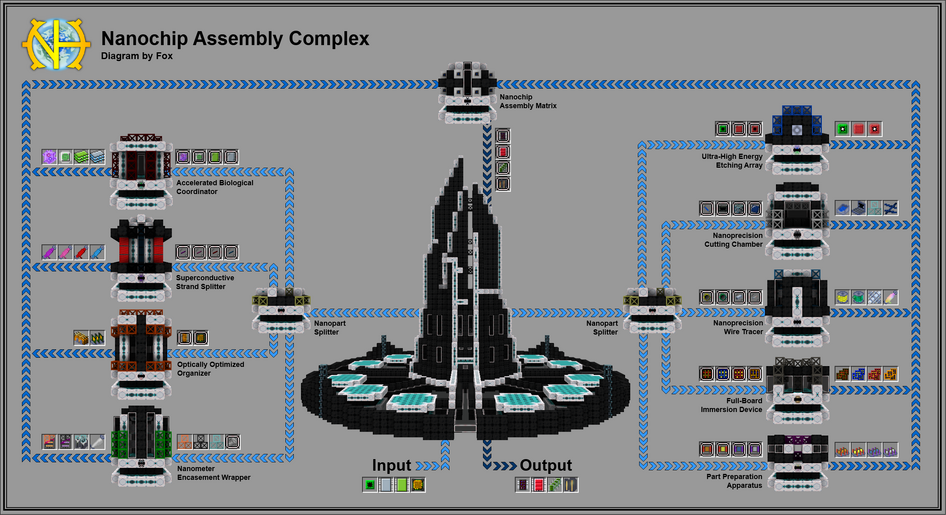
All processing and circuit assembling is done by the modules that surround the control room at the center of the structure. There are 11 unique modules to choose from and 12 module slots. A few of the modules have their own unique challenges or costs, but most are relatively straightforward. Items and circuit components (CCs) are routed between modules with vacuum conveyor hatches and vacuum conveyor pipes, which have unlimited storage capacity and throughput. Crafting enough of the same circuit type calibrates the NAC to that particular circuit line and grants additional bonuses.
Construction
The NAC consists of a large control room surrounded by 12 module slots. The control room is for both the inputs and outputs to the machine while the modules are for processing circuit components (CCs). Multi-amp and laser energy hatches are supported, but there can only be one and it must be inside or under the control room. Power is automatically distributed from the control room to all modules, similar to the Space Elevator. There is no maintenance hatch. Use the Multiblock Structure Hologram Projector to visualize/build the structure.
Modules are their own multiblocks with their own controller and construction requirements. Replace one of the nanochip mesh interface casings on the top edge of any module slot and use the Multiblock Structure Hologram Projector to visualize/build them. They can face any direction but cannot be built upside-down. The module's controller should say "Connected to Main Complex" once the NAC is enabled.
Structure
- Controller: Middle of structure, 9th layer
- 3958 Nanochip Reinforcement Casing
- 2226 Nanochip Complex Glass
- 1124-1719 Nanochip Mesh Interface Casing
- 721 Nanochip Computational Matrix Casing
- 53 Naquadah Frame Box
- 32 Nanochip Firewall Projection Casing
- 0-12 NAC Module: Any top center edge mesh casing on platforms
- 1 Energy Hatch: Any side mesh casing in control room
- 1+ Input Bus: Any side mesh casing in control room
- 1+ Output Bus: Any side mesh casing in control room
- 0+ Vacuum Conveyor Input: Any side mesh casing in control room
- 0+ Vacuum Conveyor Output: Any side mesh casing in control room
Vacuum Conveyor System
Unique to the NAC are vacuum conveyor input (VCI) and vacuum conveyor output (VCO) hatches which move items or CCs between modules. These are similar to optical transmission and reception hatches because they must be colored to work and the connections must be 1-to-1. The hatches are also machine-specific so they cannot transfer CCs between NACs. The vacuum conveyor pipes that join the hatches must be colored as well and can bend freely. It is highly recommended to use the infinite spray can to color everything.
Both hatches can hold up to 16 unique item stacks at a time with no upper limit on capacity and no transfer limit between connections. This allows for incredibly high throughput that easily scales into the end game. Items stored inside the hatches cannot be interacted with directly, but there is an option to empty/unpackage stored items to an AE2 storage cell or to simply delete all stored items. Fluids do not enter the vacuum conveyor system and must be routed directly to the module(s) that use them.
There are two ways to properly filter or split items to ensure that they are routed to the correct module. The first is prefiltering everything before it enters the NAC and the second is using the Nanopart Splitter module. The latter uses a module slot but it allows for custom routing based on input color, item type, and/or redstone signal strength.
Usage
The NAC control room only ever packages and unpackages circuit components (CCs) on a fixed 5 second cycle. The modules are what actually process and assemble the circuits. There are 11 unique modules to choose from and 12 module slots around the control room, but not all modules are required and there is no limit on the number of each one. Despite the additional processing, modules are a direct upgade from the Circuit Assembly Line because they have unlimited parallels and run 2/2 perfect overclocks down to 5 seconds for every voltage tier above the recipe tier. Typically parallels come before overclocks, but NAC modules are unique and do the opposite to reduce the length of long recipes.
The general workflow of the NAC is listed below. The image is also provided for reference although it is a slight oversimplification since not everything is routed directly to the Nanochip Assembly Matrix (NAM). See the calibration section for a much more detailed walkthrough of each circuit line.
- Insert items through a colored input bus (regular or stocking) in the control room.
- The NAC packages the items into CCs and transfers them to a VCO hatch of the same color.
- Filter the packaged CCs with a Nanopart Splitter module if not done beforehand and route them to the correct module.
- The modules turn the packaged CCs into processed components (PCs) which cannot be unpackaged or leave the NAC.
- Join the PCs in the Nanochip Assembly Matrix to create circuit CCs and route them back to the control room.
- The NAC unpackages the circuit CCs and transfers them to an output bus for retrieval. The color of the output bus is irrelevant.
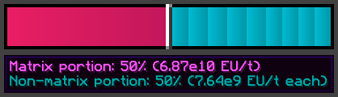
Power is automatically distributed from the control room to all modules, similar to the Space Elevator, and can even be customized in the GUI of the controller; adjust the slider at the bottom to determine how much of the incoming power should go to the NAM and how much power should go to the other modules. If there is more than one NAM, then the matrix portion is split evenly between them. If there is more than one other module, then the non-matrix portion is split evenly between those. Hover over the slider bar to see the current EU/t for each matrix and non-matrix module, as seen in the following image. The only module that does not consume power is the Nanopart Splitter.
Modules
Modules are their own multiblocks with their own controller and construction requirements, and they are what actually process and assemble the circuits in the NAC. All modules have input separation  enabled by default which means inputs must all have the same color VCI hatch to be used together in the same recipe. Disable input separation to allow modules to use inputs from different colored VCI hatches in the same recipe.
 Important: | The output color of a recipe is always the color of the FIRST input in NEI. |
Nanochip Assembly Matrix
The Nanochip Assembly Matrix (NAM) assembles circuit CCs from processed components (PCs). This module is always the final step before sending the circuit CCs to the control room to be unpackaged into real circuits. The NAM is a little unique because it has its own custom portion on the power distribution meter and its 2/2 perfect overclocks down to 5 seconds is based on recipe casing tier rather than recipe voltage tier, as seen in the following equation. Both tiers are displayed in NEI and are often different from each other.
The inputs to the Nanochip Assembly Matrix can be in separate VCIs and do not all need to be the same color, as long as input separation is disabled. There is also no restriction on the ordering of components despite recipes appearing identical to Assembly Line recipes.
Structure
|
|
Nanopart Splitter
The Nanopart Splitter filters and routes items based on rules regarding input color, item type, and/or redstone signal strength. Open the rules manager through the GUI of the controller and add any amount in any order. It is not possible to re-order them but that has no effect anyway.
All input filters apply even when clicked off their respective tab. For example, it is possible to filter specific items from specific colors if both are set in the same rule. If no color or item type is selected then it applies to all colors or all items, respectively. If there are multiple valid rules or VCOs for a single input, then it is split evenly between them. For example, select two separtae output colors or have two VCOs on the same output color to split an input perfectly in half.
The nanochip redstone input hatch  is an optional hatch that replaces any nanochip mesh interface casing on the top of the structure and acts as an external redstone receiver for dynamically adjusting filters. Simply match the channel of the hatch to one or more rules and set the minimum required strength to activate.
Structure
- Controller: Any top center edge mesh casing on platform
- 37 Nanochip Reinforcement Casing
- 18 Nanochip Mesh Interface Casing
- 10 Kevlar Frame Box
- 0+ Splitter Redstone Input: Any top mesh casing
- 0+ Vacuum Conveyor Input: Any base mesh casing
- 0+ Vacuum Conveyor Output: Any base mesh casing
Part Processing Apparatus
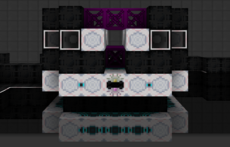
The Part Processing Apparatus processes SMD, bolted plate, and motherboard CCs. This module is required for all circuit lines.
Structure
- Controller: Any top center edge mesh casing on platform
- 44 Nanochip Reinforcement Casing
- 20 Nanochip Mesh Interface Casing
- 17 Radox Polymer Frame Box
- 8 Nanochip Complex Glass
- 4 UEV Machine Casing
- 0+ Vacuum Conveyor Input: Any base mesh casing
- 0+ Vacuum Conveyor Output: Any base mesh casing
Nanoprecision Wire Tracer
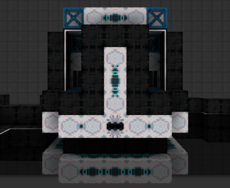
The Nanoprecision Wire Tracer processes wire CCs. This module is required for all circuit lines.
Structure
- Controller: Any top center edge mesh casing on platform
- 46 Nanochip Reinforcement Casing
- 28 Nanochip Mesh Interface Casing
- 25 Nanochip Complex Glass
- 20 Superconductor Base UHV Frame Box
- 1 Superconductor Base UEV Sheetmetal
- 0+ Vacuum Conveyor Input: Any base mesh casing
- 0+ Vacuum Conveyor Output: Any base mesh casing
Nanoprecision Cutting Chamber
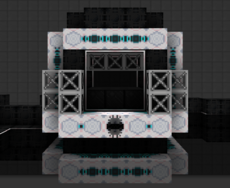
The Nanoprecision Cutting Chamber processes bolt, frame box, memory chip, and wafer CCs. This module is required for all circuit lines.
Structure
- Controller: Any top center edge mesh casing on platform
- 31 Nanochip Reinforcement Casing
- 28 Nanochip Mesh Interface Casing
- 24 Nanochip Complex Glass
- 21 Neutronium Frame Box
- 16 Naquadria-Reinforced Water Plant Casing
- 1+ Input Hatch: Any base mesh casing
- 0+ Vacuum Conveyor Input: Any base mesh casing
- 0+ Vacuum Conveyor Output: Any base mesh casing
Full-Board Immersion Device
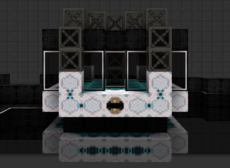
The Full-Board Immersion Device processes circuit board CCs by cleaning them in their corresponding immersion fluid. Recipes do not consume any of the immersion fluid themselves but rather increase the impurity up to 100%. A higher impurity increases the power consumption of the module up to 300% until it is drained, either manually through the GUI of the controller or by triggering the auto-flush at a configured percentage level. The auto-flush must be between 1-100% so the tank eventually needs to be refilled.
There are five immersion fluids available, but the internal tank can only hold one at a time. Supply between 500,000L and 1,000,000L of immersion fluid through a regular input hatch to get started. Excess immersion fluid is NOT consumed and having any less than the maximum increases the rate at which impurity increases, as seen in the following equation. The total item count carries over between iterations so impurity is added once every 1,000 items regardless of recipe or batch size.
Structure
- Controller: Any top center edge mesh casing on platform
- 52 Nanochip Complex Glass
- 27 Nanochip Reinforcement Casing
- 19 Octiron Frame Box
- 10 Nanochip Mesh Interface Casing
- 1+ Input Hatch: Any base mesh casing
- 1+ Output Hatch: Any base mesh casing
- 0+ Vacuum Conveyor Input: Any base mesh casing
- 0+ Vacuum Conveyor Output: Any base mesh casing
|
|
|
Nanometer Encasement Wrapper
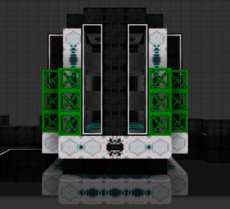
The Nanometer Encasement Wrapper processes sheet and framebox CCs. This module is required for all circuit lines except primitive.
Structure
- Controller: Any top center edge mesh casing on platform
- 47 Nanochip Mesh Interface Casing
- 40 Nanochip Complex Glass
- 32 Nanochip Reinforcement Casing
- 32 Quantium Frame Box
- 0+ Vacuum Conveyor Input: Any base mesh casing
- 0+ Vacuum Conveyor Output: Any base mesh casing
Superconductive Strand Splitter
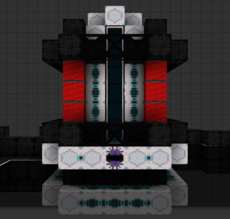
The Superconductive Strand Splitter processes superconductor CCs at the cost of 1,000 L/s of super coolant while active. Running out of super coolant during processing voids the output. This module is required for all circuit lines except primitive.
Structure
- Controller: Any top center edge mesh casing on platform
- 40 Nanochip Reinforcement Casing
- 29 Nanochip Mesh Interface Casing
- 24 Nanochip Glass
- 24 Naquadria Frame Box
- 16 UEV Solenoid Superconductor Coil
- 6 UHV Solenoid Superconductor Coil
- 1+ Input Hatch: Any base mesh casing
- 0+ Vacuum Conveyor Input: Any base mesh casing
- 0+ Vacuum Conveyor Output: Any base mesh casing
Ultra-High Energy Etching Array
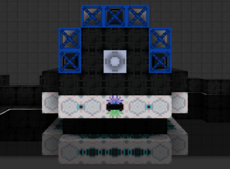
The Ultra-High Energy Etching Array processes crystal CCs with its own laser source hatch. In a fully calibrated crystal NAC, the power consumption of the module is divided by of the laser source hatch and the duration of recipes are divided by . This module is required for the crystal, bioware, and special circuit lines.
Structure
|
|
|
Accelerated Biological Coordinator
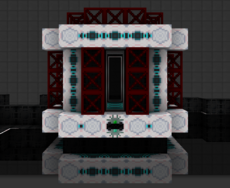
The Accelerated Biological Coordinator processes living CCs. It does not consume any growth catalyst medium in a fully calibrated wetware NAC, and additionally does not consume any sterilized bio catalyst medium in a fully calibrated bioware NAC. This module is required for the primitive, wetware, and bioware circuit lines.
Structure
- Controller: Any top center edge mesh casing on platform
- 37 Nanochip Mesh Interface Casing
- 36 Nanochip Reinforcement Casing
- 36 Tritanium Frame Box
- 20 Nanochip Complex Glass
- 1+ Input Hatch: Any base mesh casing
- 0+ Vacuum Conveyor Input: Any base mesh casing
- 0+ Vacuum Conveyor Output: Any base mesh casing
Optically Optimized Organizer
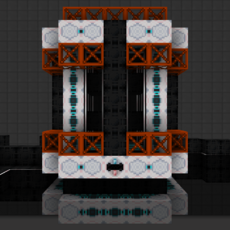
The Optically Optimized Organizer processes optical CCs by cleaning them in two types of purified water between grade 3 and grade 8, inclusive. Each purified water grants a bonus to the module, as seen in the following table. Similar effects stack multiplicatively with one another and all effects are applied twice in a fully calibrated optical NAC. This module is required for the optical and special circuit lines.
Structure
|
|
Calibration
The NAC records every circuit crafted in the Nanochip Assembly Matrix (NAM) to track the frequency of each circuit type out of the past 100,000 circuits. The circuit history is only updated once every 1,000 circuits and replaces the oldest information first. View the current circuit history and the progress towards the next 1,000 circuits through the GUI of the controller.
Once enough of the same circuit type is crafted, the NAC is calibrated to that circuit line and gains up to three stacking bonuses, as seen in the following tables. Only one calibration can be active at a time and higher tiers have higher priority over lower ones. Every calibration tier has its own unique prefix that is added to the name of the machine inside the GUI of the controller to help identify the one that is currently active. It is recommended to build one NAC per circuit line to maximize the calibration bonuses.
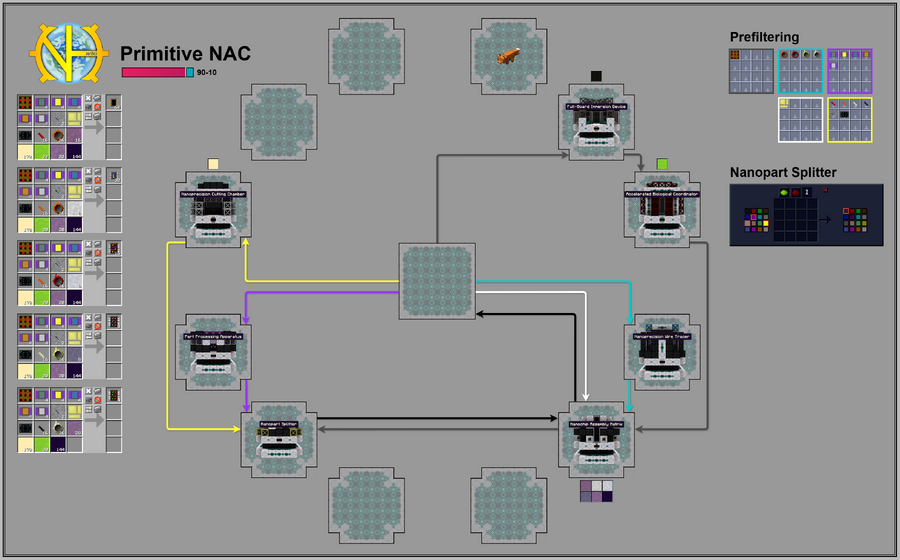
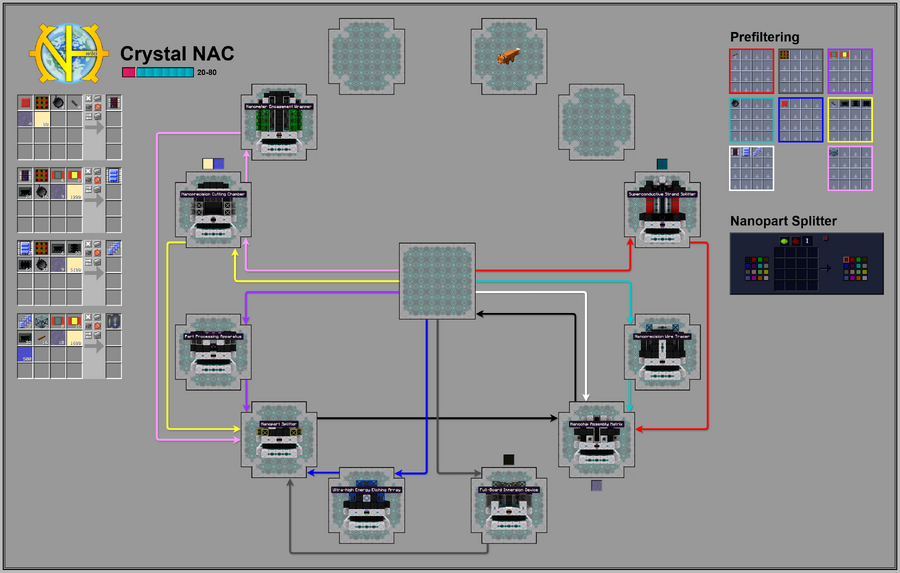
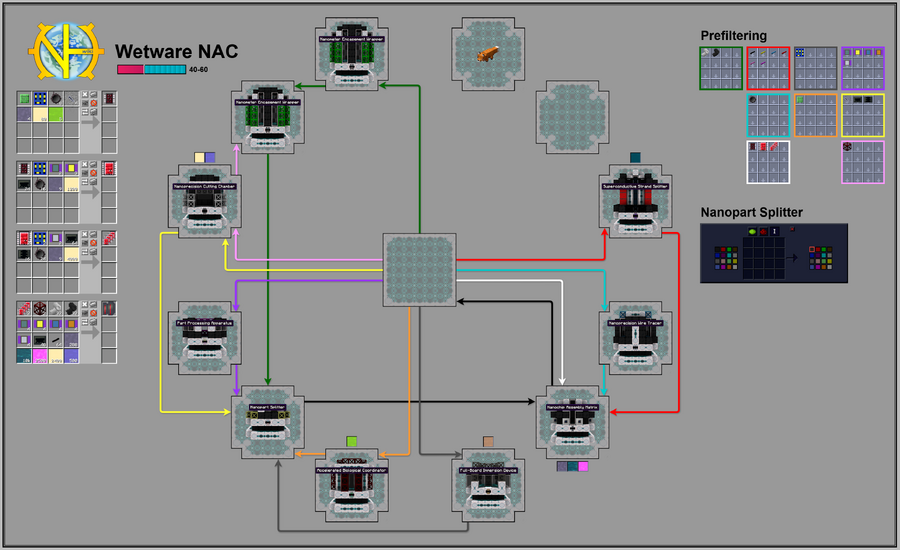
Use the following images as a reference when building each NAC and filtering the inputs between modules. Items marked with a star or (R) must be renamed prior to entering the machine to avoid stacking. Fluids included in the patterns should be routed to the modules directly and those that are NOT included should be passively stocked in the modules at all times.
Primitive
The primitive NAC is for the NAND chip (ULV), microprocessor (LV), integrated processor (MV), nano processor (HV), and quantum processor (EV). The suggested power distribution is 90% Matrix and 10% non-Matrix. The calibration thresholds are based on the number of primed unattuned circuitry (PUC) crafted rather than the number of circuits, and each one contributes only 0.1 to the threshold instead of 1.
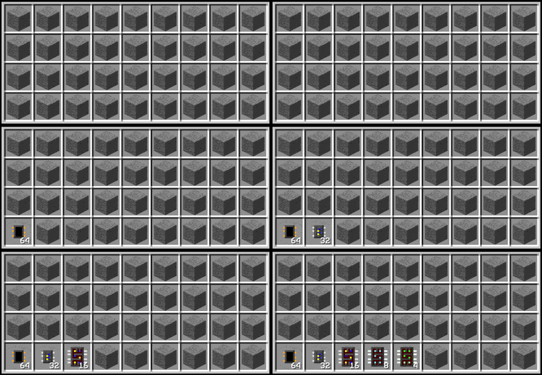
The only challenge in automating the primitive NAC is routing the PUC back into the Nanochip Assembly Matrix after its done crafting. The following solution uses both prefiltering and the Nanopart Splitter to route everything to the correct locations. The fluid for the Full-Board Immersion Device is passively stocked from the main network while the rest are pulled from a local subnetwork.
| Tier | Threshold | Prefix | Bonus |
| 1 | 400,000 PUC | Crude | +10% chance to reduce the recipe duration of primitive circuits down to 10 ticks. |
| 2 | 800,000 PUC | Robust | +5% chance to double the output for primitive circuits. |
| 3 | 1,000,000 PUC | Archaic | +5% chance to double the output for primitive circuits (10% total). |
| Recipes | ||
NAND Chip (ULV) x64
|
Microprocessor (LV) x32
|
Integrated Processor (MV) x16
|
Nano Processor (HV) x8
|
Quantum Processor (EV) x4
|
|
Crystal
The crystal NAC is for the crystal processor (IV), crystal assembly (LuV), crystal supercomputer (ZPM), and crystal mainframe (UV). The suggested power distribution is 20% Matrix and 80% non-Matrix. Upgrade the amperage of the laser source hatch on the Ultra-High Energy Etching Array to reduce its power consumption and upgrade the voltage of the laser source hatch to reduce the duration of recipes.
The only challenge in automating the crystal NAC is having two different output routes for the Nanoprecision Cutting Chamber. The following solution uses both prefiltering and the Nanopart Splitter to route everything to the correct locations. The fluids for the Full-Board Immersion Device and Superconductive Strand Splitter are passively stocked from the main network while the rest are pulled from a local subnetwork.
| Tier | Threshold | Prefix | Bonus |
| 1 | 30,000 Circuits | Shiny | x0.8 EU/t for all modules. |
| 2 | 60,000 Circuits | Glimmering | x0.8 recipe duration for crystal circuits in the Nanochip Assembly Matrix. |
| 3 | 90,000 Circuits | Prismatic | The laser source hatch on the Ultra-High Energy Etching Array provides scaling bonuses to the module. |
| Recipes | ||
Crystal Processor (IV)
|
Crystal Assembly (LuV)
|
Crystal Supercomputer (ZPM)
|
Crystal Mainframe (UV)
|
||
Wetware
The wetware NAC is for the wetware processor (LuV), wetware assembly (ZPM), wetware supercomputer (UV), and wetware mainframe (UHV). The suggested power distribution is 40% Matrix and 60% non-Matrix.
The only challenge in automating the wetware NAC is having two different output routes for both the Nanoprecision Cutting Chamber and the Nanometer Encasement Wrapper. The following solution uses both prefiltering and the Nanopart Splitter to route everything to the correct locations. The fluids for the Full-Board Immersion Device and Superconductive Strand Splitter are passively stocked from the main network while the rest are pulled from a local subnetwork.
| Tier | Threshold | Prefix | Bonus |
| 1 | 30,000 Circuits | Wet | x0.8 EU/t for all modules. |
| 2 | 60,000 Circuits | Fleshy | x0.8 recipe duration for wetware circuits in the Nanochip Assembly Matrix. |
| 3 | 90,000 Circuits | Wriggling | Growth catalyst medium is not consumed in the Accelerated Biological Coordinator. |
| Recipes | ||
Wetware Processor (LuV)
|
Wetware Assembly (ZPM)
|
Wetware Supercomputer (UV)
|
Wetware Mainframe (UHV)
|
||
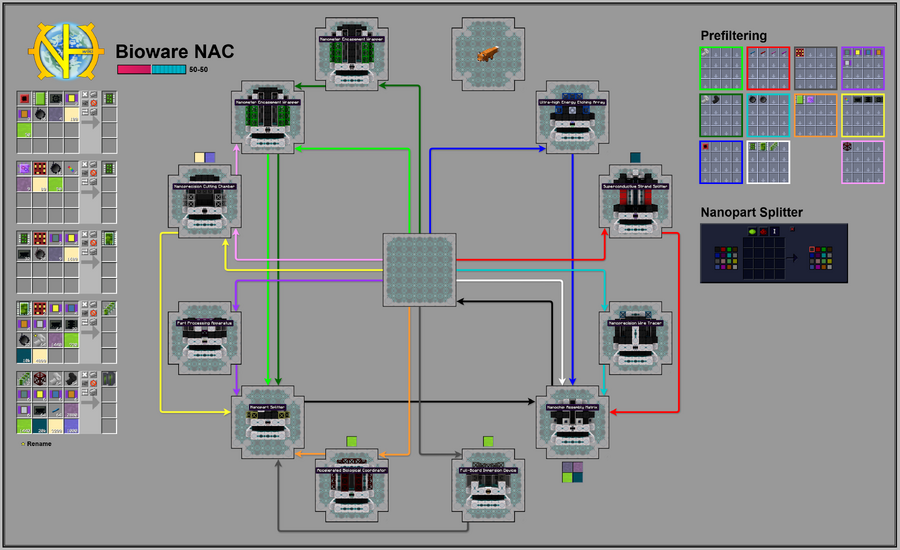
Bioware
The bioware NAC is for the bioware processor (ZPM), bioware assembly (UV), bioware supercomputer (UHV), and bioware mainframe (UEV). The suggested power distribution is 50% Matrix and 50% non-Matrix.
The only challenge in automating the bioware NAC is having two different output routes for both the Nanoprecision Cutting Chamber and the Nanometer Encasement Wrapper. One of the input foils must also be renamed prior to entering the machine. The following solution uses both prefiltering and the Nanopart Splitter to route everything to the correct locations. The fluids for the Full-Board Immersion Device and Superconductive Strand Splitter are passively stocked from the main network while the rest are pulled from a local subnetwork.
| Tier | Threshold | Prefix | Bonus |
| 1 | 25,000 Circuits | Aware | x0.8 EU/t for all modules. |
| 2 | 50,000 Circuits | Sentient | x0.8 recipe duration for bioware circuits in the Nanochip Assembly Matrix. |
| 3 | 75,000 Circuits | ALIVE!!!!!!!!! | Both catalyst mediums are not consumed in the Accelerated Biological Coordinator. |
| Recipes | ||
Bioware Processor (ZPM)
|
Bioware Processor (ZPM)
|
Bioware Assembly (UV)
|
Bioware Supercomputer (UHV)
|
Bioware Mainframe (UEV)
|
|
Optical
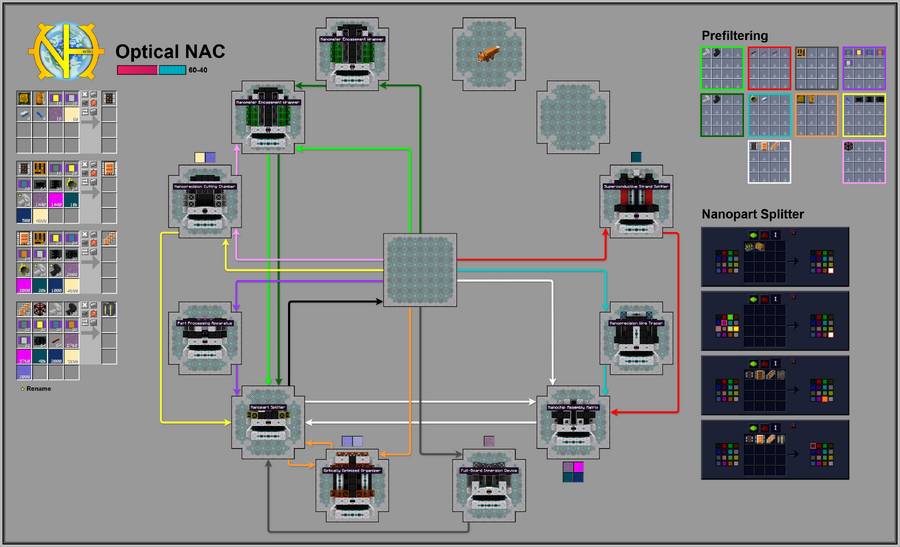
The optical NAC is for the optical processor (UV), optical assembly (UHV), optical supercomputer (UEV), and optical mainframe (UIV). The suggested power distribution is 60% Matrix and 40% non-Matrix. Use higher tier waters in the Optically Optimized Organizer to reduce its power consumption and the duration of recipes.
The biggest challenge in automating the optical NAC is handling the 50% chance for each circuit to output as an unorganized version of itself, which takes additional processing to fix. Some of the input foils must also be renamed prior to entering the machine. The following solution uses both prefiltering and the Nanopart Splitter to route everything to the correct locations. The fluids for the Full-Board Immersion Device, Superconductive Strand Splitter, and Optically Optimized Organizer are all passively stocked from the main network while the rest are pulled from a local subnetwork.
| Tier | Threshold | Prefix | Bonus |
| 1 | 25,000 Circuits | Tuned | x0.8 EU/t for all modules. |
| 2 | 50,000 Circuits | Precise | x0.8 recipe duration for optical circuits in the Nanochip Assembly Matrix. |
| 3 | 75,000 Circuits | Perfected | Water bonuses are applied twice in the Optically Optimized Organizer. |
| Recipes | ||
Optical Processor (UV)
|
Optical Assembly (UHV)
|
Optical Supercomputer (UEV)
|
Optical Mainframe (UIV)
|
||
Special
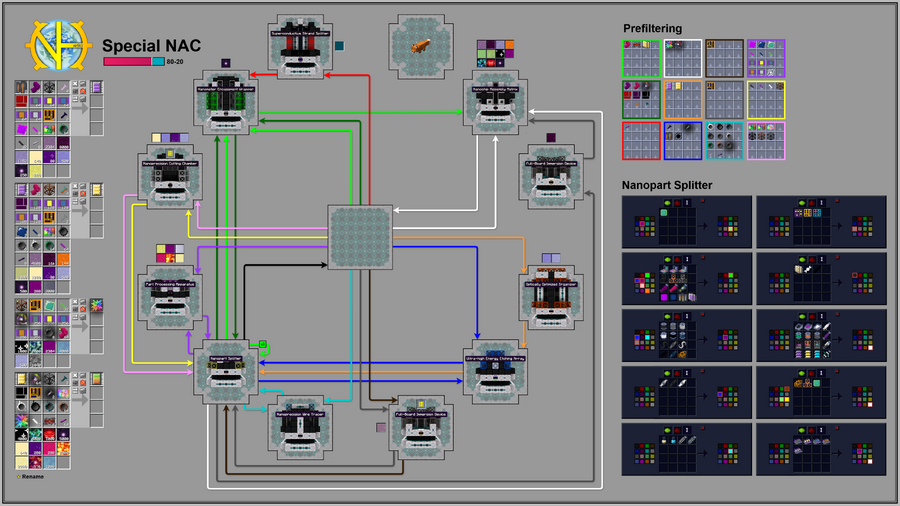
The special NAC is for the pico circuit (UMV), quantum circuit (UXV), and planck-scale circuit (MAX). The suggested power distribution is 80% Matrix and 20% Non-Matrix. Upgrade the amperage of the laser source hatch on the Ultra-High Energy Etching Array to reduce its power consumption and upgrade the voltage of the laser source hatch to reduce the duration of recipes. Use higher tier waters in the Optically Optimized Organizer to reduce its power consumption and the duration of recipes.
There are several challenges in automating the special NAC and some of the inputs must also be renamed prior to entering the machine. The following solution uses both prefiltering and the Nanopart Splitter to route everything to the correct locations. Enable input separation on the Nanoprecision Cutting Chamber and the one Full-Board Immersion Device with prismatic acid to avoid conflicts with the renamed items. The fluids for both Full-Board Immersion Devices, the Superconductive Strand Splitter, and the Optically Optimized Organizer are all passively stocked from the main network while the rest are pulled from a local subnetwork.
The x3 on the lime arrow next to the Nanopart Splitter means to build three separate lines running from the module directly back into itself. The purpose of that is to satisfy the 1:3 ratio needed for hexanite plates without running three lines across the entire width of the NAC. The black arrow is for parts that need to be processed externally, such as the lost quantum mainframe rack. It is not possible to have both a white and black ME output bus and automatically filter the outputs into their own subnetworks. Instead, all outputs must leave from the same ME output bus and then be filtered with AE2.
The recipe for the calabi-yau manifold includes the hexanite parts and optical SMD components for both itself and the actual planck circuit. This allows it to perfectly split those parts into the correct ratios every single time, and saves from running out of space in the pattern terminal. The recipe also includes the magmatter needed to process the raw manifold bud in the Industrial Arc Furnace, but not the eternity because that is perfectly looped with the output of the blossoming manifold bud in the Industrial Sledgehammer. The recipe for the planck-scale circuit similarly includes the tachyon rich temporal fluid for both the macrocosmic wire strands and the pulsating microcosmic wire strands in the Spinmatron-2737.
| Tier | Threshold | Prefix | Bonus |
| 1 | 1,000 Circuits | Foreign | -20% recipe duration for special circuits in the Nanochip Assembly Matrix. |
| 2 | 5,000 Circuits | Alien | -20% recipe duration for special circuits in the Nanochip Assembly Matrix (40% total). |
| 3 | 20,000 Circuits | Xeno | -10% recipe duration for special circuits in the Nanochip Assembly Matrix (50% total). |
| Recipes | ||
Pico Circuit (UMV)
|
Quantum Circuit (UXV)
|
Calabi-Yau Manifold
|
Planck-Scale Circuit (MAX)
|
||
Prefiltering
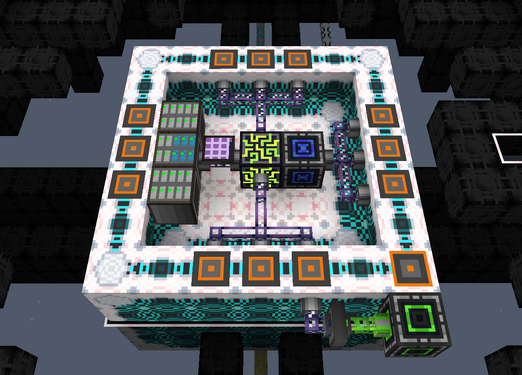
The intended method for filtering items between modules is the Nanopart Splitter, but that can be slightly difficult when items (e.g. silicone rubber sheets) must be routed to two different modules at a particular ratio, or the same item needs to be routed differently depending on the circuit requested. The alternative is prefiltering the items with stocking input buses and giving each one its own unique color and VCO hatch that leads directly to the modules that use them. Fluids also enter the prefiltering subnetwork and are supplied to the modules via wireless connectors.
The following example stores patterns on the main network (green) which is directly connected to the ME output bus. Both items and fluids enter the prefiltering subnetwork (blue) through an ME dual interface and are stored in the ME drives. It is recommended to use quantum or digital singularity storage cells because not very many types are needed for each calibration. The items are then pulled into the stocking input buses to be packaged into CCs and the fluids are pulled into the stocking input hatches on the modules themselves. Not shown are the different colored VCO hatches underneath the control room corresponding to each stocking input bus.
Patterning
NAC recipes are difficult to pattern because they are made from processed components (PCs) which are impossible to pattern themselves. One solution is using the recipe tables, calibration diagrams, and/or the draw.io board to pattern everything manually, but a faster and more accurate solution is using the autoPattern script described here. The autoPattern script is not exclusive to the NAC; there are recipes for many other machines and tiers as well.
pattern NAC_circuits
Simply connect a computer to ME dual interface(s), download everything from GitHub, and type the above command into the terminal to pattern all NAC circuit recipes in just a few seconds. The only player intervention required is providing the necessary dummy patterns, renaming anything afterwards (since the script cannot handle that), and then distributing the final patterns to wherever they are needed.
GREGOS
The NAC is home to the Gestalt Rapidly Evolving Genesis Optimization System (GREGOS), a pseudo-sentient program that is bound to be your Next Artificial Companion. Chat with GREGOS through the GUI of the controller to learn more about it, hear a joke, or have any other questions answered. The following are all the available commands in talk mode and what they do.
| Command and Description | |||
talk enters talk mode.
| |||
exit exits talk mode.
| |||
info opens a separate window with additional information about the machine.
| |||
contributors lists all the developers that have contributed to the NAC.
| |||
clear clears all text from the screen.
| |||
gregos provides a short description about GREGOS itself. The name and design of GREGOS is a reference to GLADOS from Portal.
| |||
joke prints one of the following jokes at random.
| |||
nac prints a random combination of the following words that fit the NAC abbreviation.
| |||
hi
| |||
gm or good morning
| |||
gn or good night
| |||
xyzzy
| |||
be the other guy
| |||
open the doors
| |||
open the pod bay doors
| |||
d
| |||
how fast are you
| |||
knock knock
| |||
shall we play a game
| |||
cake
| |||
6
| |||
why did the chicken cross the road
| |||
what do i do with lemons
| |||
laws or what are your laws or do you have laws
| |||
quote or speak or say something
| |||
Typing anything else prints one of the following responses at random, similar to a Magic 8 Ball.
|
Trivia
- The NAC is the only multiblock in GTNH that calculates overclocks before parallels.
- The probability of the
naccommand printing "Nanochip Assembly Complex" is 1 in 4,914. - The NAC is not to be confused with the Nanosteam Assembly Complex.