GT New Horizons · Zero Point Module (ZPM)
Hot Isostatic Pressurization Unit
The Hot Isostatic Pressurization Unit (HIP) is a ZPM tier multiblock for compressing materials with intense heat. The HIP is a direct upgrade from the Large Electric Compressor because it runs at 350% speed, only uses 75% of the EU/t normally required, and offers 4 parallels per voltage tier. The HIP gains heat during activity and dissipates heat during inactivity. If ran for too long, the machine becomes overheated and needs to fully cool down to resolve it. The HIP can still process recipes while overheated, but it runs at 40% speed, uses 110% of the EU/t normally required, and offers 1 parallel per voltage tier. Higher tier heating coils reduce the overall heat gain per second and therefore let it run for longer before overheating. Some recipes such as superdense plates specifically require the HIP and are voided if the machine is overheated when the recipe starts. The HIP is partially superseded by the Pseudostable Black Hole Containment Field, but due to its more complex black hole mechanics the HIP stays useful throughout the rest of the game.
Construction
The HIP adds to the original structure of the Large Electric Compressor with heating coils inside the main body and two side chambers connected by heating/coolant ducts. The heating coils determine the amount of heat gained per second while the machine is active. The glass can be any tier and has no effect on the operation of the machine. The input bus, input hatch, and output bus are all limited to the compression pipe casings on the sides of the structure. The remaining buses/hatches are limited to any electric compressor casings anywhere on the structure. Multi-amp and laser energy hatches are not supported, but there can be multiple regular energy hatches for overclocking. Use the Multiblock Structure Hologram Projector with subchannels "coil" and "glass" to specify the tier of each of those components.
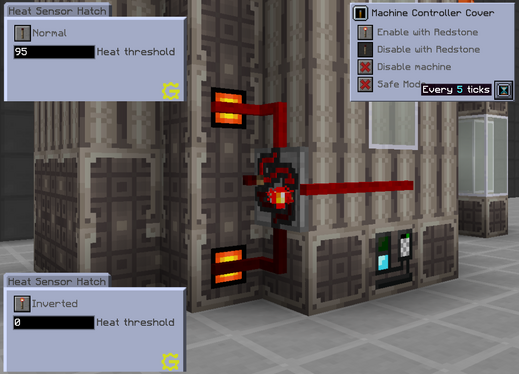
Unique to the HIP is the heat sensor hatch which outputs a redstone signal if the current heat of the machine exceeds the specified heat threshold. The redstone signal can be inverted if necessary and the threshold is represented as a percent. For example, 95 is equivalent to 95% heat.
Structure
- Controller: Front bottom center
- 95-124 Electric Compressor Casing
- 60-61 Compression Pipe Casing
- 30 Heating Coil (Tiered)
- 22 Any Tiered Glass
- 12 Coolant Duct
- 12 Heating Duct
- 0+ Heat Sensor Hatch: Any electric compressor casing
- 1+ Energy Hatch: Any electric compressor casing
- 1 Maintenance Hatch: Any electric compressor casing
- 1+ Input Bus: Any side pipe casing
- 0+ Input Hatch: Any side pipe casing
- 1+ Output Bus: Any side pipe casing
Wallsharing
HIPs may wallshare each of their sides and small chambers to save on casings, ducts, and buses/hatches. It is highly recommended to share the ducts in particular because they are the most expensive part of the structure.
Usage
The HIP is a direct upgrade to the Large Electric Compressor because it runs at 350% speed, only uses 75% of the EU/t normally required, and offers 4 parallels per voltage tier, as seen in the following table.
| Parallels | LV | MV | HV | EV | IV | LuV | ZPM | UV | UHV | UEV | UIV | UMV | UXV | MAX | MAX+ |
| Normal | 4 | 8 | 12 | 16 | 20 | 24 | 28 | 32 | 36 | 40 | 44 | 48 | 52 | 56 | 60 |
| Overheated | 1 | 2 | 3 | 4 | 5 | 6 | 7 | 8 | 9 | 10 | 11 | 12 | 13 | 14 | 15 |
The HIP gains heat during activity. The amount of heat gained per second depends on the tier () of the heating coils, as seen in the following equation. Higher tier coils are more efficient and let the machine run for longer before overheating. View the current heat of the machine through WAILA while looking at the controller.
| Tier | Heating Coil | Heat Gain | Time to 100% |
| 1 | Cupronickel | 5.00% / s | 20.0 s |
| 2 | Kanthal | 4.50% / s | 22.2 s |
| 3 | Nichrome | 4.05% / s | 24.7 s |
| 4 | TPV-Alloy | 3.65% / s | 27.4 s |
| 5 | HSS-G | 3.28% / s | 30.5 s |
| 6 | HSS-S | 2.95% / s | 33.9 s |
| 7 | Naquadah | 2.66% / s | 37.6 s |
| 8 | Naquadah Alloy | 2.39% / s | 41.8 s |
| 9 | Trinium | 2.15% / s | 46.5 s |
| 10 | Electrum Flux | 1.94% / s | 51.6 s |
| 11 | Awakened Draconium | 1.74% / s | 57.4 s |
| 12 | Infinity | 1.57% / s | 63.7 s |
| 13 | Hypogen | 1.41% / s | 70.8 s |
| 14 | Eternal | 1.27% / s | 78.7 s |
The HIP dissipates heat during inactivity. The amount of heat dissipated per second depends on the time since the machine stopped, as seen in the following equation where is the number of seconds of inactivity. For example, the heat is reduced by 2%, 4%, and 6% for the first three consecutive seconds of inactivity. The value of is reset back to 0 every time the machine resumes processing.
| Heat | Time to 0% |
| 25% | 5.0 s |
| 50% | 7.0 s |
| 75% | 9.0 s |
| 100% | 10.0 s |
The HIP becomes overheated when the heat reaches 100% which heavily nerfs the performance of the machine until it is cooled back down to 0%. While overheated, the HIP runs at 40% speed, uses 110% of the EU/t normally required, and offers 1 parallel per voltage tier. The increased EU/t requirement is particularly difficult because it can potentially raise the minimum voltage tier of a recipe and halt processing, although that can be beneficial because it lets the machine cool down and reset.
Basic compressor recipes can still be processed while the machine is overheated, but those that specifically require the HIP (ie. superdense plates) crash the machine and are voided if the machine is overheated at the very start of the recipe. Any recipes or parallels that started before the HIP overheated are perfectly safe to finish and are not penalized.
Automation
The challenge in using the HIP effectively is not letting it overheat, or at least disabling the machine until it cools back down to 0% when it does overheat. That involves using 1-2 heat sensor hatches to control the activity of the HIP based on its current heat level.
Method 1: GregTech
The core mechanic of this approach is using an RS latch to disable the HIP when it reaches a high heat value and re-enabling it when it cools back down to 0%. This works for both basic recipes and those that specifically require the HIP. This approach is simple, compact, cheap, and very quick to set up. There are no significant downsides.
| STEP 1 | |
| Build the HIP with two heat sensor hatches. Set one heat threshold to 95 with NORMAL redstone behavior and the other to 0 with INVERTED redstone behavior.
Connect the outputs of the heat sensor hatches to either side of an RS latch. Sneak right-click the RS latch twice with a screwdriver to change the configuration. Connect the output of the RS latch to a machine controller cover set to DISABLE WITH REDSTONE on top of the controller. Set the tick rate to 5 ticks to save on TPS. This does not necessarily stop the HIP from overheating but guarantees that it cools down to 0% whenever it does, without voiding the next recipe's worth of ingredients. If this is not working properly, try flipping the RS latch. The only potential mistake is that it is backwards. |
 |