GT New Horizons · GTNH Basics
Fluid & Item Pipes
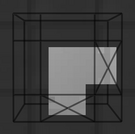
Fluid Pipes move fluids, gases, and plasma around. Item Pipes move items around. Both can connect up to six directions and support covers on each of their sides. Use a wrench to determine which sides to use and a plunger to remove any fluids/items as necessary. The stats of a pipe are listed in its tooltip, or the tables in the following section. Fluid and item pipes are generally superseded by EnderIO conduits and AE2 networks although they can remain useful for certain applications. If necessary, use the Matter Manipulator (Mk-I or greater) to place/connect many fluid or item pipes at once.
The image to the right depicts how to toggle the sides of a fluid or item pipe. The lines appear in-game when looking at the fluid or item pipe with a wrench in hand. The large center square toggles the face being looked at, the side rectangles toggle each of the four sides with respect to the face being looked at, and the corner squares toggle the back face from the one being looked at. Enabled sides extend in that direction and cross out their rectangle/square in the display.
Fluid Pipes
Fluid Pipes are the GregTech solution for moving fluids, gases, and plasma around. Fluid pipes are available in 40 different materials, 5 different sizes, and can even be joined together to form quadruple or nonuple versions. Every fluid pipe has a maximum throughput (L/s) and maximum heat limit (K). Fluids are stored inside the fluid pipe and must move between each one until it reaches its destination. Fluids with temperatures less than 260K or greater than 320K damage entities on contact.
 Caution: | Exceeding the maximum heat limit voids the fluid pipe and sets the surrounding blocks on fire. |
Distribution
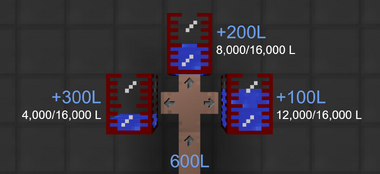
Fluid pipes attempt to distribute their entire contents to all adjacent pipes/tanks every second. The amount distributed to each one is weighted based on their available capacity in order to prioritize those with more space. For example, consider a fluid pipe that splits into three tanks with 12k, 8k, and 4k liters of space available. An incoming 600L of fluid would be distributed between them as 300L, 200L, and 100L, respectively. If they were all empty or had the same amount of space available, then the incoming fluid would have been split evenly between all three tanks. Fluids naturally follow the path of least resistance and tend towards equilibrium.
Directionality
The biggest issue with fluid distribution is that it causes sloshing or backflow because there is nothing really stopping the fluid from traveling backwards to the same pipe that it just came from. The solution is forcing the flow direction by sneak right-clicking the fluid pipe with a wrench. The direction is indicated by small arrows on the fluid pipe itself and generates a message in chat whenever it changes. This is highly recommended for all fluid pipes in all scenarios.
Wrenches have three operating modes, listed below. Switch modes by pressing the GregTech Tool Mode Switch keybind (default ".") with the wrench in hand. Default mode is for smaller pipe networks, line mode is for larger pipe networks, and precise mode is for breaking individual pipes/machines with a wrench that has an incredibly high mining speed.
- Default - Set directions of pipes individually.
- Line - Set directions of all pipes in a line simultaneously. The "line" is based on the toggled direction, not the direction that the player is facing.
- Precise - Cannot set directions. Always pauses after breaking a block regardless of the mining speed.
Contact Damage
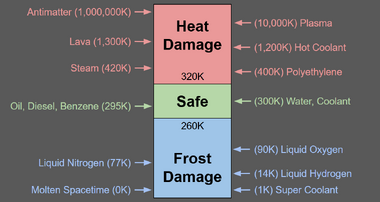
Fluid pipes damage entities (mobs/players) upon physical contact if the temperature of the fluid inside is less than 260K or greater than 320K. For example, oil has no effect on nearby entities because it is within the safe temperature range, but steam burns nearby entities because it is above the safe temperature range. The damage scales linearly with temperature, as seen in the following equations. Covers stop all damage on any sides that have them.
Materials and Sizes
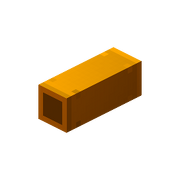
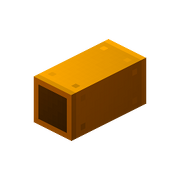
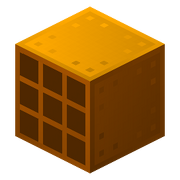
Fluid pipes are available in 40 different materials, 5 different sizes, and can even be joined together to form quadruple or nonuple versions. Larger sizes cost more to craft but have significantly higher throughput. Quadruple fluid pipes hold up to four unique fluids at once but each one has the same throughput as a normal fluid pipe. Nonuple fluid pipes hold up to nine unique fluids at once but each one has the same throughput as a small fluid pipe. Fluids may never overtake any of the other slots in a quadruple or nonuple fluid pipe to increase its throughput.
-
 Tiny
-
 Small
-
 Normal
-
 Large
-
 Huge
-
 Quadruple
-
 Nonuple
The following is the complete list of fluid pipe materials organized by the tier that they are unlocked and their throughput. The internal capacity (L) of a fluid pipe is always equivalent to its throughput. The materials highlighted BLUE are the most common and highly recommended. Notice that not all materials are available in every size, or have quadruple/nonuple versions. Wood and clay fluid pipes also cannot handle gases such as steam or oxygen. Staballoy fluid pipes are difficult to manufacture without a staballoy golem farm--see Toxic Everglades or Witchery Potion Brewing for details.
| Tier | Material | Heat Limit (K) | Throughput (L/s) | |||||||
| Tiny | Small | Normal | Large | Huge | Quad (per) | Non (per) | ||||
| S | Copper | 1,000 | 60 | 120 | 400 | 800 | 1,600 | 400 | 120 | |
| S | Wood | 350 | ---- | 200 | 600 | 1,200 | ---- | ---- | ---- | |
| S | Clay | 500 | 200 | 400 | 1,200 | 2,400 | 4,800 | ---- | ---- | |
| S | Bronze | 2,000 | 400 | 800 | 2,400 | 4,800 | 9,600 | 2,400 | 800 | |
| S | Wrought Iron | 2,250 | 600 | 1,200 | 3,600 | 7,200 | 14,400 | 3,600 | 1,200 | |
| S | Steel | 2,500 | 800 | 1,600 | 4,800 | 9,600 | 19,200 | 4,800 | 1,600 | |
| LV | Lead | 1,200 | 680 | 1,360 | 4,080 | 8,160 | 16,320 | ---- | ---- | |
| LV | Potin | 2,000 | 1,000 | 2,000 | 6,000 | 12,000 | 24,000 | ---- | ---- | |
| LV | Plastic (Polyethylene) | 350 | 1,200 | 2,400 | 7,200 | 14,400 | 28,800 | 7,200 | 2,400 | |
| LV | Dark Steel | 2,750 | 4,640 | 9,280 | 27,840 | 55,680 | 111,360 | ---- | ---- | |
| MV | Stainless Steel | 3,000 | 1,200 | 2,400 | 7,200 | 14,400 | 28,800 | 7,200 | 2,400 | |
| HV | PTFE | 600 | 1,600 | 3,200 | 9,600 | 19,200 | 38,400 | 9,600 | 3,200 | |
| HV | Void Metal | 25,000 | 3,200 | 6,400 | 19,200 | 38,400 | 76,800 | ---- | ---- | |
| EV | Titanium | 5,000 | 1,600 | 3,200 | 9,600 | 19,200 | 38,400 | 9,600 | 3,200 | |
| EV | Tungstensteel | 7,500 | 2,000 | 4,000 | 12,000 | 24,000 | 48,000 | 12,000 | 4,000 | |
| EV | Niobium-Titanium | 2,900 | 3,000 | 6,000 | 18,000 | 36,000 | 72,000 | 18,000 | 6,000 | |
| EV | Enderium | 15,000 | 6,000 | 12,000 | 36,000 | 72,000 | 144,000 | 36,000 | 12,000 | |
| EV | Tungsten | 7,200 | 8,640 | 17,280 | 51,840 | 103,680 | 207,360 | ---- | ---- | |
| EV | Tantalloy-60 | 4,250 | 20,000 | 40,000 | 120,000 | 240,000 | 480,000 | ---- | ---- | |
| EV | Tantalloy-61 | 5,800 | 24,000 | 48,000 | 144,000 | 288,000 | 576,000 | ---- | ---- | |
| EV | High Pressure | 1,500 | ---- | 96,000 | 144,000 | 192,000 | ---- | ---- | ---- | |
| EV | Staballoy | 7,500 | 25,000 | 50,000 | 150,000 | 300,000 | 600,000 | ---- | ---- | |
| EV | Inconel-690 | 4,800 | 30,000 | 60,000 | 180,000 | 360,000 | 720,000 | ---- | ---- | |
| EV | Inconel-792 | 5,500 | 32,000 | 64,000 | 192,000 | 384,000 | 768,000 | ---- | ---- | |
| EV | Incoloy-903 | 8,000 | 50,000 | 100,000 | 300,000 | 600,000 | 1,200,000 | ---- | ---- | |
| IV | PBI | 1,000 | 2,000 | 4,000 | 12,000 | 24,000 | 48,000 | 12000 | 4000 | |
| IV | Maraging Steel 300 | 2,500 | 28,000 | 56,000 | 168,000 | 336,000 | 672,000 | ---- | ---- | |
| IV | Maraging Steel 350 | 2,500 | 32,000 | 64,000 | 192,000 | 384,000 | 768,000 | ---- | ---- | |
| IV | Hastelloy-X | 4,200 | 40,000 | 80,000 | 240,000 | 480,000 | 960,000 | ---- | ---- | |
| LuV | Trinium Naquadah Carbonite | 250,000 | 40 | 80 | 240 | 480 | 960 | ---- | ---- | |
| LuV | Europium | 7,500 | 24,000 | 48,000 | 144,000 | 288,000 | 576,000 | ---- | ---- | |
| LuV | Naquadah | 19,000 | 30,000 | 60,000 | 180,000 | 360,000 | 720,000 | 180,000 | 60,000 | |
| LuV | Mysterious Crystal | 1,000,000 | 80,000 | 160,000 | 480,000 | 960,000 | 1,920,000 | 480,000 | 160,000 | |
| ZPM | Neutronium | 100,000 | 56,000 | 112,000 | 336,000 | 672,000 | 1,344,000 | 336,000 | 112,000 | |
| UV | Nether Star | 1,000,000 | 64,000 | 128,000 | 384,000 | 768,000 | 1,536,000 | 384,000 | 128,000 | |
| UHV | Radox Polymer | 1,500 | 16,660 | 33,320 | 100,000 | 200,000 | 400,000 | ---- | ---- | |
| UHV | Awakened Draconium | 10,000,000 | 150,000 | 600,000 | 600,000 | 1,800,000 | 3,600,000 | 900,000 | 300,000 | |
| UHV | Infinity | 10,000,000 | 200,000 | 400,000 | 1,200,000 | 2,400,000 | 4,800,000 | 1,200,000 | 400,000 | |
| UIV | Transcendent Metal | 2,147,482,647 | 733,320 | 1,466,660 | 4,400,000 | 8,800,000 | 17,600,000 | 4,400,000 | 1,466,660 | |
| UIV | Spacetime | 2,147,482,647 | 833,320 | 1,666,660 | 5,000,000 | 10,000,000 | 20,000,000 | 5,000,000 | 1,666,660 | |
Item Pipes
Item Pipes are the GregTech solution for moving items around. Item pipes are available in 13 different materials, 5 different sizes, and can even be made restrictive. Every item pipe has a maximum throughput (Stacks/s) and routing value. Items are only ever stored inside the first item pipe next to the source and moves directly to its destination as if it were a point-to-point connection. Item routing is omnidirectional and based on a priority system that fills lower routing values first, which are usually inventories closer to the source.
 Important: | Pulling items from a chest/barrel requires a conveyor module on IMPORT because it goes on the pipe, not the chest/barrel. |
Distribution
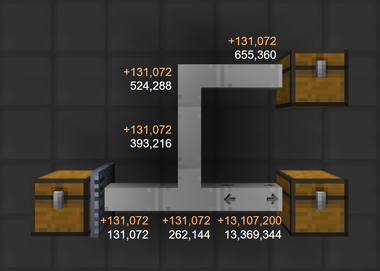
Item pipes attempt to distribute their entire contents to the inventory with the lowest routing value every second. The contents travel immediately to the destination as if it were a point-to-point connection and are never split unless there is not enough room at the destination. The routing value of an inventory is effectively its priority and is calculated by adding the individual routing values of all item pipes in the path to reach it. For example, a chest that is two small tin item pipes away has a routing value of 65,536 + 65,536 = 131,072 while a chest that is three small electrum item pipes away has a routing value of 32,768 + 32,768 + 32,768 = 98,304. The latter may be physically farther away but it would be prioritized first based on its routing value.
Routing values may also be manipulated with restrictive item pipes which have the same throughput but 100x their normal routing value. Place one in a less desirable path to effectively block it until all other paths have been saturated. Restrictive item pipes are identified by the small arrows on the item pipe itself. Do not confuse them with the directionality of fluid pipes.
Materials and Sizes
Item pipes are available in 13 different materials, 5 different sizes, and can even be made restrictive. Larger sizes cost more to craft but have significantly higher throughput. Restrictive item pipes are available in all the same sizes and increase their routing value by 100x. All materials and sizes may hold different items at the same time, unlike fluid pipes.
-
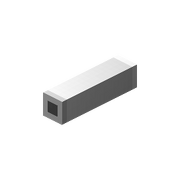 Tiny
-
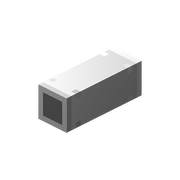 Small
-
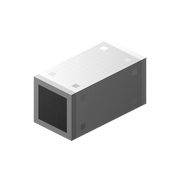 Normal
-
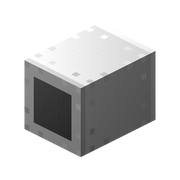 Large
-
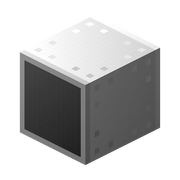 Huge
-
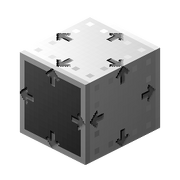 Restrictive (Huge)
The following is the complete list of item pipe materials organized by the tier that they are unlocked, their throughput, and their routing value. The internal capacity (stacks) of an item pipe is always equivalent to its throughput. The materials highlighted BLUE are the most common and highly recommended. Notice that not all materials are available in every size. Those with a fractional throughput push items every 2, 4, or 8 seconds instead of per second. Bedrockium item pipes are difficult to manufacture without Thaumcraft nugget duplication.
| Tier | Material | Throughput (Stacks/s) | Routing Value | ||||||||||
| Tiny | Small | Normal | Large | Huge | Tiny | Small | Normal | Large | Huge | ||||
| S | Tin | 1/8 | 1/4 | 1/2 | 1 | 2 | 262,144 | 131,072 | 65,536 | 32,768 | 16,384 | ||
| LV | Brass | 1/4 | 1/2 | 1 | 2 | 4 | 131,072 | 65,536 | 32,768 | 16,384 | 8,192 | ||
| LV | Electrum | 1/2 | 1 | 2 | 4 | 8 | 65,536 | 32,768 | 16,384 | 8,192 | 4,096 | ||
| LV | Nickel | ---- | ---- | 1 | 2 | 4 | ---- | ---- | 32,768 | 16,384 | 8,192 | ||
| LV | Cobalt | ---- | ---- | 2 | 4 | 8 | ---- | ---- | 16,384 | 8,192 | 4,096 | ||
| LV | Aluminium | ---- | ---- | 2 | 4 | 8 | ---- | ---- | 16,384 | 8,192 | 4,096 | ||
| MV | PVC | ---- | ---- | 4 | 8 | 16 | ---- | ---- | 8,192 | 4,096 | 2,048 | ||
| EV | Platinum | 1 | 2 | 4 | 8 | 16 | 32,768 | 16,384 | 8,192 | 4,096 | 2,048 | ||
| EV | Bedrockium | 16 | 32 | 64 | 128 | 256 | 2,048 | 1,024 | 512 | 256 | 128 | ||
| IV | Osmium | 2 | 4 | 8 | 16 | 32 | 16,384 | 8,192 | 4,096 | 2,048 | 1,024 | ||
| IV | Quantium | 32 | 64 | 128 | 256 | 512 | 1,024 | 512 | 256 | 128 | 64 | ||
| LuV | Fluxed Electrum | 4 | 8 | 16 | 32 | 64 | 8,192 | 4,096 | 2,048 | 1,024 | 512 | ||
| ZPM | Black Plutonium | 8 | 16 | 32 | 64 | 128 | 4,096 | 2,048 | 1,024 | 512 | 256 | ||