GT New Horizons · Zero Point Module (ZPM)
Void Miner
The Void Miner (VM) is a ZPM tier multiblock that can mine an unlimited amount of ore from any planet or dimension. The VM is a direct upgrade of the Ore Drilling Plant because it does not require any mining pipes, has much higher throughput, and never has to move. One type of ore is selected at random every 10 ticks from the ore veins and small ores of the current planet/dimension and the total output amount scales with both the tier of the structure and the noble gas provided. When building the weighted distribution for choosing an ore, primary and secondary ores add 100% of their vein's weight to their own, between and sporadic ores add 12.5% of their vein's weight to their own, and small ores add their amount per chunk to their weight. Use an AE2 Quantum Ring to transport ores across dimensions.
VMs produce a lot of ore so it is very important to have a robust ore processing setup to process it all. Early on that means building several Industrial Maceration Stacks, Industrial Centrifuges, Ore Washing Plants, etc. but later on that means building several Integrated Ore Factories. VMs are generally superseded by the Space Elevator in UHV, but they are still worthwhile to use in the Deep Dark throughout the rest of the game.
Construction
The VM is available in three tiers and each one has a completely different controller and structure, but there are a few similarities between them. Buses/hatches may replace any leg casing and there must be at least one input hatch regardless of whether noble gases are used or not. An input bus is optional for blacklisting or whitelisting specific ores. Multi-amp and laser energy hatches are not supported, but there can be multiple regular energy hatches as long as they are all above the minimum energy hatch tier. Use the Multiblock Structure Hologram Projector to visualize/build the structure.
 Caution: | Don't forget to protect the machine from rain and/or meteors! |
Tier 1
|
Tier 2
|
Tier 3
|
Wallsharing
VMs may wallshare each of their sides to save on casings and buses/hatches. That includes the input hatch for sharing noble gases and the output bus for any ores produced.
Usage
VMs do not have any mandatory inputs and do not require any mining pipes. Once enabled and provided with enough power, they immediately start producing ores from nothing. The style (stone, moon rock, etc.) varies based on the current planet/dimension but the type is always regular, full-sized ore even if it only exists as a small ore in that location.
All three VM tiers run on a fixed 0.5 second cycle and cannot be overclocked so their total power cost and output rates are constant regardless of the tier of the energy hatch, as seen in the following table. Each cycle also produces only one type of ore at a time which means rare ores do not appear very often, especially if batch mode is enabled which increases the cycle duration to 8 seconds to prevent lag. Optionally, supply 2 L/s of a noble gas through an input hatch to significantly boost the amount of ores produced each cycle.
| Void Miner | Power Cost | Ore/s vs. Noble Gas | ||||
| None | Neon | Krypton | Xenon | Oganesson | ||
| T1 | 32,768 EU/t | 2 | 8 | 16 | 32 | 128 |
| T2 | 131,072 EU/t | 4 | 16 | 32 | 64 | 256 |
| T3 | 524,288 EU/t | 6 | 24 | 48 | 96 | 384 |
VMs have a built-in filter in the GUI of their controller to whitelist or blacklist specific ores. Set the filter manually or insert ores through an input bus. The mode can also be switched by right-clicking the controller with a screwdriver. If no ores are selected, then nothing is voided in either mode. Use a data stick to copy-paste filter settings between VMs.
Ore Selection
The single type of ore produced each cycle is selected at random from a weighted distribution of the ore veins and small ores of the current planet/dimension. In other words, the VM cannot produce an ore that does not generate naturally in that location and each ore has a fixed weight associated with it that is directly proportional to the probability of it being chosen. The weights are calculated based on the following:
- Primary and secondary ores add 100% of their vein's weight to their own
- Between and sporadic ores add 12.5% of their vein's weight to their own
- Small ores add their amount per chunk to their weight
If an ore appears multiple times, then its total weight is the sum of those occurrences. For example, magnetite ore is both the primary and secondary ore of a magnetite vein so its weight is 160+160=320, assuming there are no other occurrences in that planet/dimension. The probability of magnetite ore being chosen is then 320 over the total combined weight of the remaining possible ores. Note that this causes many ores to appear more often than they physically do in the world, especially for veins like Dolomite which are typically voided because they generate too high up.
Unique Cases
Listed below are a few unique cases that differ from the rules or mechanics described earlier, or just require some additional clarification. Deep dark iron ore is needed for the eternity QFT catalyst, tritanium ore is a great alternative to fusion, forcicium/forcillium ore are both needed to run high tier Nano Forge recipes, and rubidium/pumice ore both are needed to craft the T10 Deep Dark planet block for the Eye of Harmony.
- Tellurium ore does not spawn naturally in the Overworld, but it is added to its VM pool with a weight of 8. This is the only way to get Tellurium ore prior to the Space Elevator and the Deep Dark, but Tellurium nuggets can still be made in an Electric Blast Furnace by smelting crushed lead ore.
- VMs are strictly dimension based which means the Far End Asteroids use the ore veins from The End instead of their own.
- The Deep Dark does not have any ore veins or small ores so VMs instead randomly select from every single ore in GTNH with equal weight. That includes ores that are otherwise unobtainable such as deep dark iron, tritanium, forcicium, forcillium, rubidium, and pumice.
Logistics
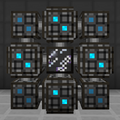
VMs are almost always on a different planet/dimension and therefore require some form of inter-dimensional logistics to connect their output to a local ore processing setup. Ender chests and dimensional transceivers could work, but the sheer amount of ore that VMs produce would quickly overwhelm their maximum throughput. The best and really the only scalable option is using an AE2 Quantum Ring which can simultaneously carry power to the machines, supply noble gases, and extract ore.
Quantum Rings are not perfect, however, and come with their own unique penalties and challenges. The first is that EU P2P Tunnels have 5% power loss for all power transferred through them, and they may briefly shut down whenever the game is restarted. The solution is chunkloading everything with ServerUtilities, but if that is still not enough then place a machine controller cover set to DISABLE WITH REDSTONE onto every VM to automatically restart them whenever they powerfail. Later on in UHV, a drone downlink module with a T4 drone could work as well.
Initially both Quantum Rings need to be powered in order to connect. A temporary or manual solution is fully charging a dense energy cell, sneak right-clicking it with a wrench to pick it up without losing all of its power, and temporarily placing it next to the ring with the VMs. A much better and permanent solution is using a magic energy absorber with a dragon/creeper egg on top to power the ring with the VMs, or any kind of singleblock generator with an emergency ender tank on top to remotely drop fuel into it. Either way it just needs an energy acceptor and prevents having to manually re-link the Quantum Rings if the AE2 network ever powerfails.
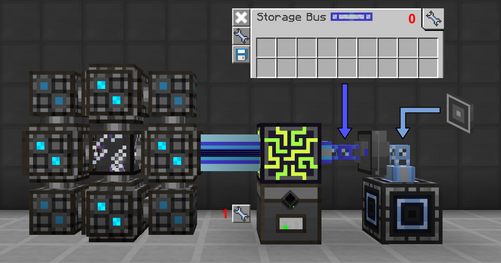
VMs have their own built-in filters, but it would be much easier to adjust them remotely. The solution is adding a filtered and high-priority void cell onto the VM subnetwork before outputting everything to a separate ore processing subnetwork, as seen in the image above. That way unwanted ores may be immediately discarded from a single location regardless of how many machines there are or where they are located. Space Elevator mining modules may also use the same subnetwork to filter their outputs as well.
Drop Rates
The following lists every ore for every planet by their Void Miner frequency. The style (stone, moon rock, etc.) varies between dimensions but the type is always regular, full-sized ore even if it only exists as a small ore in that planet or dimension. Ores highlighted BLUE signify high importance or value, such as a new material unlocked. Eventually all ores should come from either the Space Elevator or VMs in the Deep Dark and processed in the Integrated Ore Factory.
 Important: | See here for a list of dimension IDs. See here for a breakdown of each ore vein. See here for a breakdown of each Planet. |
Tier 0
| Overworld | Nether | Twilight Forest | The End | Far End Asteroids | Toxic Everglades |
|
|
|
|
|
|
Tier 1
| Moon |
|
Tier 2
| Mars | Phobos, Moon of Mars | Deimos, Moon of Mars |
|
|
|
Tier 3
| Ceres | Ross128b | Asteroids | Callisto, Moon of Jupiter | Europa, Moon of Jupiter | Ganymede, Moon of Jupiter |
|
|
|
|
|
|
Tier 4
| Io, Moon of Jupiter | Mercury | Venus |
|
|
|
Tier 5
| Enceladus, Moon of Saturn | Titan, Moon of Saturn | Miranda, Moon of Uranus | Oberon, Moon of Uranus | Ross128ba, Moon of Ross128b |
|
|
|
|
|
Tier 6
| Proteus, Moon of Neptune | Triton, Moon of Neptune |
|
|
Tier 7
| Pluto | Haumea | Kuiper Belt | Makemake |
|
|
|
|
Tier 8
| T Ceti E | Barnard C | Barnard E | Barnard F | α Centauri Bb | Vega B |
|
|
|
|
|
|
Tier 9
| Seth, Moon of Sekhmet | Maahes, Moon of Sekhmet | Horus | Anubis | Neper | Mehen Belt |
|
|
|
|
|
|
Tier 10
| Deep Dark | |||
|
|
|
|
Trivia
- Although the Deep Dark is advertised as having all ores in the game, it does not have any of the ice ores native to T3 Asteroids or T7 Kuiper Belt.