GT New Horizons · Ludicrous Voltage (LuV)
Compact Fusion Reactor
The Compact Fusion Reactor is an LuV tier multiblock for mass producing plasmas and molten rare metals from nuclear fusion. Unlike the regular Fusion Reactor, the Compact Fusion Reactor has a built-in 64 parallels plus an additional 64 for every machine tier above the minimum recipe tier. Multi-amp and laser energy hatches are also supported to compensate for energy hatches being able to pull more than 2A of power. Overclocks only occur when the tier of the machine exceeds the minimum recipe tier. The first three tiers run 2/2 perfect overclocks while the last two tiers run 4/4 perfect overclocks. The Compact Fusion Reactor is not technically required for progression, but it is extremely useful for producing catalyst for the Dimensionally Transcendent Plasma Forge and generating power in the XL Turbo Plasma Turbine or the Extreme Heat Exchanger (EHE) with a series of XL Turbo Steam Turbines behind it.
Although craftable in LuV, it is not recommended to build a Compact Fusion Reactor until later on when the demand for plasma is much higher. The compact fusion coils are extremely expensive and there is no tier skipping; the Compact Fusion Reactor is limited to the same recipes as the regular Fusion Reactor. Do not waste countless hours building a Mk-I just to realize that it cannot produce molten americium.
Spreadsheet: GTNH Power Planner 2.9
Construction
The Compact Fusion Reactor is effectively a larger Fusion Reactor with similar restrictions on the location of the buses/hatches. Input hatches are limited to specific glass blocks on each side, output hatches are limited to the same glass blocks on each side, and energy hatches are limited to specific casings on each curve. The glass is NOT tiered--there is a very specific type of glass needed for each structure tier, but it can be either normal or transparent. Multi-amp and laser energy hatches are supported for serious throughput. Every tier has a minimum voltage for the energy hatches. There is no maintenance hatch. Use the Multiblock Structure Hologram Projector to visualize/build the structure.
Structure
- Controller: Middle center, 4th layer
- 1662-1695 Fusion Machine Casing[1]
- 560 Compact Fusion Coil[1]
- 128 Frame Box[1]
- 63-93 Borosilicate Glass[1]
- 1-32 Energy Hatch: Specific casings on each curve
- 1+ Input Hatch: Specific glass on each side
- 1+ Output Hatch: Specific glass on each side
Wallsharing
Compact Fusion Reactors may wallshare each of their sides to save on casings, glass, frame boxes, and buses/hatches. However, that does not include any of the compact fusion coils. It is highly recommended to share stocking input hatches or crafting input buffers between every two machines.
Usage
The Compact Fusion Reactor functions the same as a regular Fusion Reactor. There can be up to 32 energy hatches per machine to increase its total energy capacity and split the total power consumed. Every recipe has a minimum energy capacity or start cost that must be met before the machine can begin processing. Consecutive recipes do not pay the start cost which means a lot of power can be saved by continuously running the Compact Fusion Reactor or at least increasing the size of crafting requests.
The voltage of the energy hatches is irrelevant as long as it is above the minimum tier and supplies enough EU/t. However, there are potential scenarios where the energy hatches can draw more than 2A of power depending on the recipe, tier of the machine, and number of parallels/overclocks. The solution is switching to 4A or even 16A energy hatches in those scenarios. Laser energy hatches can also technically work but they are extreme overkill and not worth it at all, especially because the power is split evenly amongst the energy hatches; there cannot be one really high amp energy hatch to compensate for many low amp energy hatches.
Overclocks only occur when the tier of the Compact Fusion Reactor exceeds the minimum recipe tier. They have nothing to do with the tier of the energy hatches or the available power. The first three machine tiers run 2/2 perfect overclocks while the last two tiers run 4/4 perfect overclocks.
| Tier | Overclocks | Energy Hatches (4A* / 16A**) | |||
| Min Tier | Max Power | Energy Capacity | Universal Setup | ||
| Mk-I | ---- | LuV | 65,536 EU/t (2A LuV) per | 5M EU per | 30 LuV |
| Mk-II | 2/2 | ZPM | 524,288 EU/t (4A ZPM) per | 10M EU per | 32 ZPM |
| Mk-III | 2/2 | UV | 3,145,728 EU/t (6A UV) per | 20M EU per | 30 UV |
| Mk-IV | 4/4 | UHV | 16,777,216 EU/t (8A UHV) per | 160M EU per | 30 UHV** |
| Mk-V | 4/4 | UEV | 83,886,080 EU/t (10A UEV) per | 640M EU per | 30 UEV** |
The Compact Fusion Reactor offers a significant number of parallels. There is a built-in 64 parallels plus an additional 64 for every machine tier above the minimum recipe tier. Furthermore, recipes that are overclocked beyond 0.05s (1 tick) multiply the total number of parallels as compensation for the capped speed. A Mk-I recipe in a Mk-V Compact Fusion Reactor can have up to 5120 parallels, for example.
The only LED button in the GUI of the controller sets the batch size of the Compact Fusion Reactor. It is highly recommended to increase the batch size to save TPS and reduce lag. Use the Parametrizer memory card to copy-paste settings between Compact Fusion Reactors of the same tier. Note that batch size does NOT improve the throughput of the machine like parallels do. Recall the difference:
- Batch Size - More recipes per iteration, same EU/t, longer duration.
- Parallels - More recipes per iteration, higher EU/t, same duration.
Recipes
The following table lists all the available recipes by their start cost (EU), total output (L/s), maximum power consumption (EU/t), and the minimum number of energy hatches that support ALL overclocks and ALL parallels. Multi-amp energy hatches are identified by the number of asterisks (*) and only used if absolutely necessary. Higher voltage energy hatches can be used instead of multi-amp energy hatches as long as the energy capacity still exceeds the start cost. The "universal" setups for all recipes, overclocks, and parallels are listed in the table above.
| Fusion Recipe | Start (EU) | Max Output (L/s) | Max Power Consumption (EU/t) | Min Energy Hatches (4A* / 16A**) | |||||||||||||||
| Mk-I | Mk-II | Mk-III | Mk-IV | Mk-V | Mk-I | Mk-II | Mk-III | Mk-IV | Mk-V | Mk-I | Mk-II | Mk-III | Mk-IV | Mk-V | |||||
| Helium Plasma [v1] | 40M | 10.0k | 40.0k | 120k | 2.56M | 12.8M | 123k | 492k | 1.47M | 31.5M | 157M | 8 LuV | 4 ZPM | 3 UV | 16 UHV | 20 UEV | |||
| Molten Sunnarium | 40M | 640 | 2.56k | 7.68k | 164k | 819k | 492k | 1.97M | 5.90M | 126M | 629M | 8 LuV | 8 ZPM | 6 UV | 30 UHV | 19 UEV* | |||
| Boron Plasma | 50M | 768 | 3.07k | 9.22k | 246k | 1.84M | 655k | 2.62M | 7.86M | 168M | 839M | 10 LuV | 10 ZPM | 8 UV | 20 UHV* | 25 UEV* | |||
| Helium Plasma [v2] | 60M | 10.0k | 40.0k | 120k | 2.56M | 12.8M | 262k | 1.05M | 3.15M | 67.1M | 336M | 12 LuV | 6 ZPM | 3 UV | 8 UHV | 10 UEV | |||
| Neon Plasma | 100M | 20.0k | 80.0k | 240k | 5.12M | 25.6M | 1.97M | 7.86M | 23.6M | 503M | 2.52B | 30 LuV | 30 ZPM | 23 UV | 30 UHV** | 30 UEV** | |||
| Force Plasma | 100M | 40.0k | 160k | 480k | 10.2M | 51.2M | 1.97M | 7.86M | 23.6M | 503M | 2.52B | 30 LuV | 30 ZPM | 23 UV | 30 UHV** | 30 UEV** | |||
| Calcium Plasma | 120M | 160 | 640 | 1.92k | 41.0k | 205k | 492k | 1.97M | 5.90M | 126M | 629M | 24 LuV | 12 ZPM | 6 UV | 30 UHV | 19 UEV* | |||
| Molten Iron | 120M | 320 | 1.28k | 3.84k | 81.9k | 410k | 492k | 1.97M | 5.90M | 126M | 629M | 24 LuV | 12 ZPM | 6 UV | 30 UHV | 19 UEV* | |||
| Molten Duranium | 140M | 320 | 1.28k | 3.84k | 81.9k | 410k | 1.05M | 4.19M | 12.6M | 268M | 1.34B | 28 LuV | 14 ZPM | 12 UV | 32 UHV* | 16 UEV** | |||
| Molten Chrome | 140M | 320 | 1.28k | 3.84k | 81.9k | 410k | 1.57M | 6.29M | 18.9M | 403M | 2.01B | 28 LuV | 14 ZPM | 18 UV | 24 UHV** | 24 UEV** | |||
| Molten Osmium | 150M | 80.0 | 320 | 960 | 20.5k | 102k | 1.57M | 6.29M | 18.9M | 403M | 2.01B | 30 LuV | 15 ZPM | 18 UV | 24 UHV** | 24 UEV** | |||
| Molten Europium | 150M | 640 | 2.56k | 7.68k | 164k | 819k | 1.57M | 6.29M | 18.9M | 403M | 2.01B | 30 LuV | 15 ZPM | 18 UV | 24 UHV** | 24 UEV** | |||
| Molten Platinum | 150M | 640 | 2.56k | 7.68k | 164k | 819k | 1.97M | 7.86M | 23.6M | 503M | 2.52B | 30 LuV | 15 ZPM | 23 UV | 30 UHV** | 30 UEV** | |||
| Titanium Plasma | 180M | ---- | 1.15k | 4.61k | 55.3k | 369k | ---- | 3.15M | 12.6M | 151M | 805M | ---- | 18 ZPM | 12 UV | 18 UHV* | 24 UEV* | |||
| Oxygen Plasma | 180M | ---- | 768 | 3.07k | 36.9k | 246k | ---- | 3.15M | 12.6M | 151M | 805M | ---- | 18 ZPM | 12 UV | 18 UHV* | 24 UEV* | |||
| Zinc Plasma | 180M | ---- | 5.76k | 23.0k | 276k | 1.47M | ---- | 3.15M | 12.6M | 151M | 805M | ---- | 18 ZPM | 12 UV | 18 UHV* | 24 UEV* | |||
| Nitrogen Plasma | 180M | ---- | 10.0k | 40.0k | 480k | 2.56M | ---- | 1.05M | 4.19M | 50.3M | 268M | ---- | 18 ZPM | 9 UV | 12 UHV | 16 UEV | |||
| Molten Tungsten | 200M | ---- | 1.28k | 5.12k | 61.4k | 328k | ---- | 1.57M | 6.29M | 75.5M | 403M | ---- | 20 ZPM | 10 UV | 18 UHV | 24 UEV | |||
| Molten Tritanium | 200M | ---- | 320 | 1.28k | 15.4k | 81.9k | ---- | 1.97M | 7.86M | 94.4M | 503M | ---- | 20 ZPM | 10 UV | 23 UHV | 30 UEV | |||
| Niobium Plasma | 200M | ---- | 11.5k | 46.1k | 553k | 2.95M | ---- | 3.15M | 12.6M | 151M | 805M | ---- | 20 ZPM | 12 UV | 18 UHV* | 24 UEV* | |||
| Molten Americium | 200M | ---- | 213 | 853 | 10.2k | 81.9k | ---- | 3.15M | 12.6M | 151M | 805M | ---- | 20 ZPM | 12 UV | 18 UHV* | 24 UEV* | |||
| Uranium Fuel (Excited) | 200M | ---- | 320 | 1.28k | 19.2k | 102k | ---- | 492k | 1.97M | 23.6M | 126M | ---- | 20 ZPM | 10 UV | 6 UHV | 8 UEV | |||
| Plutonium Fuel (Excited) | 220M | ---- | 1.28k | 5.12k | 76.8k | 410k | ---- | 983k | 3.93M | 47.2M | 252M | ---- | 22 ZPM | 11 UV | 12 UHV | 15 UEV | |||
| Molten Uranium 238 | 240M | ---- | 320 | 1.28k | 15.4k | 81.9k | ---- | 3.15M | 12.6M | 151M | 805M | ---- | 24 ZPM | 12 UV | 18 UHV* | 24 UEV* | |||
| Sulfur Plasma | 240M | ---- | 5.76k | 23.0k | 276k | 1.47M | ---- | 655k | 2.62M | 31.5M | 168M | ---- | 24 ZPM | 12 UV | 8 UHV | 10 UEV | |||
| Tin Plasma | 280M | ---- | 23.0k | 92.2k | 1.11M | 5.90M | ---- | 3.15M | 12.6M | 151M | 805M | ---- | 28 ZPM | 14 UV | 18 UHV* | 24 UEV* | |||
| Molten Iridium | 300M | ---- | 320 | 1.28k | 15.4k | 81.9k | ---- | 1.97M | 7.86M | 94.4M | 503M | ---- | 30 ZPM | 15 UV | 23 UHV | 30 UEV | |||
| Molten Naquadah | 300M | ---- | 320 | 1.28k | 15.4k | 81.9k | ---- | 1.97M | 7.86M | 94.4M | 503M | ---- | 30 ZPM | 15 UV | 23 UHV | 30 UEV | |||
| Krypton Plasma | 300M | ---- | 5.76k | 23.0k | 276k | 1.47M | ---- | 7.86M | 31.5M | 377M | 2.01B | ---- | 30 ZPM | 30 UV | 24 UHV** | 24 UEV** | |||
| Astral Titanium Plasma | 300M | ---- | 40.0k | 160k | 1.92M | 10.2M | ---- | 7.86M | 31.5M | 377M | 2.01B | ---- | 30 ZPM | 30 UV | 24 UHV** | 24 UEV** | |||
| Runite Plasma | 300M | ---- | 40.0k | 160k | 1.92M | 10.2M | ---- | 7.86M | 31.5M | 377M | 2.01B | ---- | 30 ZPM | 30 UV | 24 UHV** | 24 UEV** | |||
| Naq Fuel Mk-I | 320M | ---- | 256 | 512 | 8.26k | 54.9k | ---- | 1.97M | 3.93M | 62.9M | 377M | ---- | 32 ZPM | 16 UV | 15 UHV | 23 UEV | |||
| Silver Plasma | 350M | ---- | ---- | 11.5k | 92.2k | 553k | ---- | ---- | 3.15M | 25.2M | 151M | ---- | ---- | 18 UV | 6 UHV | 9 UEV | |||
| Bismuth Plasma | 350M | ---- | ---- | 11.5k | 92.2k | 553k | ---- | ---- | 3.15M | 25.2M | 151M | ---- | ---- | 18 UV | 6 UHV | 9 UEV | |||
| Iron Plasma | 360M | ---- | ---- | 5.76k | 46.1k | 276k | ---- | ---- | 492k | 3.93M | 23.6M | ---- | ---- | 18 UV | 3 UHV | 2 UEV | |||
| Molten Indium | 380M | ---- | ---- | 640 | 5.12k | 30.7k | ---- | ---- | 1.57M | 12.6M | 75.5M | ---- | ---- | 19 UV | 3 UHV | 5 UEV | |||
| Radon Plasma | 450M | ---- | ---- | 5.76k | 46.1k | 276k | ---- | ---- | 6.29M | 50.3M | 302M | ---- | ---- | 23 UV | 12 UHV | 18 UEV | |||
| Nickel Plasma | 480M | ---- | ---- | 11.5k | 92.2k | 553k | ---- | ---- | 1.97M | 15.7M | 94.4M | ---- | ---- | 24 UV | 4 UHV | 6 UEV | |||
| Molten Plutonium 239 | 480M | ---- | ---- | 160 | 1.28k | 7.68k | ---- | ---- | 3.15M | 25.2M | 151M | ---- | ---- | 24 UV | 6 UHV | 9 UEV | |||
| Molten Californium [v1] | 480M | ---- | ---- | 256 | 2.05k | 12.3k | ---- | ---- | 3.15M | 25.2M | 151M | ---- | ---- | 24 UV | 6 UHV | 9 UEV | |||
| Molten Rubidium | 500M | ---- | ---- | 7.68k | 61.4k | 553k | ---- | ---- | 6.29M | 50.3M | 302M | ---- | ---- | 25 UV | 12 UHV | 18 UEV | |||
| Americium Plasma | 500M | ---- | ---- | 2.88k | 23.0k | 138k | ---- | ---- | 6.29M | 50.3M | 302M | ---- | ---- | 25 UV | 12 UHV | 18 UEV | |||
| Molten Curium | 500M | ---- | ---- | 1.92k | 15.4k | 92.2k | ---- | ---- | 6.29M | 50.3M | 302M | ---- | ---- | 25 UV | 12 UHV | 18 UEV | |||
| Celestial Tungsten Plasma | 500M | ---- | ---- | 160k | 1.28M | 7.68M | ---- | ---- | 31.5M | 252M | 1.51B | ---- | ---- | 30 UV | 30 UHV* | 18 UEV** | |||
| Xenon Plasma | 500M | ---- | ---- | 11.5k | 92.2k | 553k | ---- | ---- | 31.5M | 252M | 1.51B | ---- | ---- | 30 UV | 30 UHV* | 18 UEV** | |||
| Advanced Nitinol Plasma | 500M | ---- | ---- | 80.0k | 640k | 3.84M | ---- | ---- | 31.5M | 252M | 1.51B | ---- | ---- | 30 UV | 30 UHV* | 18 UEV** | |||
| Oganesson | 600M | ---- | ---- | 1.92k | 15.4k | 92.2k | ---- | ---- | 3.15M | 25.2M | 151M | ---- | ---- | 30 UV | 6 UHV | 9 UEV | |||
| Molten Neutronium | 600M | ---- | ---- | 768 | 6.14k | 36.9k | ---- | ---- | 7.86M | 62.9M | 377M | ---- | ---- | 30 UV | 15 UHV | 23 UEV | |||
| Molten Californium [v2] | 750M | ---- | ---- | ---- | 5.76k | 46.1k | ---- | ---- | ---- | 12.6M | 101M | ---- | ---- | ---- | 5 UHV | 6 UEV | |||
| Technetium Plasma | 800M | ---- | ---- | ---- | 5.76k | 46.1k | ---- | ---- | ---- | 12.6M | 101M | ---- | ---- | ---- | 5 UHV | 6 UEV | |||
| Bromine Plasma | 1.00B | ---- | ---- | ---- | 5.76k | 46.1k | ---- | ---- | ---- | 12.6M | 101M | ---- | ---- | ---- | 7 UHV | 6 UEV | |||
| Molten Flerovium | 1.00B | ---- | ---- | ---- | 1.15k | 9.22k | ---- | ---- | ---- | 12.6M | 101M | ---- | ---- | ---- | 7 UHV | 6 UEV | |||
| Metastable Oganesson [v1] | 1.00B | ---- | ---- | ---- | 76.0 | 614 | ---- | ---- | ---- | 31.5M | 252M | ---- | ---- | ---- | 8 UHV | 15 UEV | |||
| Neptunium Plasma [v1] | 1.00B | ---- | ---- | ---- | 213 | 1.71k | ---- | ---- | ---- | 126M | 1.01B | ---- | ---- | ---- | 30 UHV | 30 UEV* | |||
| Fermium Plasma [v1] | 1.00B | ---- | ---- | ---- | 213 | 1.71k | ---- | ---- | ---- | 126M | 1.01B | ---- | ---- | ---- | 30 UHV | 30 UEV* | |||
| Molten Hypogen | 1.20B | ---- | ---- | ---- | 5.63 | 45.0 | ---- | ---- | ---- | 126M | 1.01B | ---- | ---- | ---- | 30 UHV | 30 UEV* | |||
| Molten Rhugnor [v1] | 2.00B | ---- | ---- | ---- | 360 | 2.88k | ---- | ---- | ---- | 31.5M | 252M | ---- | ---- | ---- | 13 UHV | 15 UEV | |||
| Molten Rhugnor [v2] | 2.00B | ---- | ---- | ---- | ---- | 29.5k | ---- | ---- | ---- | ---- | 1.01B | ---- | ---- | ---- | ---- | 30 UEV* | |||
| Plutonium 241 Plasma | 6.00B | ---- | ---- | ---- | ---- | 184k | ---- | ---- | ---- | ---- | 252M | ---- | ---- | ---- | ---- | 15 UEV | |||
| Lead Plasma | 6.00B | ---- | ---- | ---- | ---- | 184k | ---- | ---- | ---- | ---- | 252M | ---- | ---- | ---- | ---- | 15 UEV | |||
| Thorium Plasma | 6.00B | ---- | ---- | ---- | ---- | 184k | ---- | ---- | ---- | ---- | 252M | ---- | ---- | ---- | ---- | 15 UEV | |||
| Neptunium Plasma [v2] | 6.00B | ---- | ---- | ---- | ---- | 23.0k | ---- | ---- | ---- | ---- | 503M | ---- | ---- | ---- | ---- | 30 UEV | |||
| Fermium Plasma [v2] | 6.00B | ---- | ---- | ---- | ---- | 23.0k | ---- | ---- | ---- | ---- | 503M | ---- | ---- | ---- | ---- | 30 UEV | |||
| Metastable Oganesson [v2] | 6.00B | ---- | ---- | ---- | ---- | 7.37k | ---- | ---- | ---- | ---- | 503M | ---- | ---- | ---- | ---- | 30 UEV | |||
Plasma Line
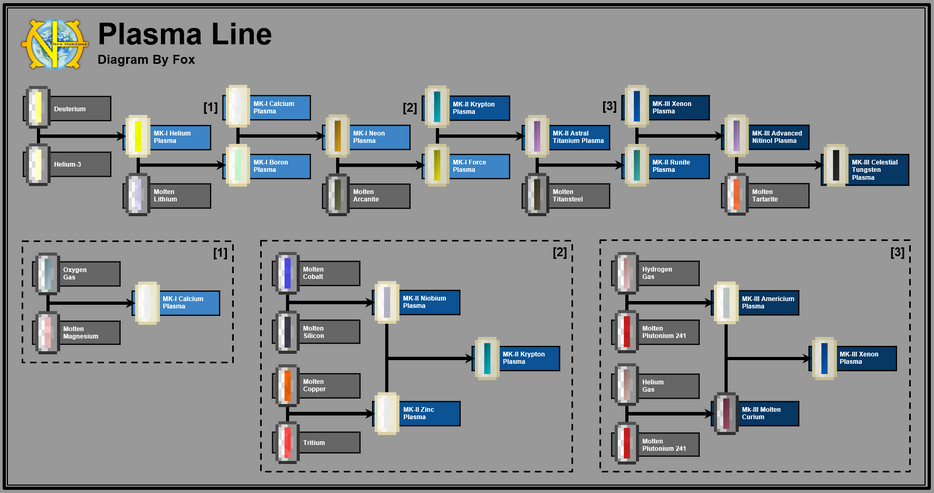
Some fusion recipes use plasma as one or both of their input ingredients. This forms a chain that culminates with celestial tungsten plasma. Each combination is more energy dense than the last which reduces the penalty of using the XL Turbo Plasma Turbine for power. The following tables list the order of plasmas and the ratio of Compact Fusion Reactors to sustain ONE running the highest tier plasma available, assuming they all have enough power for the maximum number of overclocks and parallels.
The required L/s refers to how much fluid is needed for the highest tier plasma. The per reactor L/s refers to the values in the table above, or how much fluid one Compact Fusion Reactor can actually produce. The latter is responsible for the ratios. Note that it may be easier to just pattern fusion recipes and level-maintain the highest tier plasma available rather than dedicate Compact Fusion Reactors to specific recipes. The ratios also do not have to be perfect--it is significantly easier to overestimate the lower tier plasmas than to follow these numbers exactly.
Mk-I Max
| Ratio | Inverse | Fusion Recipe | Req L/s | Per L/s | Input 1 | Req L/s | Per L/s | Input 2 | Req L/s | Per L/s | |
| 0.083 | 1.000 | Mk-I Helium Plasma [v1] | 829 | 10.0k | Deuterium | 829 | 10.0k | Helium-3 | 829 | 10.0k | |
| 1.080 | 13.02 | Mk-I Boron Plasma | 829 | 768 | Helium Plasma | 829 | 768 | Molten Lithium | 829 | 768 | |
| 0.576 | 6.944 | Mk-I Calcium Plasma | 92.0 | 160 | Oxygen Gas | 737 | 1.28k | Molten Magnesium | 737 | 1.28k | |
| 0.288 | 3.472 | Mk-I Neon Plasma | 5.76k | 20.0k | Boron Plasma | 829 | 2.88k | Calcium Plasma | 92.0 | 320 | |
| 1.000 | 12.06 | Mk-I Force Plasma | 40.0k | 40.0k | Neon Plasma | 5.76k | 5.76k | Molten Arcanite | 80.0 | 80.0 |
Mk-II Max
| Ratio | Inverse | Fusion Recipe | Req L/s | Per L/s | Input 1 | Req L/s | Per L/s | Input 2 | Req L/s | Per L/s | |
| 0.012 | 1.000 | Mk-I Helium Plasma [v1] | 119 | 10.0k | Deuterium | 119 | 10.0k | Helium-3 | 119 | 10.0k | |
| 0.156 | 13.02 | Mk-I Boron Plasma | 119 | 768 | Helium Plasma | 119 | 768 | Molten Lithium | 119 | 768 | |
| 0.083 | 6.944 | Mk-I Calcium Plasma | 13.0 | 160 | Oxygen Gas | 106 | 1.28k | Molten Magnesium | 106 | 1.28k | |
| 0.041 | 3.472 | Mk-I Neon Plasma | 829 | 20.0k | Boron Plasma | 119 | 2.88k | Calcium Plasma | 13.0 | 320 | |
| 0.144 | 12.06 | Mk-I Force Plasma | 5.76k | 40.0k | Neon Plasma | 829 | 5.76k | Molten Arcanite | 12.0 | 80.0 | |
| 0.072 | 6.028 | Mk-II Niobium Plasma | 829 | 11.5k | Molten Cobalt | 829 | 11.5k | Molten Silicon | 829 | 11.5k | |
| 0.144 | 12.06 | Mk-II Zinc Plasma | 829 | 5.76k | Molten Copper | 829 | 5.76k | Tritium | 2.88k | 20.0k | |
| 0.144 | 12.06 | Mk-II Krypton Plasma | 829 | 5.76k | Niobium Plasma | 829 | 5.76k | Zinc Plasma | 829 | 5.76k | |
| 0.144 | 12.06 | Mk-II Astral Titanium Plasma | 5.76k | 40.0k | Krypton Plasma | 829 | 5.76k | Force Plasma | 5.76k | 40.0k | |
| 1.000 | 83.72 | Mk-II Runite Plasma | 40.0k | 40.0k | Astral Titanium Plasma | 5.76k | 5.76k | Molten Titansteel | 80.0 | 80.0 |
Mk-III Max
| Ratio | Inverse | Fusion Recipe | Req L/s | Per L/s | Input 1 | Req L/s | Per L/s | Input 2 | Req L/s | Per L/s | |
| 0.003 | 1.000 | Mk-I Helium Plasma [v1] | 34.0 | 10.0k | Deuterium | 34 | 10.0k | Helium-3 | 34.0 | 10.0k | |
| 0.045 | 13.02 | Mk-I Boron Plasma | 34.0 | 768 | Helium Plasma | 34 | 768 | Molten Lithium | 34.0 | 768 | |
| 0.024 | 6.944 | Mk-I Calcium Plasma | 4.00 | 160 | Oxygen Gas | 31 | 1.28k | Molten Magnesium | 31.0 | 1.28k | |
| 0.012 | 3.472 | Mk-I Neon Plasma | 239 | 20.0k | Boron Plasma | 34 | 2.88k | Calcium Plasma | 4.00 | 320 | |
| 0.041 | 12.06 | Mk-I Force Plasma | 1.66k | 40.0k | Neon Plasma | 239 | 5.76k | Molten Arcanite | 3.00 | 80.0 | |
| 0.021 | 6.028 | Mk-II Niobium Plasma | 239 | 11.5k | Molten Cobalt | 239 | 11.5k | Molten Silicon | 239 | 11.5k | |
| 0.041 | 12.06 | Mk-II Zinc Plasma | 239 | 5.76k | Molten Copper | 239 | 5.76k | Tritium | 829 | 20.0k | |
| 0.041 | 12.06 | Mk-II Krypton Plasma | 239 | 5.76k | Niobium Plasma | 239 | 5.76k | Zinc Plasma | 239 | 5.76k | |
| 0.041 | 12.06 | Mk-II Astral Titanium Plasma | 1.66k | 40.0k | Krypton Plasma | 239 | 5.76k | Force Plasma | 1.66k | 40.0k | |
| 0.288 | 83.72 | Mk-II Runite Plasma | 11.5k | 40.0k | Astral Titanium Plasma | 1.66k | 5.76k | Molten Titansteel | 23.0 | 80.0 | |
| 0.864 | 251.2 | Mk-III Molten Curium | 1.66k | 1.92k | Molten Plutonium 241 | 1.66k | 1.92k | Helium | 11.5k | 13.3k | |
| 0.576 | 167.4 | Mk-III Americium Plasma | 1.66k | 2.88k | Hydrogen Gas | 23.0k | 40.0k | Molten Plutonium 241 | 1.66k | 2.88k | |
| 0.144 | 41.86 | Mk-III Xenon Plasma | 1.66k | 11.5k | Americium Plasma | 1.66k | 11.5k | Molten Curium | 1.66k | 11.5k | |
| 0.144 | 41.86 | Mk-III Advanced Nitinol Plasma | 11.5k | 80.0k | Xenon Plasma | 1.66k | 11.5k | Runite Plasma | 11.5k | 80.0k | |
| 1.000 | 290.7 | Mk-III Celestial Tungsten Plasma | 160k | 160k | Advanced Nitinol Plasma | 11.5k | 11.5k | Molten Tartarite | 320 | 320 |
DTPF Catalyst
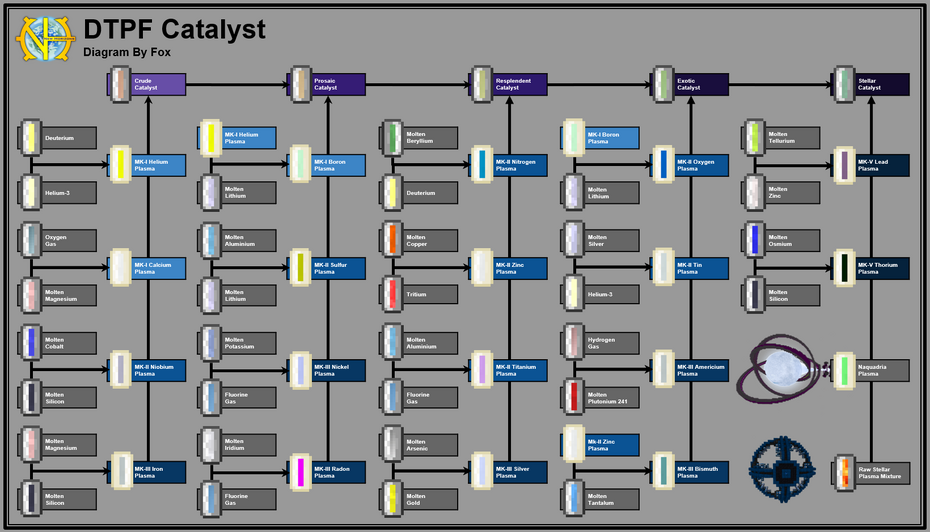
There are five tiers of catalyst for use in the Dimensionally Transcendent Plasma Forge. Each catalyst is crafted with various plasmas in an Industrial Mixing Machine or Transcendent Plasma Mixer. The following tables list the required plasmas and the ratio of Compact Fusion Reactors to sustain 10,000 L/s of each, assuming they all have enough power for the maximum number of overclocks and parallels.
The per reactor L/s refers to the values in the table above, or how much fluid one Compact Fusion Reactor can actually produce. Note that it may be easier to just pattern fusion recipes and level-maintain them rather than dedicate Compact Fusion Reactors to specific recipes. The ratios also do not have to be perfect--it is significantly easier to overestimate the lower tier plasmas than to follow these numbers exactly.
Crude Catalyst
| Ratio | Fusion Recipe | per L/s | Input 1 | per L/s | Input 2 | per L/s | |
| 0.083 | Mk-III Helium Plasma [v1] | 120k | Deuterium | 120k | Helium-3 | 120k | |
| 5.208 | Mk-III Calcium Plasma | 1.92k | Oxygen Gas | 15.4k | Molten Magnesium | 15.4k | |
| 0.217 | Mk-III Niobium Plasma | 46.1k | Molten Cobalt | 46.1k | Molten Silicon | 46.1k | |
| 1.736 | Mk-III Iron Plasma | 5.76k | Molten Magnesium | 5.76k | Molten Silicon | 80.0 |
Prosaic Catalyst
| Ratio | Fusion Recipe | per L/s | Input 1 | per L/s | Input 2 | per L/s | |
| 1.085 | Mk-III Boron Plasma | 9.22k | Helium Plasma | 9.22k | Molten Lithium | 9.22k | |
| 0.434 | Mk-III Sulfur Plasma | 23.0k | Molten Aluminium | 2.56k | Molten Lithium | 2.56k | |
| 0.868 | Mk-III Nickel Plasma | 11.5k | Molten Potassium | 1.28k | Fluorine Gas | 11.5k | |
| 1.736 | Mk-III Radon Plasma | 5.76k | Molten Iridium | 5.76k | Fluorine Gas | 20.0k |
Resplendent Catalyst
| Ratio | Fusion Recipe | per L/s | Input 1 | per L/s | Input 2 | per L/s | |
| 0.021 | Mk-IV Nitrogen Plasma | 480k | Molten Beryllium | 61.4k | Deuterium | 1.44M | |
| 0.036 | Mk-IV Zinc Plasma | 276k | Molten Copper | 276k | Tritium | 960k | |
| 0.181 | Mk-IV Titanium Plasma | 55.3k | Molten Aluminium | 55.3k | Fluorine Gas | 55.3k | |
| 0.109 | Mk-IV Silver Plasma | 92.2k | Molten Arsenic | 92.2k | Molten Gold | 92.2k |
Exotic Catalyst
| Ratio | Fusion Recipe | per L/s | Input 1 | per L/s | Input 2 | per L/s | |
| 0.271 | Mk-IV Oxygen Plasma | 36.9k | Boron Plasma | 36.9k | Molten Lithium | 36.9k | |
| 0.009 | Mk-IV Tin Plasma | 1.11M | Molten Silver | 553k | Helium-3 | 1.44M | |
| 0.434 | Mk-IV Americium Plasma | 23.0k | Hydrogen Gas | 320k | Molten Plutonium 241 | 23.0k | |
| 0.109 | Mk-IV Bismuth Plasma | 92.2k | Zinc Plasma | 46.1k | Molten Tantalum | 92.2k |
Stellar Catalyst
| Ratio | Fusion Recipe | per L/s | Input 1 | per L/s | Input 2 | per L/s | |
| 0.054 | Mk-V Lead Plasma | 184k | Molten Tellurium | 184k | Molten Zinc | 184k | |
| 0.054 | Mk-V Thorium Plasma | 184k | Molten Osmium | 184k | Molten Silicon | 184k |
Raw Material Sources
Fluid Extractor
|
Space Elevator Pumping Module
|
Power
Plasmas are incredibly energy dense and generate an immense amount of power in the Large Plasma Turbine, the XL Turbo Plasma Turbine, or the Extreme Heat Exchanger (EHE) with a series of XL Turbo Steam Turbines behind it. The most popular plasmas are highlighted blue in the following table and the remaining subsections cover a few example setups. Use the planner linked at the top for a complete list of turbine materials and full setup breakdowns.
| Fuel | EU/L | Fuel | EU/L | Fuel | EU/L | ||
| Carbon Plasma | 12,288 | Chlorine Plasma | 172,032 | Rhugnor Plasma | 333,824 | ||
| Hydrogen Plasma | 20,480 | Force Plasma | 180,000 | Naquadah Plasma | 337,920 | ||
| Bedrockium Plasma | 20,480 | Potassium Plasma | 183,705 | Barium Plasma | 342,302 | ||
| Phosphorus Plasma | 30,720 | Calcium Plasma | 188,416 | Lanthanum Plasma | 344,801 | ||
| Deuterium Plasma | 40,960 | Argon Plasma | 188,416 | Praseodymium Plasma | 346,931 | ||
| Desh Plasma | 50,176 | Rhenium Plasma | 190,464 | Cerium Plasma | 346,931 | ||
| Tritium Plasma | 61,440 | Titanium Plasma | 196,608 | Promethium Plasma | 347,996 | ||
| Meteoric Iron Plasma | 69,632 | Vanadium Plasma | 198,451 | Neodymium Plasma | 347,996 | ||
| Germanium Plasma | 74,752 | Chrome Plasma | 202,342 | Runite Plasma | 350,000 | ||
| Helium Plasma | 81,920 | Manganese Plasma | 202,752 | Samarium Plasma | 353,280 | ||
| Advanced Nitinol Plasma | 93,184 | Dragonblood Plasma | 205,824 | Europium Plasma | 355,635 | ||
| Chromatic Glass Plasma | 93,184 | Oriharukon Plasma | 205,824 | Gadolinium Plasma | 366,551 | ||
| Ardite Plasma | 100,352 | Iron Plasma | 206,438 | Terbium Plasma | 368,885 | ||
| Cosmic Neutronium Plasma | 100,352 | Thallium Plasma | 208,896 | Holmium Plasma | 376,176 | ||
| Six-Phased Copper Plasma | 100,352 | Nickel Plasma | 213,811 | Erbium Plasma | 376,217 | ||
| Infinity Plasma | 100,352 | Cobalt Plasma | 217,497 | Thulium Plasma | 378,470 | ||
| Creon Plasma | 100,352 | Copper Plasma | 219,340 | Ytterbium Plasma | 379,695 | ||
| Awakened Draconium Plasma | 100,352 | Zinc Plasma | 226,304 | Lutetium Plasma | 381,296 | ||
| Draconium Plasma | 100,352 | Gallium Plasma | 229,376 | Tantalum Plasma | 384,000 | ||
| Lithium Plasma | 100,352 | Arsenic Plasma | 230,400 | Tungsten Plasma | 384,778 | ||
| Ichorium Plasma | 100,352 | Neptunium Plasma | 242,688 | Osmium Plasma | 393,659 | ||
| Naquadria Plasma | 100,352 | Rubidium Plasma | 243,712 | Iridium Plasma | 397,148 | ||
| Neutronium Plasma | 102,400 | Strontium Plasma | 249,446 | Platinum Plasma | 399,360 | ||
| Beryllium Plasma | 110,592 | Curium Plasma | 252,928 | Gold Plasma | 401,408 | ||
| Boron Plasma | 112,640 | Yttrium Plasma | 255,180 | Mercury Plasma | 409,600 | ||
| Nitrogen Plasma | 129,024 | Fermium Plasma | 263,168 | Lead Plasma | 423,936 | ||
| Iodine Plasma | 130,048 | Niobium Plasma | 269,516 | Bismuth Plasma | 425,984 | ||
| Tellurium Plasma | 130,048 | Molybdenum Plasma | 272,384 | Radon Plasma | 450,560 | ||
| Oxygen Plasma | 131,072 | Palladium Plasma | 282,214 | Thorium Plasma | 471,040 | ||
| Fluorine Plasma | 147,456 | Silver Plasma | 282,685 | Uranium 235 Plasma | 481,280 | ||
| Sodium Plasma | 148,684 | Astral Titanium Plasma | 284,672 | Uranium 238 Plasma | 487,424 | ||
| Tin Plasma | 150,000 | Cadmium Plasma | 293,601 | Plutonium 241 Plasma | 497,664 | ||
| Magnesium Plasma | 152,371 | Flerovium Plasma | 295,936 | Americium Plasma | 501,760 | ||
| Aluminium Plasma | 159,744 | Indium Plasma | 296,509 | Hypogen Plasma | 502,784 | ||
| Raw Silicon Plasma | 160,563 | Antimony Plasma | 309,760 | Plutonium 239 Plasma | 503,808 | ||
| Dysprosium Plasma | 165,888 | Tritanium Plasma | 330,752 | Celestial Tungsten Plasma | 720,000 | ||
| Sulfur Plasma | 170,393 | Caesium Plasma | 332,513 |
XL Turbo Plasma Turbine
See More: XL Turbo Plasma Turbine
The XL Turbo Plasma Turbine (XLPT) consumes plasma every second to generate an immense amount of power. It has 16x the throughput as the LPT with only 12 turbines, supports multi-amp and laser dynamo hatches, and does not explode if the dynamo hatch is broken while the machine is running. However, the turbines must be identical for the machine to run, there are harsher penalties for exceeding the optimal flow rate, there are penalties for using lower density fuels, and the machine must be running for at least 50 seconds to fully warm-up. Consumed plasma is returned as its molten variant.
| Compact Fusion Reactor | XLPT | Power | ||||||||||
| Amount | Tier | Output | Tier | Amount | Size | Material | Fitting | Flow Rate (per) | Net (total) | Amps | ||
| 1 | Mk-I | 10,000 L/s Helium Plasma | LuV | 6 | Large | Draconium | Loose | 1,667 L/s | 38,713,842 EU/t | 295A ZPM | ||
| 1 | Mk-II | 11,520 L/s Niobium Plasma | ZPM | 7 | Huge | Duranium | Loose | 1,646 L/s | 282,495,530 EU/t | 539A UV | ||
| 1 | Mk-III | 46,080 L/s Niobium Plasma | ZPM | 6 | Huge | Adamantium Alloy | Loose | 7,680 L/s | 497,681,292 EU/t | 237A UHV | ||
| 1 | Mk-IV | 23,040 L/s Americium Plasma | ZPM | 8 | Huge | Cosmic Neutronium | Loose | 2,880 L/s | 1,062,441,696 EU/t | 127A UEV | ||
| 1 | Mk-V | 7,680,000 L/s Celest. Tung. Plasma | UHV | 1,095 | Huge | Infinity | Loose | 7,014 L/s | 647,449,598,656 EU/t | 19,311A UIV | ||
Extreme Heat Exchanger
See More: Extreme Heat Exchanger
The Extreme Heat Exchanger (EHE) evaporates distilled water into dense supercritical steam with the heat from plasma regardless of the input rate. The dense supercritical steam must then pass through a series of XL Turbo Steam Turbines (XLST) to generate an immense amount of power. The supercritical, superheated, and regular variants of the machine all have 16x the throughput as the Large Steam Turbine, support multi-amp and laser dynamo hatches, and do not explode if the dynamo hatch is broken while the machine is running. Consumed plasma is returned as its molten variant.
| Compact Fusion Reactor | EHE | XLSTs | Power | |||||||||||||
| Amount | Tier | Output | Amount | Distilled Water | Dense SC Steam | Tier | Amount | Size | Material | Fitting | Flow Rate (per) | Net (total) | Amps | |||
| 1 | Mk-I | 10,000 L/s Helium Plasma | 20 | 230,400 L/t | 36,864 L/t | LuV | 1 ea | Large | Duranium | Loose | 36,864 L/t | 103,003,512 EU/t | 786A ZPM | |||
| 2 | Mk-II | 23,040 L/s Niobium Plasma | 10 | 1,746,463 L/t | 279,434 L/t | ZPM | 3 ea | Huge | Duranium | Loose | 93,145 L/t | 1,032,033,444 EU/t | 1,968A UV | |||
| 1 | Mk-III | 46,080 L/s Niobium Plasma | 19 | 3,492,927 L/t | 558,868 L/t | ZPM | 5 ea | Huge | Duranium | Loose | 111,774 L/t | 2,122,880,913 EU/t | 1,012A UHV | |||
| 1 | Mk-IV | 1,280,000 L/s Celest. Tung. Plasma | 52 | 259,200,000 L/t | 41,472,000 L/t | ZPM | 400 ea | Huge | Duranium | Loose | 103,680 L/t | 171,279,447,760 EU/t | 20,418A UEV | |||
| 1 | Mk-V | 7,680,000 L/s Celest. Tung. Plasma | 308 | 1,555,200,000 L/t | 248,832,000 L/t | UHV | 1,528 ea | Huge | Infinity | Loose | 162,849 L/t | 1,314,181,846,080 EU/t | 39,166A UIV | |||