GT New Horizons · Zero Point Module (ZPM)
Flocculation Purification Unit
The Flocculation Purification Unit (FPU) is a ZPM tier multiblock used for the third step of the Water Line. It continuously consumes a flocculant liquid, Polyaluminium Chloride, while running, and requires precise amounts in order to avoid a major penalty to its success chance. All the consumed Polyaluminium Chloride is converted to an equal amount of Flocculation Waste Liquid, which can be recycled back into Polyaluminium Chloride at no cost.
Construction
The FPU has no tiered components or energy hatches because it receives power directly from the Water Purification Plant once linked with a data stick, like the rest of the Water Line multiblocks. The water is spawned for free once formed and therefore does NOT need to be placed manually. Use the Multiblock Structure Hologram Projector to visualize/build the structure.
Structure
- Controller: Front center, 2nd layer
- 56-63 Slick Sterile Flocculation Casing
- 30 Sterile Water Plant Casing
- 16 Reinforced Sterile Water Plant Casing
- 12 Adamantium Frame Box
- 9 Filter Machine Casing
- 6 Tinted Industrial Glass (any color)
- 1-3 Input Hatch: Any flocculation casing
- 0+ Output Bus: Any flocculation casing
- 1-3 Output Hatch: Any flocculation casing
Mechanics
See More: Waterline#Shared Mechanics
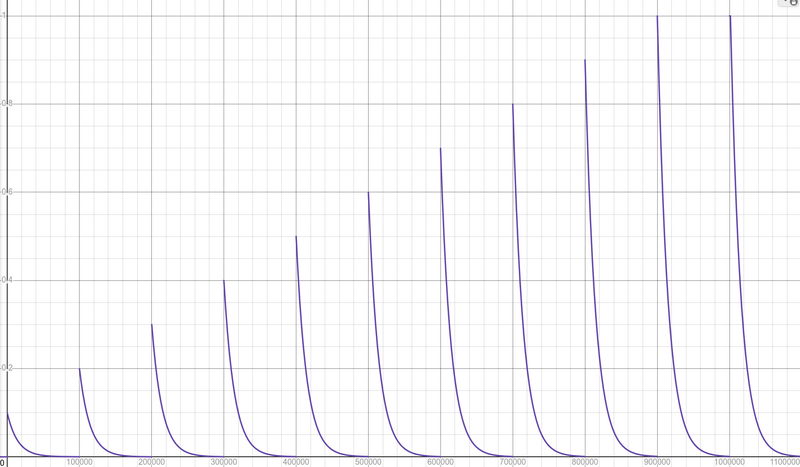
The FPU consumes a flocculant liquid, Polyaluminium Chloride, during operation. Unlike most machines, flocculant is continuously consumed for as long as the FPU is running, not just when a recipe starts. The goal is to feed it an amount of flocculant that is an exact multiple of 100 kL. If this is done, the success chance will be equal to the amount of flocculant divided by 10,000, plus a base 10%: 10% with 0 kL, 20% with 100 kL, 30% with 200 kL, and so on up to 100% with 900 kL. However, exceeding this by even 1L will apply an exponential penalty to the success chance, given by this formula:
where the overflow is defined as the amount of flocculant above the most recent multiple of 100 kL.
When the FPU finishes a cycle, it will output Flocculation Waste Liquid in an amount equal to the Polyaluminium Chloride it consumed. This can be recycled with no outside inputs other than water, making flocculant a closed loop, although it is possible to lose flocculant if there isn't enough Output Hatch space for all of the Flocculation Waste Liquid.
Automation
See More: Automation#Method 1: Fully Passive
The best way to maximize the success chance of the FPU is to give it exactly 1 ML of Polyaluminium Chloride, which will provide a 100% success chance with no risk of overflowing and recycle cleanly without any leftover crafting ingredients stuck between machines. The Waste Liquid can be recycled passively using one Distillation Tower or Dangote Distillus (the latter being preferred) and three Large Chemical Reactors, with Reservoir Hatches to supply water and some Sodium Hydroxide that is looped. By doing this, even if the FPU runs continuously, it will always be able to consume 1 ML before the end of its cycle. In order to ensure the full 1 ML can be recycled within 120 seconds, the minimum voltage for each machine is as follows:
| Machine | Voltage |
| Dangote Distillus | IV |
| Distillation Tower | ZPM |
| LCR 1 (Sodium Aluminate) | LuV |
| LCR 2 (Aluminium Hydroxide) | IV |
| LCR 3 (Polyaluminium Chloride) | ZPM |