GT New Horizons · Ultimate Voltage (UV)
Nano Forge
The Nano Forge is a UV tier multiblock for crafting nanites. No other machine has the precision or capability to create such advanced, microscopic robots. The Nano Forge is available in four tiers and each one requires a specific nanite inside its controller to form. T2 and T3 both add a new structure around the original machine, but T4 is completely different with its own automation challenge for increasing the total number of parallels and reducing the duration of recipes. The only requirements are magmatter and a copy of the output nanite as an additional input, but there are some restrictions. The challenge is technically optional but highly recommended for T3 and T4 recipes. The Nano Forge runs imperfect overclocks for recipes that are the same tier as the machine and perfect overclocks for recipes that are a lower tier than the machine. The Nano Forge is first required in UHV when building the Mothership or T2 PCB Factory and remains an integral part of progression up through UXV.
Construction
There are four tiers to the Nano Forge and each one requires a specific nanite in the GUI of the controller, listed below. T2 and T3 both add a new structure around the original machine, but T4 is completely different. The location of the additions are fixed and do not support any buses/hatches--put those on the main structure. Multi-amp and laser energy hatches are supported for serious overclocking. Right-click the controller with a screwdriver to disable the T4 animation. Use the Multiblock Structure Hologram Projector to visualize/build the structure where the projector stack size determines the structure tier.
| Tier 1 (Base Structure)
Requires a Carbon Nanite in Controller
|
Tier 4 (New Structure)
Requires an Eternity Nanite in Controller
|
| Tier 2 (Adds to T1)
Requires a Neutronium Nanite in Controller
| |
| Tier 3 (Adds to T2)
Requires a Transcendent Metal Nanite in Controller
|
Wallsharing
Nano Forges may wallshare each of their sides and additional structures to save on space, casings, frame boxes, and buses/hatches. The additional structures are not very expensive, but it makes an array of Nano Forges much more compact.
Usage
The Nano Forge has unlimited tier skips which means it can run any recipe regardless of voltage tier as long as there is enough power to meet the EU/t threshold. For example, the Nano Forge can run UMV recipes with a 256A UV laser if necessary. The Nano Forge runs imperfect overclocks for recipes that are the same tier as the machine and perfect overclocks for recipes that are a lower tier than the machine.
Nanites
The following are all the different types of nanites by tier and their non-consumable items. Note that the dilithium lens is gated behind the Mothership and the forcicium/forcillium lenses are gated behind the Deep Dark.
| Tier | Nanite | Required Non-Consumable(s) |
| 1 | Carbon | Quite Certain Crystal Lens |
| Neutronium | Chromatic Lens | |
| 2 | Silver | Radox Polymer Lens |
| Glowstone | Radox Polymer Lens | |
| Transcendent Metal | Energised Tesseract | |
| 3 | Gold | Dilithium Lens |
| Six-Phased Copper | Energised Tesseract | |
| White Dwarf Matter | Dilithium Lens, Magneto Resonatic Lens, Quantum Anomaly | |
| Black Dwarf Matter | Dilithium Lens, Magneto Resonatic Lens, Quantum Anomaly | |
| Universium | Dilithium Lens, Magneto Resonatic Lens, Quantum Anomaly | |
| Eternity | Forcicium Lens, Quantum Anomaly | |
| 4 | Magmatter | Forcicium Lens, Forcillium Lens |
Tier 4
Upgrading the Nano Forge to T4 by placing an eternity nanite into the controller completely transforms the structure and unlocks an OPTIONAL automation challenge for increasing the total number of parallels and reducing the duration of recipes. The only requirements are magmatter and a copy of the output nanite as an additional input, but there are two restrictions:
- All magmatter present in the machine is consumed at the start of a recipe regardless of the amount of parallels that can run.
- There cannot be any other type of nanite available or else the Nano Forge voids the magmatter without applying any bonuses.
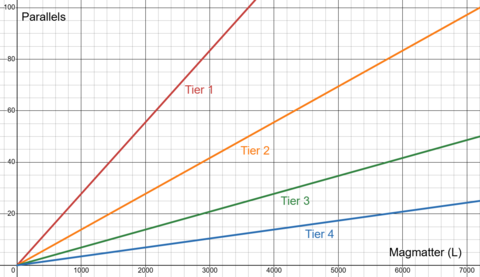
Magmatter is commonly added to patterns as another fluid input and the amount consumed determines both the speed bonus and number of parallels, as seen in the following equations where refers to the recipe tier 1-4. There is no maximum number of parallels but there is a minimum of 1 which is the same as if no magmatter was present at all. The reduced time actually reduces the total EU cost as well since the EU/t does not change.
|
 | ||||||||||||||||||||||||||||||||||||||||||||||||||||||||||||||||||||||||||||||||||||||||
The T4 Nano Forge also slightly changes the overclocking mechanics, as listed below. T1 and T2 recipes are exceptionally fast with the unlimited perfect overclocks and likely do not require the extra speed or parallels from magmatter. T3 and T4 recipes, however, really need the bonuses and should always use magmatter when possible.
- T1 and T2 Recipes - Unlimited perfect overclocks.
- T3 Recipes - Unlimited perfect overclocks if there are 2 or more parallels.
- T4 Recipes - No perfect overclocks.
Automation
The challenge in using the T4 Nano Forge effectively is being very deliberate in the amount of magmatter provided and recursively using the output of the machine as input for the next. Passively stocking magmatter and the different types of nanites is not a valid strategy because ALL magmatter is consumed at the start of each recipe and no bonuses are applied if there is more than one nanite available amongst the inputs.
Method 1: Applied Energistics
The core mechanic behind this approach is using level emitters to enable a stocking input bus with the corresponding nanite and any required non-consumables for T3-T4 recipes. Magmatter is included directly in patterns and enters the Nano Forge subnetwork with the rest of the inputs. Blocking mode prevents recipe mixing so only one level emitter is ever enabled at a time, making it impossible for multiple nanites to be available simultaneously. The recipe can then safely begin processing with any bonuses. An ME drive on the output subnetwork is filled with storage cells that are filtered to hold one of each type of nanite and are prioritized over the interface back to the main network to prep the machine for following recipes. This approach is very compact, accurate, and scales well but takes a few minutes to set up. The patterns also require a little bit of math.
The Nano Forge is automatically disabled while running because subsequent recipes of the same type could start before the new buffer nanite is available in one of the stocking input buses. T1-T2 recipes are stored in a crafting input buffer along with their non-consumables because they do not require any further bonuses and can safely ignore this whole automation challenge.
 Caution: | This method technically works on 2.8 but one of the hatches must be ignored to meet the Nano Forge's minimum casing requirement, which was later reduced on 2.9. |
| STEP 1 | |
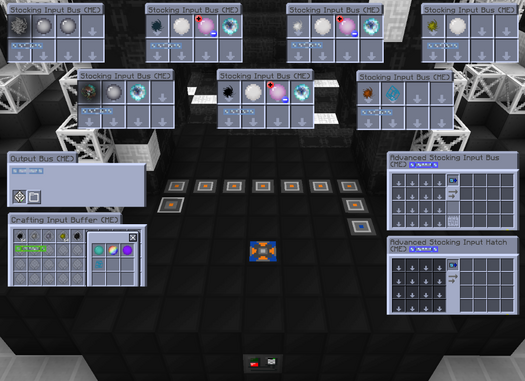
| Place a horizontal row of seven stocking input buses and set the filters to each type of T3-T4 nanite with their non-consumables. The order is not important.
Place an ME output bus on the left and right-click it with wire cutters to allow connections from any side. Do the same for the seven stocking input buses. Place an advanced stocking input bus and advanced stocking input hatch on the right. Enable AUTO-PULL on both to automatically retrieve any inputs that enter the Nano Forge subnetwork (blue). Place a crafting input buffer at the center with patterns for T1-T2 recipes and their non-consumables. This skips the entire automation challenge and takes priority over T3-T4 recipes. |
|
| STEP 2 | |
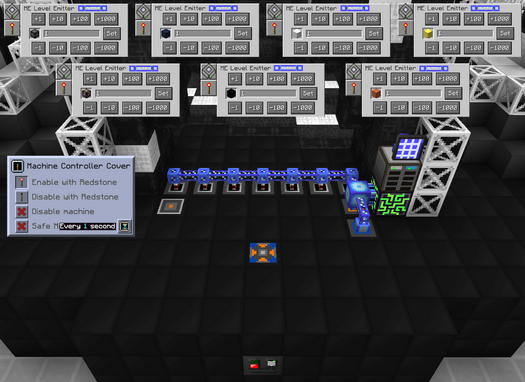
| Build the Nano Forge subnetwork (blue) with an ME controller, ME drive, and level emitters facing into machine controller covers set to ENABLE WITH REDSTONE on each of the stocking input buses.
Filter the level emitters to one block of each type corresponding to the nanite in the stocking input bus below. These are triggered when a recipe enters the Nano Forge subnetwork and needs their specific nanite and non-consumables to begin processing. Insert a solid and fluid storage cell into the ME drive on the Nano Forge subnetwork to buffer inputs. They must support multiple types but the size can vary based on the scale of patterns and crafting requests. Disable input separation in the controller to share everything between all the buses. |
|
| STEP 3 | |
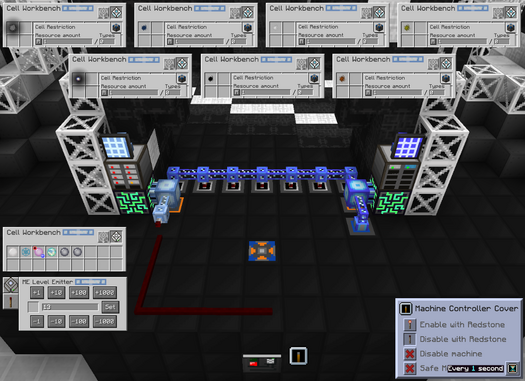
| Build the output subnetwork (light blue) with an ME controller, ME drive, and another level emitter leading to a machine controller cover set to DISABLE WITH REDSTONE on the Nano Forge controller.
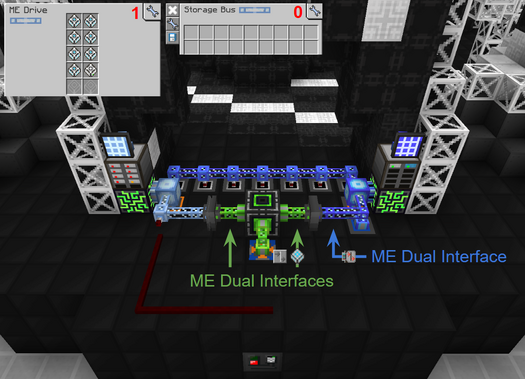
Filter the level emitter to 13 and emit when levels are below the limit. The number 13 comes from the combined total number of nanites and non-consumables in the output subnetwork. The resulting redstone signal disables the machine until it has all its nanites again. Insert eight storage cells into the ME drive with the settings shown. Seven of them are filtered to one of each type of T3-T4 nanite and restricted to hold only one item. The last one is filtered to all T3-T4 non-consumables. Insert one of everything to prep the machine. |
|
| STEP 4 | |
| Build the main network connection (green) with a wireless connector and two ME dual interfaces. The right one needs BLOCKING MODE enabled and holds the patterns for T3-T4 recipes. The left one receives the final nanites after they pass through the output subnetwork. Also connect the crafting input buffer for the T1-T2 recipes.
On the Nano Forge subnetwork (blue), add an ME dual interface with an ADVANCED BLOCKING CARD inside to receive inputs and prevent subsequent recipes from entering the subnetwork. On the output subnetwork (light blue), add a storage bus set to INSERT ONLY to push outputs back to the main network. Increase the priority of the ME drive to 1 to ensure it receives one of the output nanites first, prior to everything leaving the network. This preps the machine for following recipes. |
|
| STEP 5 | |
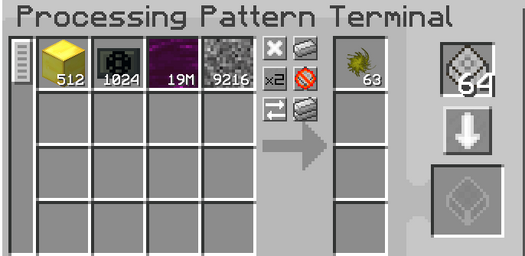
| Pattern the T3-T4 recipes with the appropriate amount of magmatter as input and ONE less nanite as output. Larger patterns are more efficient because only one nanite is ever consumed regardless of the size of the recipe or the amount of magmatter.
Following the table above, a T3 recipe with 64 parallels requires exactly 9,216L of magmatter. Scale this approach by hitting the x2 button to double the size of the recipe and then adjusting the expected number of nanites to be one less than normal. |
|