GT New Horizons · GTNH Basics
Electricity
The Energy Unit (EU) is GregTech's unit of electrical energy. EU is used to run GregTech and IC2 machines. Every Tier offers multiple types of Power Generation options at LV and above. EU is also compatible with machines from Applied Energistics 2 and other machines that accept Redstone Flux (RF), converting at a rate of 1 EU to 3.6 RF. The reverse is not possible; RF cannot be converted to EU.
Voltage and Amperage
| Acronym | Voltage Tier | EU Limit |
|---|---|---|
| ULV | Ultra Low Voltage | 8 |
| LV | Low Voltage | 32 |
| MV | Medium Voltage | 128 |
| HV | High Voltage | 512 |
| EV | Extreme Voltage | 2,048 |
| IV | Insane Voltage | 8,192 |
| LuV | Ludicrous Voltage | 32,768 |
| ZPM | ZPM Voltage | 131,072 |
| UV | Ultimate Voltage | 524,288 |
| UHV | Highly Ultimate Voltage | 2,097,152 |
| UEV | Extremely Ultimate Voltage | 8,388,608 |
| UIV | Insanely Ultimate Voltage | 33,554,432 |
| UMV | Mega Ultimate Voltage | 134,217,728 |
| UXV | Extended Mega Ultimate Voltage | 536,870,912 |
| MAX | Maximum Voltage | 2,147,483,648 |
EU in GregTech comes in a system of Voltage (Volts, V) and Amperage (Amps, A).
Energy is transferred in packages. Voltage describes the size of the energy packages, while Amperage describes the number of packages. When you multiply both, you get the power in EU/t (Energy Units per tick), which describes the energy produced, transferred, or consumed over time.
Quick Tip
- If you have X generators of Tier Y, use cables that can handle X Amperes of Tier Y.
Voltage Tiers
Main Article: Tier
GregTech uses voltage tiers to define its progression. The voltage of a Generator (or, for a multiblock generator, its Dynamo Hatch) determines the maximum amount of EU it can generate and transfer per amp. The voltage of a singleblock machine or Energy Hatch determines the maximum EU that can be present in any given amp before the machine explodes. The minimum voltage required to process a recipe is listed next to the usage or voltage in NEI.
The EU Limit of each subsequent tier is typically four times the previous.
Note: When used as numbers in calculations, the ULV Tier counts as Tier 0, the LV Tier counts as Tier 1, and so on.
Amperage
In code, amps are pushed, not pulled. However, they are only pushed when requested by machines. Thus, for all scopes except pack development, you can assume amps are only ever pulled as needed.
Machines and energy hatches draw amps to fill their internal EU buffers. The capacity of the internal buffer is listed as "Capacity:" in the machine's or hatch's tooltip. When processing a recipe, a machine will draw from its internal buffer. The current contents of the internal buffer can be checked with the Portable Scanner.
The maximum amount of amps a machine can draw is either listed on its tooltip or recipe-dependent. A machine can draw up to a maximum of amps to fill its internal buffer. This means that if the machine isn't processing a recipe, it will draw 1 amp to refill the internal buffer. Recipe amperages listed in NEI are a recommended number to fill the internal buffer at a rate that breaks even against usage.
Several common amperages of GregTech machines can be found in the table below. "Drawing" means "draws up to", unless otherwise stated.
Output amps contain the maximum EU for the outputting machine's voltage tier.
| Machine | Notes |
|---|---|
| Singleblock Generators | Output 1A of its tier |
| Energy Hatches | Draws 2A (second amp mostly for extra draw for loss) |
| Step-up Transformers | Draws 4A lower voltage, outputs 1A higher voltage |
| Step-down Transformers | Draws 1A higher voltage, outputs 4A lower voltage |
| Battery Buffers | Draws 2A per Battery, outputs 1A per Battery. |
| Battery Chargers | Draws 4-8A per Battery, outputs 2-4A per Battery correspondingly. |
| Arc Furnace | Most recipes require 3A to break even against EU/t usage |
| Thermal Centrifuge | Most recipes require 2A to break even against EU/t usage |
Overclocking
Main Article: Overclocking
Machines of higher tiers can receive overclocks to speed up their recipes.
Regular overclocks double the recipe's speed and total EU consumption, leading to quadrupled EU/t usage. For this reason, overclocking is also called 2/4 overclocking.
A perfect overclock instead quadruples the recipe's speed while keeping the total EU consumption the same. This still leads to quadrupled EU/t usage. For this reason, perfect overclocking is also called 4/4 overclocking.
Machines typically receive one overclock per voltage tier above the minimum required for a recipe.
Singleblock machines can only ever regular overclock.
Multiblock machines perfect overclock on a case-by-case basis; their tooltips contain information on how to achieve perfect overclocks or upgrade overclocks to perfect overclocks. If no information is mentioned, they will regular overclock.
Multiblocks with two energy hatches of the same voltage will always draw 4A to overclock a recipe to a tier higher than the energy hatch voltage (since 4A of the lower voltage contains the same EU as 1A of the higher voltage). This also allows them to run recipes with a minimum requirement of that higher voltage tier.
Cables and Loss
GregTech EU can be transferred using GregTech Cables.
Rather than priority by destination, power priority is given by cardinal direction. Cables will push power in the following priority:
- Down
- Up
- North
- South
- West
- East
When producing power, each generator will always attempt to empty all of its internal buffer at once. This can cause one generator in a cable network to use fuel more rapidly than another, with order depending on tile entity processing and changing on chunk reloads.
All GT Cables have a max Voltage, max Amperage and a Loss/Meter/Ampere, indicated on their tooltip:
- Cables which receive amps containing more EU than their maximum Voltage will catch fire and melt.
- Cables that have more amps travelling through them than their maximum Amperage limit will catch fire and melt.
Note that machines can request more Amperage than strictly required by their active recipe. - Each energy packet travelling through a cable loses Voltage per block travelled. The amount of EU lost is indicated by the Loss/Meter/Ampere number.
Each Material has 1x, 2x, 4x, 8x, 12x, and 16x uninsulated wires. Most of these have cable variants, except for the superconductor wires, as well as Graphene, Ichorium, Hypogen, Black Plutonium, Awakened Draconium, Infinity, and SpaceTime wires. Note that uninsulated wires have twice the Loss/Meter/Ampere as Insulated Cables. The only exceptions to this are Red Alloy and Redstone Alloy (as their cables are lossless, while the wires are not), Quantium, Lumiium, and Signalium (four times the loss when uninsulated), and Bedrockium (eight times the loss when uninsulated).
For example:
- A 1x Tin Cable can handle 1A containing 32EU at a loss of 1 EU-Volt/Meter/Ampere. This means that 1 amp can travel 32 blocks before it dies.
- A 1x Tin Wire can handle 1A containing 32EU at a loss of 2 EU-Volt/Meter/Ampere. In this case, the amp can travel 16 blocks only.
Below is a table of the current properties of various types of cables in GregTech: Note: In 2.8.0, many cables received maximum amperage and loss changes. This table is accurate as of version 2.8.1+.
| Material | Max Voltage[1] | Amp [2] | Loss [3] | Decay [4] |
|---|---|---|---|---|
| Tin | LV (32) | 1 | 1 | 32 |
| Cobalt | LV (32) | 2 | 1 | 32 |
| Lead | LV (32) | 2 | 2 | 16 |
| Zinc | LV (32) | 1 | 1 | 32 |
| Soldering Alloy | LV (32) | 1 | 1 | 32 |
| Iron | MV (128) | 2 | 3 | 43 |
| Nickel | MV (128) | 3 | 3 | 43 |
| Cupronickel | MV (128) | 4 | 3 | 43 |
| Copper | MV (128) | 1 | 2 | 64 |
| Annealed Copper | MV (128) | 1 | 1 | 128 |
| Electrical Steel | MV (128) | 3 | 1 | 128 |
| Kanthal | HV (512) | 5 | 3 | 171 |
| Gold | HV (512) | 3 | 2 | 256 |
| Electrum | HV (512) | 2 | 1 | 512 |
| Silver | HV (512) | 1 | 1 | 512 |
| Blue Alloy | HV (512) | 2 | 1 | 512 |
| Energetic Alloy | HV (512) | 4 | 1 | 512 |
| Nichrome | EV (2,048) | 6 | 4 | 512 |
| Steel | EV (2,048) | 2 | 3 | 683 |
| Black Steel | EV (2,048) | 4 | 1 | 2048 |
| Titanium | EV (2,048) | 4 | 2 | 1024 |
| TPV-Alloy | EV (2,048) | 6 | 1 | 2048 |
| Vibrant Alloy | EV (2,048) | 6 | 3 | 683 |
| Aluminium | EV (2,048) | 1 | 1 | 2048 |
| Graphene[5] | IV (8,192) | 1 | 2 | 4096 |
| Platinum | IV (8,192) | 2 | 1 | 8192 |
| Tungstensteel | IV (8,192) | 4 | 4 | 2048 |
| Tungsten | IV (8,192) | 6 | 2 | 4096 |
| End Steel | IV (8,192) | 6 | 3 | 2731 |
| Melodic Alloy | LuV (32,768) | 4 | 2 | 16384 |
| Osmium | LuV (32,768) | 4 | 2 | 16384 |
| HSS-G | LuV (32,768) | 4 | 2 | 16384 |
| Niobium-Titanium | LuV (32,768) | 4 | 2 | 16384 |
| Vanadium-Gallium | LuV (32,768) | 4 | 4 | 8192 |
| Yttrium Barium Cuprate | LuV (32,768) | 6 | 3 | 10923 |
| HSS-E | LuV (32,768) | 6 | 4 | 8192 |
| Osmiridium | ZPM (131,072) | 16 | 1 | 131072 |
| Naquadah | ZPM (131,072) | 2 | 2 | 65536 |
| Trinium | ZPM (131,072) | 6 | 3 | 43691 |
| Signalium | ZPM (131,072) | 12 | 8 | 16384 |
| Stellar Alloy | UV (524,288) | 12 | 12 | 43690 |
| Naquadah Alloy | UV (524,288) | 6 | 4 | 131072 |
| Duranium | UV (524,288) | 4 | 2 | 262144 |
| Fluxed Electrum | UV (524,288) | 6 | 3 | 174763 |
| Lumiium | UV (524,288) | 8 | 16 | 32768 |
| Ichorium[5] | UHV (2,097,152) | 12 | 8 | 262144 |
| Bedrockium | UHV (2,097,152) | 3 | 6 | 349526 |
| HSS-S | UHV (2,097,152) | 8 | 4 | 524288 |
| Draconium | UEV (8,388,608) | 8 | 32 | 262144 |
| Nether Star | UIV (33,554,432) | 4 | 16 | 2097152 |
| Hypogen[5] | UIV (33,554,432) | 8 | 0 | inf. |
| Quantium | UMV (134,217,728) | 4 | 32 | 4194304 |
| Black Plutonium[5] | UXV (536,870,912) | 8 | 8 | 67108864 |
| Awakened Draconium[5] | MAX (2,147,483,640) | 8 | 64 | 33554432 |
| Red Alloy | ULV (8) | 1 | 0 | inf. |
| Redstone Alloy | LV (32) | 1 | 0 | inf. |
| Superconductor MV[5] | MV (128) | 4 | 0 | inf. |
| Superconductor HV[5] | HV (512) | 6 | 0 | inf. |
| Superconductor EV[5] | EV (2,048) | 8 | 0 | inf. |
| Superconductor IV[5] | IV (8,192) | 12 | 0 | inf. |
| Superconductor LuV[5] | LuV (32,768) | 16 | 0 | inf. |
| Superconductor ZPM[5] | ZPM (131,072) | 24 | 0 | inf. |
| Superconductor UV[5] | UV (524,288) | 32 | 0 | inf. |
| Superconductor UHV[5] | UHV (2,097,152) | 48 | 0 | inf. |
| Superconductor UEV[5] | UEV (8,388,608) | 64 | 0 | inf. |
| Superconductor UIV[5] | UIV (33,554,432) | 64 | 0 | inf. |
| Superconductor UMV[5] | UMV (134,217,728) | 64 | 0 | inf. |
| Infinity[5] | MAX (2,147,483,640) | 8,192 | 0 | inf. |
| SpaceTime[5] | MAX (2,147,483,640) | 1,000,000 | 0 | inf. |
| Superconductor Base MV[5] | MV (128) | 1 | 2 | 64 |
| Superconductor Base HV[5] | HV (512) | 2 | 8 | 64 |
| Superconductor Base EV[5] | EV (2,048) | 3 | 16 | 128 |
| Superconductor Base IV[5] | IV (8,192) | 4 | 64 | 128 |
| Superconductor Base LuV[5] | LuV (32,768) | 6 | 256 | 128 |
| Superconductor Base ZPM[5] | ZPM (131,072) | 8 | 1,024 | 128 |
| Superconductor Base UV[5] | UV (524,288) | 12 | 4,096 | 128 |
| Superconductor Base UHV[5] | UHV (2,097,152) | 16 | 16,384 | 128 |
| Superconductor Base UEV[5] | UEV (8,388,608) | 24 | 65,536 | 128 |
| Superconductor Base UIV[5] | UIV (33,554,432) | 32 | 262,144 | 128 |
| Superconductor Base UMV[5] | UMV (134,217,728) | 32 | 1,048,576 | 128 |
- Superconductors start from MV, and their maximum amperage varies per tier.
- ↑ Maximum Voltage tier and EU
- ↑ Maximum amperage (Amp) for a 1x insulated cable of the listed material, or 1x wire if it does not exist.
- ↑ EU-volt loss per meter/block, per amperage (Amp).
- ↑ Length until 0 Power, in meters/blocks. "inf." means no loss, infinite length possible.
- ↑ 5.00 5.01 5.02 5.03 5.04 5.05 5.06 5.07 5.08 5.09 5.10 5.11 5.12 5.13 5.14 5.15 5.16 5.17 5.18 5.19 5.20 5.21 5.22 5.23 5.24 5.25 5.26 5.27 5.28 No insulated cable version exists for this material.
Multi-Amp Generation
Multiblock Generators use Dynamo Hatches to output power. These come in 1A, 4A, 16A, and 64A variants, as well as 256A variants past UV. These generators will always attempt to fill existing generated amps with EU before generating more amps.
Output Loss
Any GT Block outputting EU has an energy loss on output. This means there is no such thing as lossless power transfer. A power outputting singleblock will take EU from its internal buffer and output EU (which is always the maximum EU one amp of that voltage tier can hold). For example, a LV Combustion Generator draws 33 EU from its internal buffer to generate 1 amp holding 32 EU. The energy lost is therefore .
| Tier | Output (EU) | Loss (EU) | Loss (%) | Internal Buffer Consumption (EU) |
|---|---|---|---|---|
| ULV | 8 | 1 | 12.5 | 9 |
| LV | 32 | 1 | 3.0303 | 33 |
| MV | 128 | 2 | 1.5384 | 130 |
| HV | 512 | 4 | 0.77519 | 516 |
| EV | 2048 | 8 | 0.38911 | 2056 |
| IV | 8192 | 16 | 0.19493 | 8208 |
| LuV | 32768 | 32 | 0.097561 | 32800 |
| ZPM | 131072 | 64 | 0.048804 | 131136 |
| UV | 524288 | 128 | 0.024408 | 524416 |
Transformers
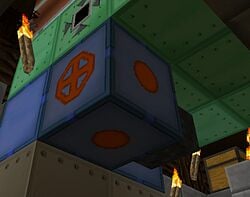
Transformers convert EU between voltage tiers. In Step Up mode, they draw up to 4 amps of a lower voltage to fill their internal buffers, and draw from their internal buffers to produce 1A of a higher voltage. This can allow lower tier amps to power higher tier machines which may only draw 1-2 A for a recipe. Similarly, in Step Down mode, they draw 1 amp of a higher voltage to fill their internal buffers, and draw from their internal buffers to produce up to 4A of a lower voltage. This allows use of higher tier power generators with lower tier machines while preventing explosions. Use a Soft Mallet to switch the mode.
The big dot with a plus is the high voltage side and is the front face, while the five smaller circles are the lower voltage sides. Regardless of mode, the big dot is always for the higher voltage. That means in Step Up mode, transformers have one output, five inputs, and in Step Down mode, they have five outputs, one input.
The output loss section above applies to transformer outputs as well.
Power Transformer and Hi-Amp Transformer
The Power Transformer and the Hi-Amp Transformer work like an ordinary transformer with one exception:
The Hi-Amp Transformer will accept 4 amps of higher voltage and turn it into 16 amps of lower voltage in its default mode. In inverted mode it will transform 16 amps of lower voltage to 4 amps of higher voltage.
The Power Transformer will accept 16 amps of higher voltage and turn it into 64 amps of lower voltage in its default mode. In inverted mode it will transform 64 amps of lower voltage to 16 amps of higher voltage.
Active Transformer
The Active Transformer is a multiblock unlocked in ZPM tier that can transform to and from any voltage, accepting energy with an Energy Hatch and outputting energy with a Dynamo Hatch.
- Note: Prior to Version 2.7.0 Wrenching or modifying the Active Transformer while it is running would cause it to explode.
Trivia
- GregTech's current power system is called the GT Enet API (Enet).
- Since version 5.0 (for Minecraft 1.7.2), GregTech has its own Energy System since GregoriusT wasn't satisfied with IC2 Experimental's Energy System.
The reasons of why I removed compatibility to the IC² Enet are that Cable Loss doesn't work, that the Network doesn't have Packets anymore and that it switched from Integer to Double (what is horrible for larger Energy Storages). Not to mention that it is very hard to have control over Energy flow without constantly registering and unregistering TileEntities.
— GregoriusT