GT New Horizons · Insane Voltage (IV)
Thorium High Temperature Reactor
The Thorium High Temperature Reactor (THTR) is an IV tier multiblock that decays TRISO pebbles through nuclear fission for their heat. The THTR must be primed with 100,000 TRISO pebbles and 730,000L of helium to start processing, but having any less than the maximum 675,000 TRISO pebbles reduces efficiency. Optionally, supply coolant to receive an extraordinary amount of hot coolant for power generation. The THTR consumes up to 0.5% of the TRISO pebbles and all the helium at the very beginning of each cycle, but then uses as little as 3,840 EU/t to produce up to 4,800 L/t of hot coolant for the next 9 hours. Burned out TRISO pebbles can be recycled in an Industrial Centrifuge for a small chance at lead dust. The peak fuel throughput is 375 TRISO pebbles per hour which is a very low amount of graphite, raw silicon, thorium-232, and uranium-235.
The hot coolant is used by the Thermal Boiler, Large Heat Exchanger, or Whakawhiti Wera XL to produce superheated steam, or the Extreme Heat Exchanger to produce supercritical steam. The steam is then used to generate power in a series of Large Steam Turbines. Expect upwards of 110A of LuV power per THTR at maximum efficiency.
The THTR is very similar to the High Temperature Gas-Cooled Reactor (HTGR). The difference is that the HTGR runs for a very short amount of time and produces significantly more byproducts. In other words, use the HTGR for resources and the THTR for power.
Spreadsheet: GTNH Power Planner 2.9
Construction
The THTR consists of a single type of casing and has no tiered components. Input buses/hatches are limited to the casings on the top layer of the structure and all other buses/hatches are limited to the casings on the bottom layer of the structure. Stocking input buses can insert TRISO pebbles, but stocking input hatches cannot insert helium or coolant into the reactor--use regular input hatches instead. Multi-amp and laser energy hatches are not supported, but one regular EV energy hatch is all that is needed at maximum efficiency anyway. The interior is entirely mandatory air so there cannot be anything inside the machine. Use the Multiblock Structure Hologram Projector to visualize/build the structure.
A THTR requires 29.1k lead, 1.07k tungstensteel, 696k (L) concrete, and a few other resources to build. Crafting the full 675k TRISO pebbles requires 225k graphite, 113k raw silicon, 17.6k thorium-232, and 1.76k uranium-235.
Structure
- Controller: Front bottom center
- 500-531 Radiation Proof Machine Casing
- 1+ Energy Hatch: Any bottom casing
- 1 Maintenance Hatch: Any bottom casing
- 1+ Input Bus: Any top casing
- 1+ Input Hatch: Any top casing
- 1+ Output Bus: Any bottom casing
- 1+ Output Hatch: Any bottom casing
Wallsharing
THTRs may wallshare each of their sides to save on casings and buses/hatches. However, they cannot overlap more than one block due to the mandatory air inside the structure.
Usage
The THTR uses helium gas to stabilize the fission decay of TRISO pebbles inside the reactor. The end result is burned out TRISO pebbles which can be recycled in an Industrial Centrifuge for a small chance at lead dust. There is only one type of TRISO pebble, the other types of TRISO balls are for the HTGR. Optionally, supply coolant to receive an extraordinary amount hot coolant for power generation.
The THTR has two operating modes, listed below. Switch modes by right-clicking the controller with a screwdriver while the machine is idle. Do not enable the machine until all TRISO balls and helium have entered the reactor to maximize efficiency. View their current amounts and the consumption rate of coolant by right-clicking the controller with a Portable Scanner.
- Normal - Stores TRISO pebbles and helium internally, and starts processing when the minimum conditions are met.
- Emptying - Returns all internally stored TRISO pebbles to the output bus.
Each cycle or operation consumes up to 0.5% of the total TRISO pebbles and 100% of the total helium at the start and runs for the next 9 hours. The only mandatory input during that time is power which ranges from 3,840 - 384,000 EU/t depending on the efficiency of the machine or how many TRISO pebbles were present at the start.
Fuel
The THTR uses TRISO pebbles (NOT balls) for fuel. Only the generic TRISO pebbles can be used since the rest are limited to the High Temperature Gas-Cooled Reactor. The minimum amount of fuel to begin processing is 100,000 TRISO pebbles, but having any less than the maximum 675,000 TRISO pebbles reduces the efficiency of the machine, as seen in the following equation and graph. The efficiency cannot be increased while the machine is active and cannot exceed 100%. Maintenance issues reduce the maximum efficiency by 10% each.
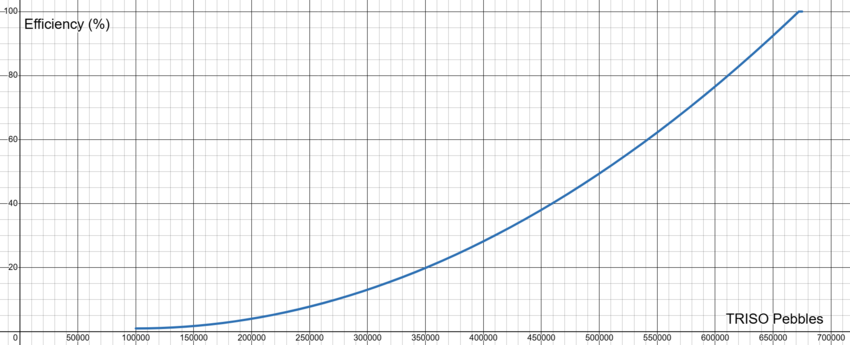
The efficiency of the THTR is inversely proportional to the power consumption of the machine and directly proportional to the production rate of hot coolant, as seen in the following equations. The maximum power consumption is 384,000 EU/t and the minimum power consumption is 3,840 EU/t. Note that coolant is converted into hot coolant at a 1:1 ratio and there is no consequence for running out of it during processing, or adding in more later.
The efficiency of the THTR is also directly proportional to the amount of TRISO pebbles consumed/burned per cycle, as seen in the following equation. The maximum is 3,375 TRISO pebbles per cycle which is crafted with 1.17k graphite, 585 raw silicon, 90 thorium-232, and 9 uranium-235.
Every cycle is exactly 9 hours long and starts by consuming both the TRISO pebbles and the 730,000L of helium. The THTR does not consume anything during processing so this is a one-time, upfront cost. The THTR outputs the same number of burned out TRISO pebbles, except every 64 pebbles is replaced with a burned out TRISO ball instead. Centrifuge the balls into pebbles and the pebbles into lead dust, at a 3% chance each. This is simply a minor byproduct to earn back a few resources and pales in comparison to the hot coolant.
Summary
| Total Pebbles | Efficiency | Power Consumption | Hot Coolant | -Pebbles/Cycle |
| 100,000 | 1% | 384,000 EU/t | 48 L/t | -5 Pebbles |
| 272,500 | 10% | 38,400 EU/t | 480 L/t | -136 Pebbles |
| 350,637 | 20% | 19,200 EU/t | 960 L/t | -351 Pebbles |
| 409,647 | 30% | 12,800 EU/t | 1,440 L/t | -614 Pebbles |
| 459,087 | 40% | 9,600 EU/t | 1,920 L/t | -918 Pebbles |
| 502,500 | 50% | 7,680 EU/t | 2,400 L/t | -1,256 Pebbles |
| 541,666 | 60% | 6,400 EU/t | 2,880 L/t | -1,625 Pebbles |
| 577,631 | 70% | 5,486 EU/t | 3,360 L/t | -2,022 Pebbles |
| 611,071 | 80% | 4,800 EU/t | 3,840 L/t | -2,444 Pebbles |
| 642,454 | 90% | 4,267 EU/t | 4,320 L/t | -2,891 Pebbles |
| 675,000 | 100% | 3,840 EU/t | 4,800 L/t | -3,375 Pebbles |
Power
Despite high up-front costs, the THTR outputs up 4,800 L/t of hot coolant for 9 hours straight. That is 70x greater than the output of a Fluid Reactor and 25x greater than the output of a Deep Earth Heating Pump. It is also more than enough to generate supercritical (SC) steam in an Extreme Heat Exchanger or superheated (SH) steam in a Thermal Boiler, Large Heat Exchanger, or Whakawhiti Wera XL. The only problem is that so much hot coolant requires many heat exchangers and a massive supply of distilled water, as seen in the following table. The EHE is recommended over the WWXL because the supercritical steam yields more power overall, even if it is more machines to build.
Conversion Ratios
- 1 L/t Hot Coolant = 200 L/t SC Steam (EHE) or 200 L/t SH Steam (Thermal Boiler, LHE, WWXL)
- 160 L/t SC Steam = 160 L/t SH Steam = 160 L/t Steam = 1 L/t Distilled Water
| Hot Coolant | Heat Exchanger | Amount | Max Input | Max Output | |
| 4,800 L/t | Thermal Boiler | 192 | 6,000 L/t Water | 960,000 L/t SH Steam | |
| 4,800 L/t | Large Heat Exchanger | 60 | 6,000 L/t Distilled Water | 960,000 L/t SH Steam | |
| 4,800 L/t | Extreme Heat Exchanger | 0.75 | 6,000 L/t Distilled Water | 960,000 L/t SC Steam | |
| 4,800 L/t | Whakawhiti Wera XL | 1.875 | 6,000 L/t Distilled Water | 960,000 L/t SH Steam |
The natural order of XL Turbo Steam Turbines is listed below. All three types of steam have the same conversion ratio so the output of one can feed directly into the input of the next. At maximum efficiency, 100% of the steam is recycled back into distilled water--forming a sustainable closed loop system. Both SC steam and SH steam generate 2x more EU than regular steam at the same optimal flow rate.
- The XL Turbo SC Steam Turbine generates power from SC steam and converts it to SH steam at a 1:1 ratio.
- The XL Turbo HP Steam Turbine generates power from SH steam and converts it to regular steam at a 1:1 ratio.
- The XL Turbo Steam Turbine generates power from regular steam and converts it to distilled water at a 160:1 ratio.
If the steam throughput is too high for steam valves or fluid pipes, use fluid P2P tunnels instead. They have no transfer limit and evenly distribute all fluids between all output connections.
Example Setups
The following are some example setups for various turbine materials. These all assume the maximum hot coolant production which means 675,000 TRISO pebbles are used for fuel. Use the planner linked at the top for a complete list of turbine materials and full setup breakdowns.
| THTR | EHE | XLSTs | Power | ||||||||||||
| Amount | Coolant | Amount | Distilled Water | SC Steam | Tier | Amount | Size | Material | Fitting | Flow Rate (per) | Net (total) | Amps | |||
| 1 | 4,800 L/t | 1 | 6,000 L/t | 960,000 L/t | IV | 1 ea | Large | HSS-E | Loose | 960,000 L/t | 1,894,485 EU/t | 57.8A LuV | |||
| 1 | 4,800 L/t | 1 | 6,000 L/t | 960,000 L/t | IV | 1 ea | Large | Oriharukon | Loose | 960,000 L/t | 2,409,230 EU/t | 73.5A LuV | |||
| 1 | 4,800 L/t | 1 | 6,000 L/t | 960,000 L/t | LuV | 3 ea | Large | Trinium | Tight | 320,000 L/t | 4,251,156 EU/t | 130A LuV | |||
| 1 | 4,800 L/t | 1 | 6,000 L/t | 960,000 L/t | IV | 2 ea | Large | Ichorium | Tight | 480,000 L/t | 5,171,160 EU/t | 158A LuV | |||
| 1 | 4,800 L/t | 1 | 6,000 L/t | 960,000 L/t | LuV | 12 ea | Large | Gaia Spirit | Tight | 80,000 L/t | 5,171,160 EU/t | 158A LuV | |||